
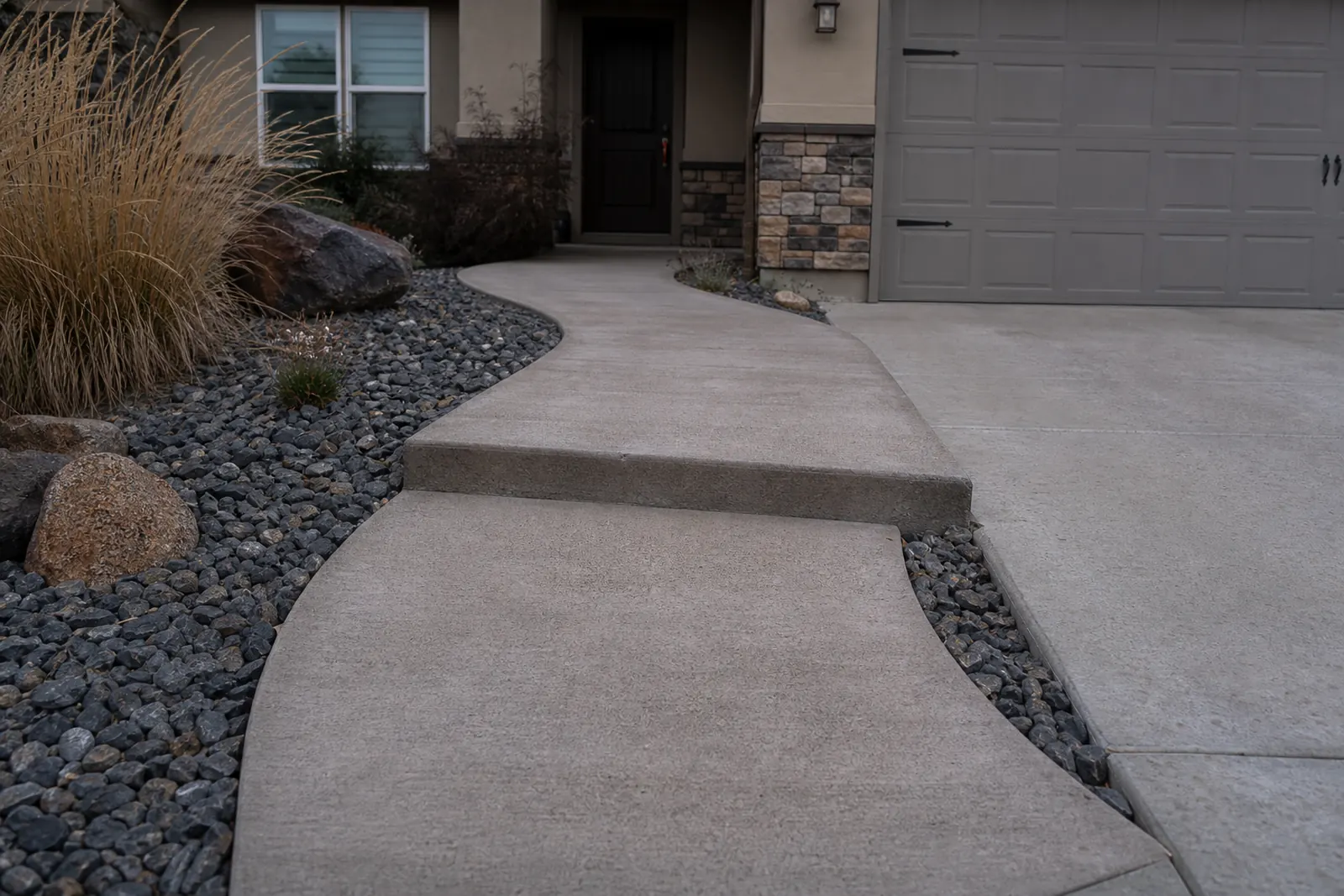
Can an uneven concrete walkway be leveled?
Usually. The private walkway from your driveway to the front door, or along the side of the house to the backyard, is made of the same kind of slabs as a sidewalk and settles for the same reasons. If the sections are still mostly intact, polyurethane foam can lift the low ones back in line so the path is even again, without breaking any of it out.
Walkways are not sidewalks
We treat the public sidewalk along the street separately on sidewalk leveling. A walkway is the concrete path on your own property, and it tends to have its own set of problems.
- It runs right beside the house. Many walkways sit under the roof edge, so every storm drops water along one side.
- It’s surrounded by landscaping. Flower beds, lawn and drip lines keep the soil beside the walk wet much of the year.
- It connects to other slabs. A walkway usually meets the driveway at one end and the front steps at the other, and the joints at both ends are where most of the movement shows up.
- It often curves. Curved walks are poured in odd-shaped sections that can tip in more than one direction.
What you might be seeing
- A section that dropped where the walk meets the driveway
- The walk sinking at the front steps so there’s a new step up
- One side of the path lower than the other, so it tilts toward the house
- Water standing on the walk after the sprinklers run
- Soil washed out along the edge next to a flower bed
- A section that rocks slightly when you step on one corner
A walk that tilts toward the house is worth fixing sooner, because it sends water at the foundation. A section that rocks has lost support underneath and will keep moving. Signs of concrete settlement has a longer checklist for walking your property.
Why walkways settle
Walkways are thin slabs, and they’re often poured on whatever soil is there with less base prep than a driveway. Backfill near the foundation compresses over time. Roof water and irrigation wash fine soil out from under the edges. Tree roots can push sections up. And each winter, water that gets underneath freezes, expands and leaves a looser base behind when it thaws. Why does concrete sink? explains the soil side in more detail.
How walkway leveling works
Sunken
Concrete has settled or lost support.
Lifted
Polyurethane foam is injected beneath the slab.
Level
The slab is raised toward its proper position, and the void space is stabilized.
We drill small ports in each low section and inject polyurethane foam underneath. The foam fills the empty space first, then lifts the slab. On a walkway we work section by section, keeping each one in line with the next and making sure the finished path sheds water away from the house.
Where the walk meets the steps or the driveway, those slabs sometimes need a small lift too so everything meets cleanly. When the lift is done, the ports are patched and the walk gets power washed. How foam concrete lifting works covers the process step by step.
Sealing the joints
Once the walk is back in line, the joints along the house and between sections can be sealed. That cuts down on water getting under the slab again, which is the main reason walkways settle in the first place.
Is your walkway a good candidate?
| What we check | Good candidate | Replacement may make more sense |
|---|---|---|
| Sections | Whole or cracked into large pieces | Broken into many small pieces |
| Movement | Sank or tipped | Pushed up by a root that’s still there |
| Surface | Sound | Crumbling or badly scaled |
| Layout | You like the path where it is | You want to widen it or reroute it |
Cracked walks are a common question. Can cracked concrete be lifted? explains which cracks still allow a lift.
When a new walkway may be the better choice
If you’re redoing the landscaping, want a wider path or a different route to the door, or most of the sections are broken up, new concrete may be worth it. If lifting doesn’t make sense for your walk, you’ll hear that from us up front. Concrete leveling vs replacement compares the two.
What affects the cost
Number of sections, how far they’ve dropped, how much void is under them and whether the steps or driveway need lifting at the joints. The evaluation is free, and concrete leveling cost covers the factors.
Walkway leveling around the Magic Valley
We level walkways in Twin Falls and the surrounding towns.
Walkway leveling questions
Can you level a curved walkway?
Yes. Curved walks are just odd-shaped sections. We lift each one to meet the next and keep the path shedding water.
My walkway tilts toward the house. Is that a problem?
It can be, because it sends water at the foundation. Lifting the low edge usually brings back the slope away from the house.
Will lifting damage the landscaping next to the walk?
The work is done from the top of the slab through small holes, so beds and lawn beside the walk are normally left alone.
Can a walkway section that rocks be fixed?
A rocking section has lost support under part of it. Filling the void and lifting it back into line gives it solid support again.