
What is polyurethane concrete lifting?
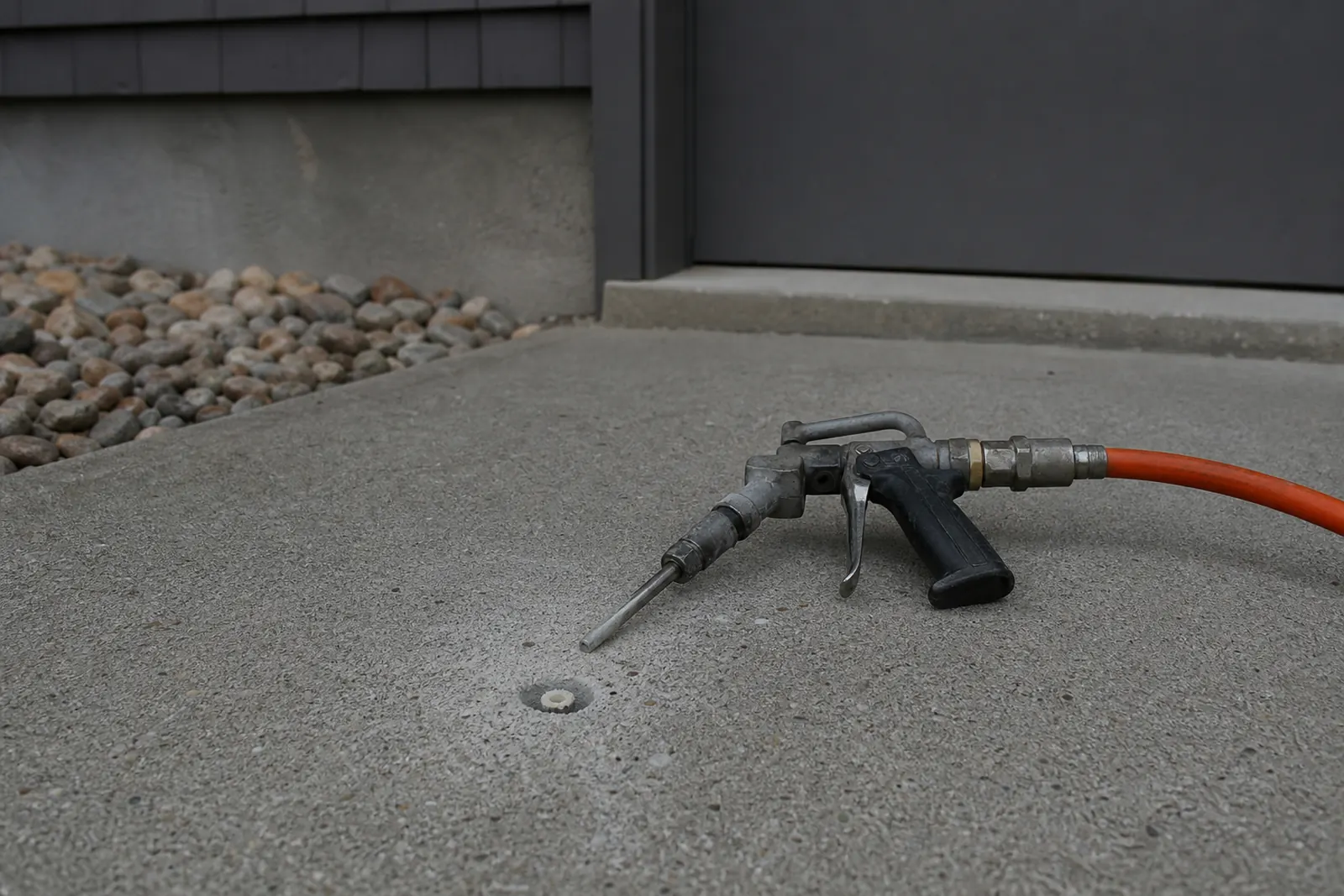
Polyurethane concrete lifting raises sunken slabs by injecting a two-part expanding foam beneath them through small drilled holes. The two liquid components react as they’re mixed and expand into a lightweight, rigid foam that fills empty space under the slab and pushes it up. It’s sometimes called polyurethane foam lifting or polyjacking. It’s the only method we use.
The material
The foam starts as two separate liquids, kept apart until the moment of injection. When they meet at the injection gun, they react and begin to expand. The foam flows into the voids under the slab, keeps expanding until it meets resistance, and then hardens into a solid, closed-cell material.
Lifting foams come in different densities. Lower-density foams expand more and are used mainly to fill space. Higher-density foams are stronger and are used where the slab needs more support, like under driveways. Part of planning a lift is choosing the right foam for the slab and the load it carries.
Why foam works well under concrete
It’s light
Cured foam weighs far less than the soil or concrete around it. That matters when the reason the slab sank is weak soil. Adding a heavy material under a slab puts more load on the same soil that already gave way. Foam fills the space without adding much weight.
It fills the space it’s put into
Because it goes in as a liquid and expands, the foam flows into gaps and voids of odd shapes before it hardens. It fills the empty space as it lifts, so the slab ends up resting on support instead of on a gap.
It uses small holes
The injection ports are small, typically around 5/8 of an inch across. They’re patched when the job is done and far less noticeable than a section of new concrete.
It doesn’t wash out like soil
Cured foam is a solid material, not loose particles. Water running along the slab can still erode the soil around it, but it doesn’t carry the foam off the way it carries soil.
It cures quickly
The foam reaches working strength soon after injection. That’s why lifted slabs usually go back into use soon after the work. We’ll tell you when yours is ready for foot traffic and for vehicles.
Honest limits
Polyurethane foam is a good tool, but it has limits, and you should know them before anyone drills a hole.
| Limit | What it means for you |
|---|---|
| It can’t lower concrete | Slabs pushed up by roots or heave need a different fix |
| It can’t repair broken concrete | Slabs in many small pieces are usually better replaced |
| It doesn’t stop water | If a downspout or sprinkler keeps washing soil out, that needs to change too |
| It can’t fix a failing surface | Scaling or crumbling concrete stays scaled or crumbling |
| It can’t add slope that was never there | A slab poured too flat may still drain poorly after lifting |
These are the same things we check at the evaluation. If one of them applies to your slab, we’ll tell you before any work is done. Is my concrete too damaged to lift? goes through them.
How it’s used on a job
Sunken
Concrete has settled or lost support.
Lifted
Polyurethane foam is injected beneath the slab.
Level
The slab is raised toward its proper position, and the void space is stabilized.
A lift starts with a plan for where the ports go, based on how the slab moved and where the voids are. Foam is injected in stages, usually starting where the voids are largest. The first injections fill empty space. Later injections start lifting. We watch the slab against a fixed reference, like the garage floor or the next panel, and stop when it’s back in line. How foam concrete lifting works walks through what happens under the slab in more detail, and how concrete leveling works covers the whole job from your side.
What it’s used for
- Lifting slabs that settled: driveways, sidewalks, patios, garage aprons, steps and walkways
- Filling voids before a slab drops: concrete void filling
- Stabilizing slabs that rock or shift: slab stabilization
- Commercial walks, sidewalks and entrances: commercial concrete leveling
Why we only use foam
We keep things simple. You don’t need to research repair methods or pick between options before calling us. The question is whether your concrete can be lifted, and if it can, polyurethane foam is how we do it. If it can’t, we’ll tell you it’s a replacement job.
Polyurethane lifting questions
Is polyurethane foam the same as polyjacking?
Yes. Polyjacking is another name for lifting concrete with polyurethane foam.
Does the foam break down over time?
Cured lifting foam is a stable, solid material designed to stay under the slab. How long the lift holds depends more on the soil and water around it than on the foam itself.
Is the foam affected by water?
Cured lifting foam is a closed-cell material, so it doesn't soak up water the way soil does. Water can still erode the soil beside it.
Why not just pump soil or gravel under the slab?
Getting loose material under a slab evenly is difficult, and it adds weight to soil that already gave way. Foam flows into the voids and stays light.