
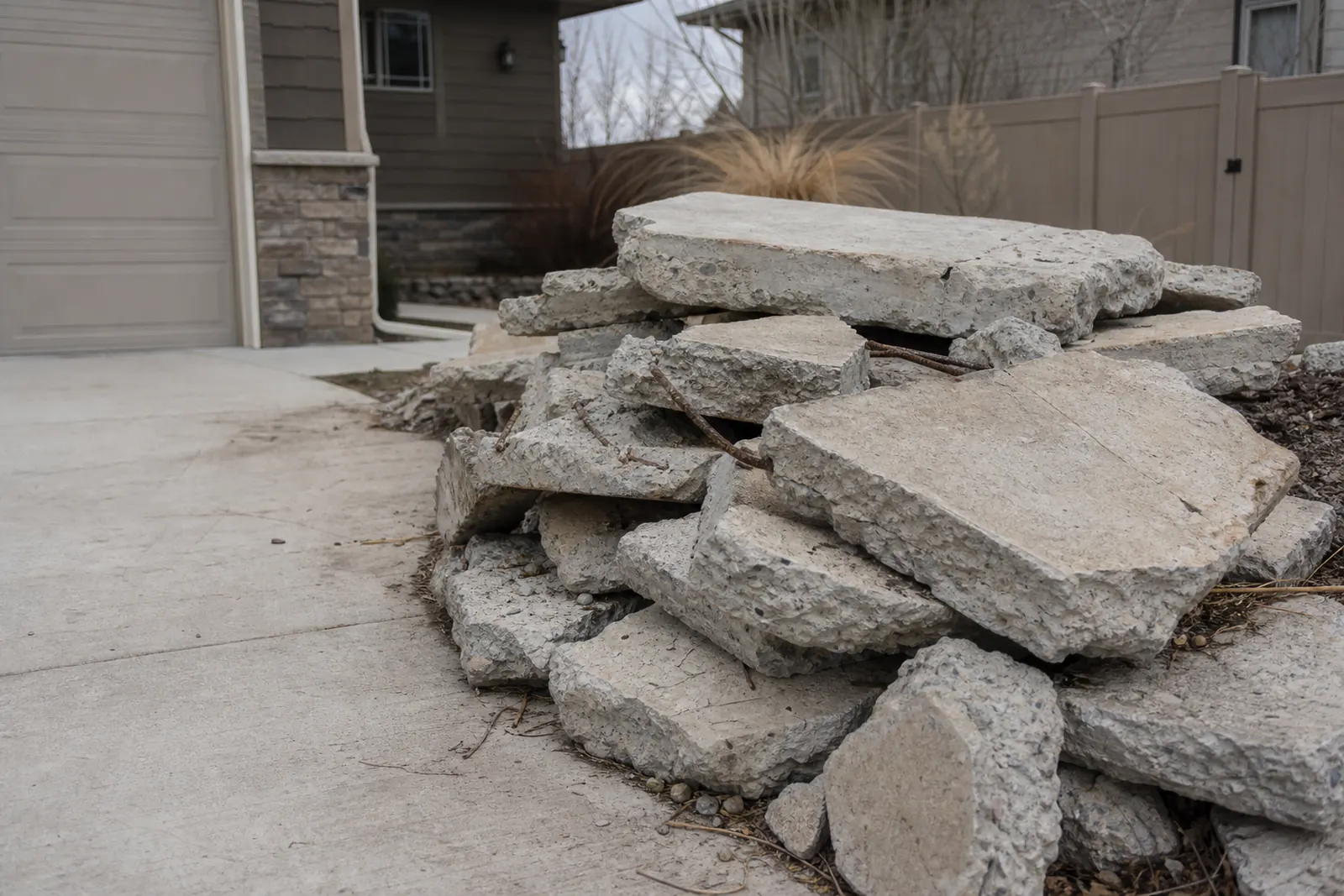
Should you level concrete or replace it?
If the slab sank but is still in one piece or a few large pieces, and the surface is sound, leveling is usually the better choice: the concrete stays, there’s no demolition, and it’s back in use sooner. If the slab is broken into many pieces, pushed up by roots, crumbling on the surface, or you want a new layout anyway, replacement is usually the better choice. The free evaluation tells you which one fits your concrete.
The two options, side by side
| Leveling (foam lifting) | Replacement | |
|---|---|---|
| What happens | Small holes, foam under the slab, slab raised back into line | Old slab broken out and hauled away, base prepared, new concrete poured |
| What stays | Your existing concrete | Nothing. It’s all new |
| Disruption | Work stays on the slab, no demolition | Breaking, hauling, forms, pouring and finishing |
| Back in use | Usually soon after the work, since foam cures quickly | After new concrete has cured enough for use, which takes much longer |
| Appearance | Same slab, with small patched holes | New, uniform surface that may not match nearby concrete |
| Fixes | Settlement, voids, tipped and rocking slabs | Almost anything, including broken, heaved and worn-out slabs |
| Can’t fix | Heave, badly broken slabs, failing surfaces | Doesn’t by itself fix the water or soil problem that caused settling |
Cost is covered separately on concrete leveling cost vs replacement.
When leveling makes more sense
Leveling tends to be the better choice when:
- The slab dropped or tipped but is still whole, or in a few large pieces
- The surface is in decent shape and worth keeping
- The concrete matches other slabs around it and you’d like to keep it that way
- You want the area back in use quickly
- Tearing out would mean disturbing landscaping, fencing or other slabs
- Only one or two panels moved, not the whole area
This is the case more often than people expect. A lot of concrete that gets torn out was only sunken, not broken. Can sunken concrete be lifted? covers the criteria in detail.
When replacement makes more sense
Replacement tends to be the better choice when:
- The slab is broken into many small pieces
- A tree root or swelling soil pushed it up
- The surface is scaling, flaking or crumbling across large areas
- Most of the panels in the area have failed, not just one or two
- You want a different size, shape or finish anyway
- The slab was poured without enough slope, and drainage needs to be redesigned
When should concrete be replaced? goes through these, and is my concrete too damaged to lift? is the checklist from the slab’s point of view.
The cause matters either way
Whichever way you go, the slab moved for a reason. Usually it’s water washing soil out, or loose fill that kept compressing. Replacing a slab without dealing with the water can mean the new one settles too. Lifting a slab without dealing with the water can mean voids forming next to the foam. The fix for the cause is often simple, like extending a downspout or adjusting sprinklers, and it helps both options last. Why does concrete sink? covers the causes.
Appearance
People sometimes worry that a lifted slab will look patched. The only new marks are the small filled holes, typically around 5/8 of an inch across. Everything else is the same concrete, with the same color and wear as the slabs next to it.
A replaced section, on the other hand, is new concrete next to old concrete. It’s often noticeably lighter and a different texture for years. On a driveway where only one or two panels moved, that can stand out more than the patched ports would.
It doesn’t have to be all or nothing
On a lot of properties, the right answer is a mix. Lift the panels that settled and are still sound, and replace the one that’s broken up or pushed up by a root. That keeps most of your concrete in place and only replaces what actually needs it. We’ll show you which is which.
How we decide
At the evaluation, we look at each slab: how it moved, whether it’s intact, what the surface is like and where the water is coming from. Then we tell you what we’d do and why. If replacement is the better call, we say so and point you toward a concrete contractor. How concrete leveling works explains the whole process.
Leveling vs replacement questions
Is leveling a temporary fix?
Not when the slab is a good candidate and the cause is dealt with. The foam fills the voids and supports the slab. How long it holds depends mostly on the soil and water around it.
Will a replaced slab settle again?
It can, if the base wasn't prepared well or water keeps washing soil out. Replacement doesn't automatically fix the cause.
Can you lift some panels and replace others?
Yes, and that's often the best approach. We lift what can be lifted and tell you which sections should be replaced.
Do you do concrete replacement?
Our work is lifting and leveling. If a slab needs to be replaced, we'll tell you plainly so you can take it to a concrete contractor.