
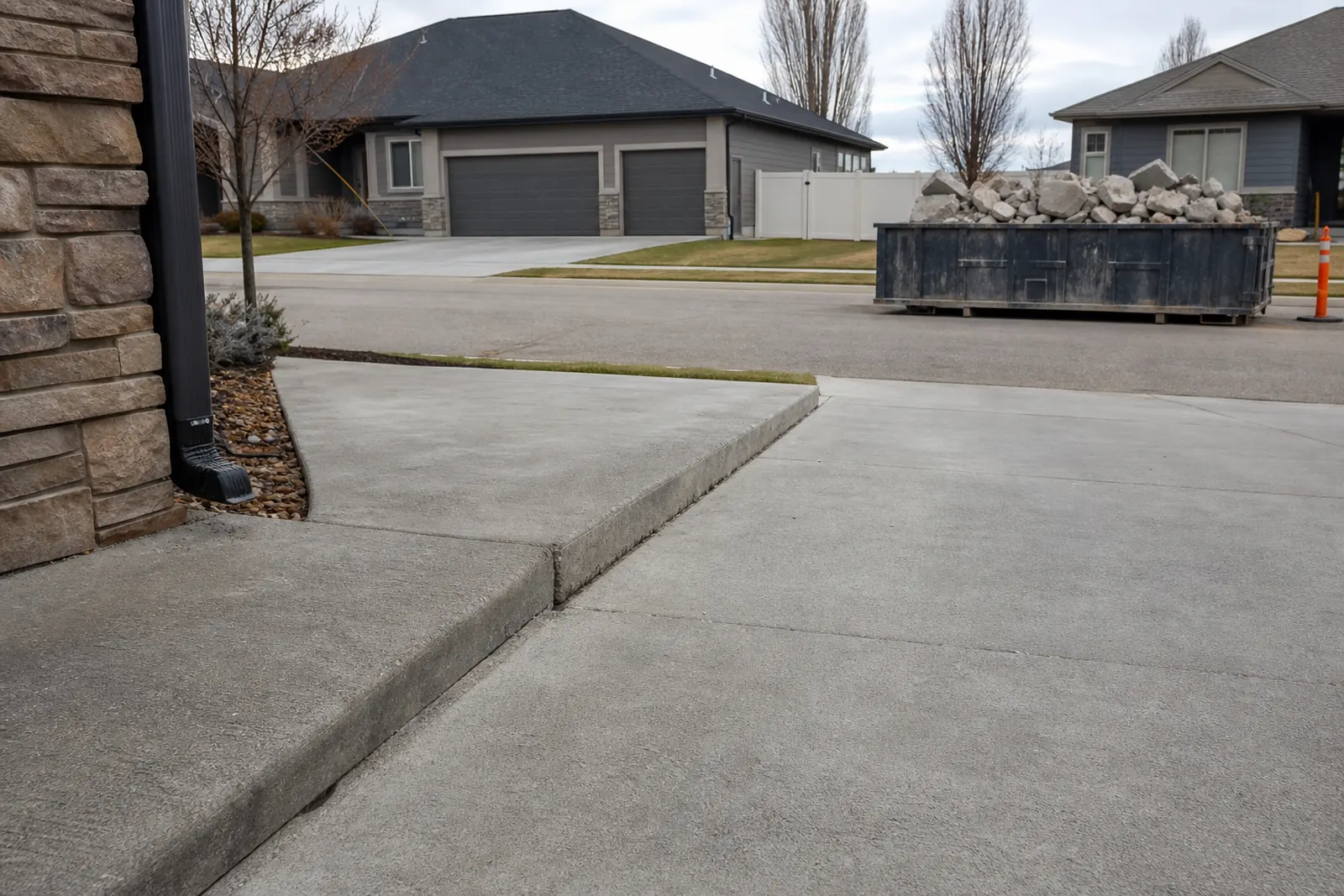
Is concrete leveling cheaper than replacement?
In most cases, yes, because a lift skips the demolition, hauling, base preparation, forming and new concrete that replacement requires. But not always. When a slab has very large voids under it, is failing in other ways, or is going to be replaced soon anyway, the comparison can shift. The useful way to compare isn’t price per square foot, it’s what goes into each price.
We don’t publish prices, because every slab is different. What we can do is show you what you’re paying for with each option, so the quotes you get make sense.
What goes into a replacement price
Replacing a concrete slab is a full construction project, even when it’s only one panel.
- Break out the old concrete. Cutting and demolition, often with heavy equipment.
- Haul it away. Loading, trucking and disposing of broken concrete.
- Prepare the base. Removing soft soil, bringing in and compacting new base material.
- Form the slab. Setting forms to the right height and slope.
- Pour and finish. New concrete, delivered, placed and finished.
- Cure. Waiting before the slab can take foot traffic, and longer before vehicles.
- Restore around it. Repairing lawn, sprinklers or landscaping disturbed along the way.
Each step has labor, materials or equipment in it. Some also have minimums: a concrete truck costs something to send out whether it’s delivering a lot or a little.
What goes into a leveling price
A lift has far fewer steps.
- Drill ports. Small holes at planned spots.
- Inject foam. Filling voids and lifting the slab.
- Patch. Filling the ports.
- Wash down. Power washing the area, which is free.
The main variables are how much foam the job takes, which depends mostly on the empty space under the slab, and how much time the lift takes. Concrete leveling cost explains each factor.
Side by side
| Cost item | Leveling | Replacement |
|---|---|---|
| Demolition | None | Yes |
| Hauling and disposal | None | Yes |
| New base material | None, foam fills the voids | Usually |
| Forms and new concrete | None | Yes |
| Time before use | Usually short, since foam cures quickly | Longer, while concrete cures |
| Landscaping repair | Usually none | Sometimes |
| Matching old concrete | Same slab, so it matches | New next to old often looks different |
| Main variable | Void size under the slab | Area and difficulty of removal |
When leveling usually costs less
- The slab is sound and only settled
- Only part of an area moved, so replacement would mean cutting out sections
- The slab is surrounded by things that would have to be torn up for replacement
- The concrete has a finish, like stamped or colored, that would be expensive to recreate
When the gap narrows, or reverses
Lifting isn’t always the cheaper option. These are the cases where it may not be:
- Very large voids. When a lot of soil has washed out, filling it takes a lot of foam. The lift may still be worth it, but the difference from replacement shrinks.
- A slab near the end of its life. If the surface is failing, a lift now and replacement in a few years costs more than replacement now.
- You’re redoing the area soon. Paying to lift concrete you’re about to remove doesn’t make sense.
- The water problem can’t be fixed. If the slab will keep moving, repeated lifts can add up.
If any of these apply, we’ll tell you. When should concrete be replaced? covers those situations.
Partial jobs
Many properties don’t need all of one or all of the other. A driveway might have three panels that settled and are still sound, plus one that a root pushed up. Lifting the three and replacing the one usually costs less than replacing all four, and it keeps most of the original concrete so the new panel is the only one that stands out. We’ll mark which is which at the evaluation.
The costs people forget
When comparing quotes, it helps to think about:
- Downtime: how long you’ll be without the driveway, walk or entrance.
- Matching: whether a new section next to old concrete will bother you.
- The cause: whether either quote deals with the water or soil problem that made the slab sink. A replacement slab poured over the same washout can settle too.
Getting a clear comparison
The evaluation is free. We’ll tell you whether your slab is a good lifting candidate, walk you through what’s driving the price, and tell you if we think replacement is the better value. For the non-cost side of the decision, see concrete leveling vs replacement. For driveways specifically, see driveway leveling cost.
Cost comparison questions
Why is replacement usually more expensive?
It involves demolition, hauling, base preparation, forms and new concrete. A lift skips all of those steps.
Can lifting ever cost more than replacing?
It can get close when there's a very large void to fill. And if the slab needs replacing soon anyway, lifting it first just adds cost. We'll tell you if that's the case.
Should I get a replacement quote too?
It's reasonable to compare. When you do, check whether the replacement quote deals with the water or soil problem that made the slab sink.
What costs aren't in either quote?
Downtime and appearance. How long you're without the area, and whether new concrete next to old will bother you, are worth weighing too.