
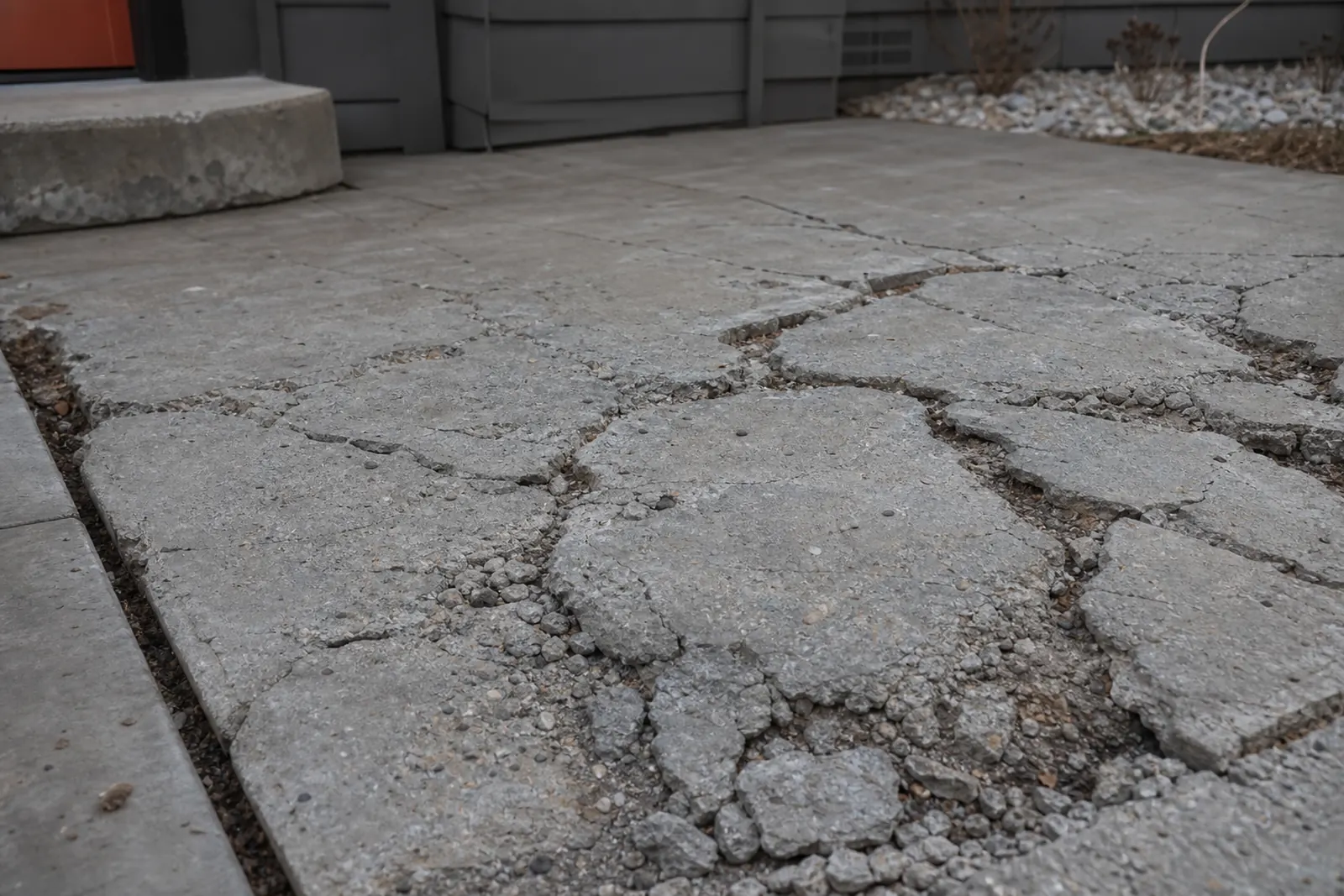
How do you know if concrete is too damaged to lift?
Concrete is usually too damaged to lift when it’s broken into many small pieces, crumbling or scaling across much of the surface, pushed up by roots or swelling ground, missing chunks, or so worn that a level slab still wouldn’t be usable. If none of those apply, lifting is probably still on the table, even if the slab looks rough.
The checklist
Walk out to the slab with this list. Each item is something we look for at the evaluation.
Broken into many small pieces
A slab in two or three large pieces can usually be lifted together. A slab in a dozen pieces, where each piece moves on its own when you step on it, can’t be lifted as a unit. The pieces shift, tip and grind against each other.
Sign: pieces rock separately, or you can see gaps opening between several fragments.
Crumbling along the cracks
When the edges of a crack are breaking down into gravel and dust, the concrete there has lost its strength. Lifting would put stress on those edges and break them further.
Sign: loose aggregate along the crack, edges that chip when you press on them.
Surface failing across large areas
Scaling and spalling are when the top layer of the concrete flakes or pops off, often from freeze and thaw, deicing salts or a weak finish. A little is cosmetic. When it covers much of the slab, lifting just gives you a level slab with a bad surface.
Sign: exposed stones across the surface, flakes and pits, rough patches that keep getting bigger.
Pushed up, not down
Roots growing under a slab, or ground that swells, push concrete up. Lifting only raises concrete, so it can’t fix a slab that’s too high.
Sign: the slab is higher than the concrete around it, humped in the middle or peaked along a crack. There’s often a large tree nearby.
Missing concrete
Chunks broken out of edges or corners, especially on driveways, mean there’s nothing there to lift. Patching might be possible, but it’s not a lifting job.
Sign: holes, missing corners, broken edges where vehicles turn.
Too thin or undermined everywhere
Some slabs were poured very thin, or have been washed out so thoroughly that there’s little support left anywhere. These can crack further during a lift.
Sign: a slab that flexes visibly, or cracks under ordinary foot traffic.
Heavily patched
Old patches, especially thick mortar or asphalt filled into a sunken edge, can hide what’s going on and don’t lift the same way as the original concrete. A slab that has been patched over and over is often telling you it has been moving for a long time.
Sign: layers of patching material, especially along one edge or at a joint.
Damage that looks worse than it is
Some things look alarming but don’t rule out lifting.
| Looks bad | Usually |
|---|---|
| One big crack with a height difference | Liftable. The pieces come up together |
| A panel that dropped a lot | Liftable if intact. More drop means more foam, not a harder job |
| Hairline cracks all over | Normal shrinkage. Not a reason to replace |
| Staining and discoloration | Cosmetic. The power wash at the end often helps |
| A gap along the house | Usually settlement. Lifting often closes it |
| An old, weathered slab | Age alone doesn’t matter if the concrete is sound |
Partially damaged areas
A common situation: most of the slabs are fine but settled, and one is broken up. That doesn’t mean replacing everything. Lift the ones that can be lifted, replace the one that can’t. We’ll mark which is which.
Why we’ll tell you no
A lift on a slab that’s too far gone doesn’t hold up, and it doesn’t look good. That’s bad for you and bad for us. If your concrete is past the point where lifting makes sense, we’ll tell you plainly at the evaluation. When should concrete be replaced? covers the bigger-picture replacement reasons, and concrete leveling vs replacement compares the options.
If you’re still not sure
Most people can’t tell for certain from looking, and that’s fine. Send a few photos: a wide shot, a close-up of the worst area, and anything you’re worried about. Can sunken concrete be lifted? and can cracked concrete be lifted? cover the cases where the answer is usually yes.
Questions about damaged concrete
Is old concrete too old to lift?
Age alone doesn't rule it out. Plenty of older slabs are still sound and lift well. Condition matters more than age.
Can you lift a slab with scaling on the surface?
Minor scaling is cosmetic and doesn't stop a lift. Scaling across large areas usually means the surface is failing, and replacement may be better value.
What if only one panel is badly damaged?
Lift the ones that can be lifted and replace the damaged one. There's no need to replace the whole area.
Will you still come out if I think it's too damaged?
Yes. The evaluation is free, and it's common for a slab to be in better shape than it looks.