
How long does concrete leveling last?
There’s no honest single number, because it depends mostly on what’s happening under and around the slab after the lift. When the slab was a good candidate and the cause of the settlement was dealt with, like redirecting a downspout or fixing a sprinkler, a lifted slab can stay in place for a long time. When water keeps washing soil out next to the slab, it can move again.
The foam isn’t usually the weak link
Cured polyurethane lifting foam is a solid, stable material designed to stay under the slab. It doesn’t wash away like soil and it adds very little weight to the ground. So when a lifted slab moves again, the cause is almost always the soil around the foam, not the foam itself.
That’s why the question “how long does it last” is really “what’s going to happen to the ground under this slab from here on.”
What decides how long a lift holds
Whether the water was dealt with
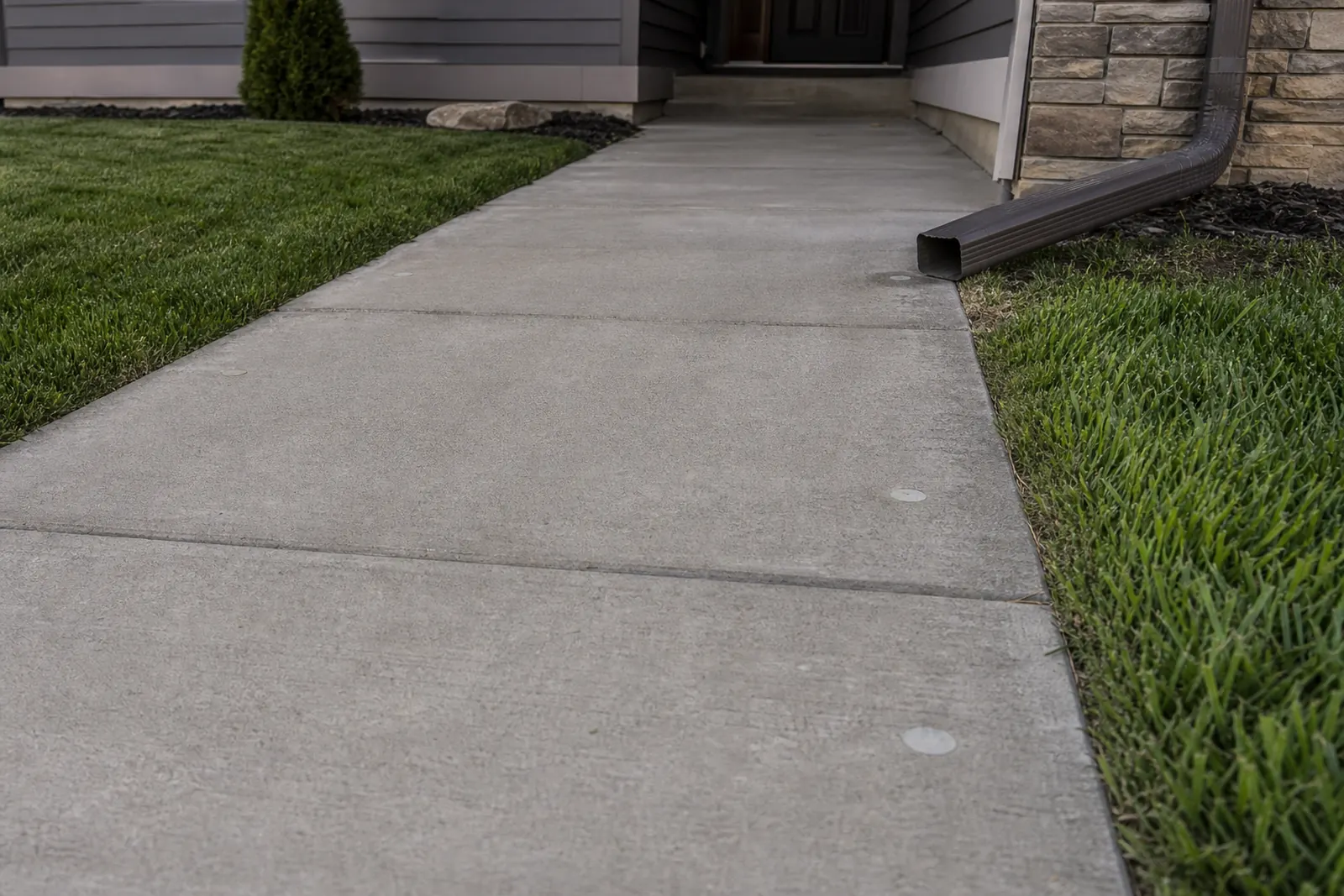
This is the biggest one. Most settlement is caused by water: downspouts, sprinklers, irrigation runoff, leaks and snowmelt at the edges. If that water is redirected, the soil around the slab stays put. If it keeps pouring into the same spot, it can wash out soil next to the foam, and new voids can form. Soil washout under concrete covers the fixes.
Whether the settlement had finished
Backfill around newer homes can keep compressing for years. A slab lifted while the ground beneath is still settling may need attention again. Around established homes, where the fill has long since compacted, this is less of a factor. Concrete settlement explains how to tell if movement is still active.
The soil itself
Some soils change more with moisture than others. Fine, silty soils that soften when wet are more likely to move again if water keeps getting to them.
The slab’s condition
A sound slab that was fully supported is more likely to stay put than one that was already cracked. Cracked pieces can shift independently if the ground moves.
How the slab is used
A driveway edge that carries vehicle weight every day has more working against it than a patio corner.
Freeze and thaw
Water that gets under a slab in winter freezes and expands. Sealed joints and good drainage help keep water from getting there in the first place.
What you can do to make it last
- Extend downspouts so they discharge well away from the concrete
- Adjust sprinklers so they don’t spray slab edges
- Fix irrigation or plumbing leaks near slabs
- Seal the joints, and the gap between the slab and the house
- Keep soil graded so it slopes away from slab edges
- Watch the slab after its first winter
Most of these are simple, and they make the biggest difference.
What we do on our side
We fill the voids as well as lifting the slab, so it has full support. We lift to meet the concrete around it and restore the slope so water runs off. And at the evaluation, we point out the water sources we see so they can be dealt with. That’s part of why the evaluation looks at more than just the slab.
Why we won’t give you a number
You’ll see big lifespan claims for concrete lifting in some places. We don’t make those, because the honest answer depends on things no one controls completely: the soil, the water and the weather. What we can tell you is what we see at your property and what would help the lift hold.
Signs a lifted slab is moving again
- A lip starting to form again at the same joint
- New soil washing out along an edge
- Water standing where it used to drain
- A hollow sound returning near an edge
- A crack opening beside the patched ports
If you see any of these, look first for the water. It’s usually the same source that caused the original settlement, or a new one, like a sprinkler head that got moved.
If a slab moves again
If a lifted slab settles again, it can often be lifted again, as long as it’s still in solid pieces. More importantly, it’s a sign something is still washing out or compressing under it, and that’s worth finding.
For the full picture of whether leveling makes sense for your slab, see is concrete leveling worth it? and concrete leveling vs replacement. The material itself is covered on polyurethane concrete lifting.
Questions about how long leveling lasts
Does leveling last as long as new concrete?
It depends on the conditions. A new slab on the same soil with the same water problem can settle too. Dealing with the cause matters for both.
What's the most common reason a lifted slab moves again?
Water continuing to wash soil out next to it, usually from a downspout, sprinkler or leak.
Do the patched holes hold up over time?
The ports are filled and finished flush with the surface. Like any patch in concrete, they weather along with the slab, and they can be touched up later if one ever needs it.
Should I seal the joints after lifting?
It's a good idea. Sealed joints keep water from getting under the slab, which is what causes most settlement.