
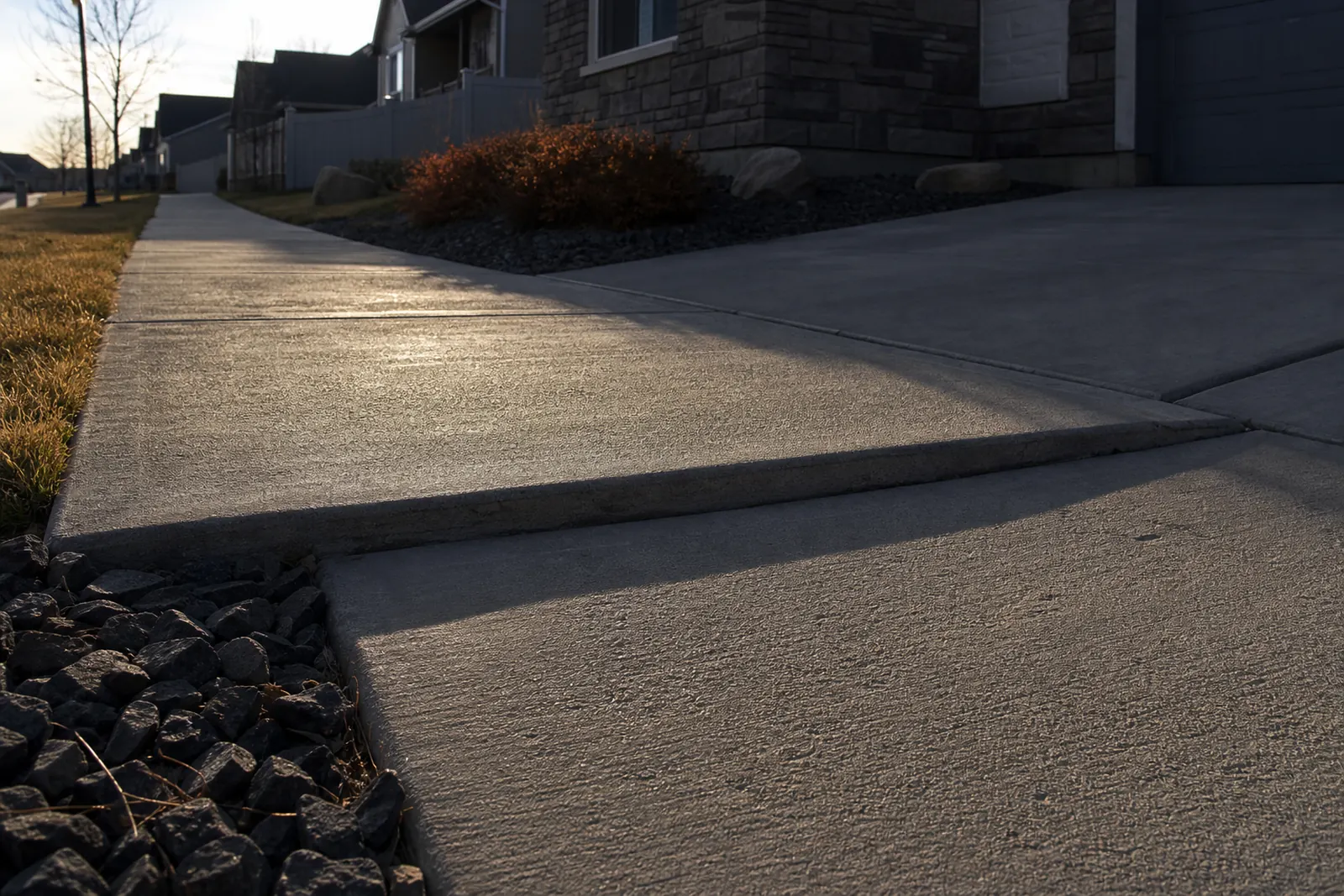
What is concrete leveling?
Concrete leveling raises a slab that has sunk or tipped back toward the height it was poured at, without tearing it out. We do it with polyurethane foam: small holes are drilled through the slab, foam is injected underneath, and as it expands it fills the empty space and lifts the concrete. The same slab goes back into service with support under it again.
The concrete we lift
Almost any flat slab that rests on soil can settle, and most of them can be lifted if the concrete is still in decent shape. These are the jobs we see most around the Magic Valley.
| Slab | What usually happens | More detail |
|---|---|---|
| Driveways | The panel by the garage or the street drops and leaves a lip | Driveway leveling |
| Garage aprons | The slab outside the garage door sinks below the garage floor | Garage apron leveling |
| Sidewalks | One square drops or tips and creates a trip edge | Sidewalk leveling |
| Walkways | The path to the front door settles unevenly | Walkway leveling |
| Patios | The slab tips toward the house or pulls away from it | Patio leveling |
| Steps and landings | The stoop sinks or leans away from the door | Concrete step leveling |
| Commercial slabs | Entrances, walks and sidewalks at businesses and rentals | Commercial concrete leveling |
If your slab isn’t on this list, ask anyway. Pool decks, shop floors and pads for equipment can often be looked at the same way.
Why slabs sink in the first place
Concrete is strong, but it’s only as steady as the ground under it. When that ground shifts, compresses or washes away, the slab has nothing to rest on and it follows the soil down.
The usual causes are loose fill that was never compacted well, water that runs under the edges and carries soil away, and years of freeze and thaw loosening the base. Around here, sprinklers and irrigation water add to it, because a slab that stays wet at one edge loses support there first. Why does concrete sink? goes through each cause in plain terms.
Settlement is different from heave. Concrete that has been pushed up, usually by roots or by ground that swelled, can’t be pulled back down by lifting. That’s one of the first things we check.
How foam lifting works
Sunken
Concrete has settled or lost support.
Lifted
Polyurethane foam is injected beneath the slab.
Level
The slab is raised toward its proper position, and the void space is stabilized.
The work happens from the top of the slab. We drill small ports, typically around 5/8 of an inch across, at planned spots. A two-part polyurethane foam goes in through those ports and expands underneath. It fills the hollow areas first, then starts to push the slab up. We lift in small steps and watch the level against the concrete around it, stopping when the slab is back in line. The ports are patched and the area gets power washed.
Because the foam is light and expands to fill the space, the slab ends up resting on a new layer of support instead of on the gap that let it drop. How foam concrete lifting works walks through what happens under the slab step by step, and polyurethane concrete lifting covers the material itself.
Lifting, filling and stabilizing
People usually call about a slab that has already dropped. But the same method handles two related jobs.
- Sometimes the soil has washed out but the slab hasn’t dropped much yet. Filling the empty space now can keep it from sinking later. See concrete void filling.
- A slab that rocks when you step on it, or keeps moving a little every season, may need support more than it needs lift. See slab stabilization.
Often a single job includes all three: fill the voids, lift the panel that dropped, and make sure the ones beside it are supported.
Can your concrete be lifted?
This is the question the free evaluation answers. It comes down to a few things.
| What we look at | Usually liftable | Replacement may make more sense |
|---|---|---|
| Condition | One piece, or a few large stable pieces | Broken into many small pieces |
| Direction of movement | Sank or tipped down | Pushed up by roots or heave |
| Surface | Sound, normal wear | Scaling or crumbling across large areas |
| Your goals | Keep the concrete you have | New layout, new size or new finish |
The detailed version of this is on can sunken concrete be lifted?, and if you already suspect your slab is in rough shape, is my concrete too damaged to lift? walks through the damage that rules lifting out.
When replacement is the better answer
We’d rather lift a slab than see it hauled away, but not every slab should be lifted. If most of the concrete is broken up, if the surface is failing, or if you’re planning to change the layout anyway, new concrete may be the better value. When that’s what we see, we’ll tell you. Concrete leveling vs replacement lays the two options side by side.
What concrete leveling costs
There isn’t a flat price, because no two slabs are the same. Cost depends on how much concrete needs to move, how far it dropped, how much empty space is underneath and how easy the area is to reach. We explain the factors for your job at the evaluation. Concrete leveling cost covers each one.
Where we work
We lift concrete in Twin Falls and around the Magic Valley, north and south of the canyon.
Concrete leveling questions
What's the difference between concrete leveling and concrete lifting?
Nothing, in practice. Leveling, lifting, raising and slab jacking all describe raising a settled slab back toward where it belongs. We use foam to do it.
Does lifting fix the reason the concrete sank?
It fills the empty space and gives the slab support again. If water is still washing soil out, like a downspout emptying at the edge, that needs to be dealt with too, and we'll point it out.
How far can a slab be lifted?
It depends on the slab and what's around it. Most jobs involve raising a panel back in line with its neighbors, and we lift in small steps so it doesn't go too far.
Will the slab be perfectly flat afterward?
The goal is to bring it back in line with the concrete around it so edges meet and water drains. Old concrete that has warped or has uneven wear won't become brand new, and we'll tell you what to expect.
Do you need to dig around the slab?
No. The work is done through small holes drilled in the concrete. There's no excavation around the edges in a normal lift.