
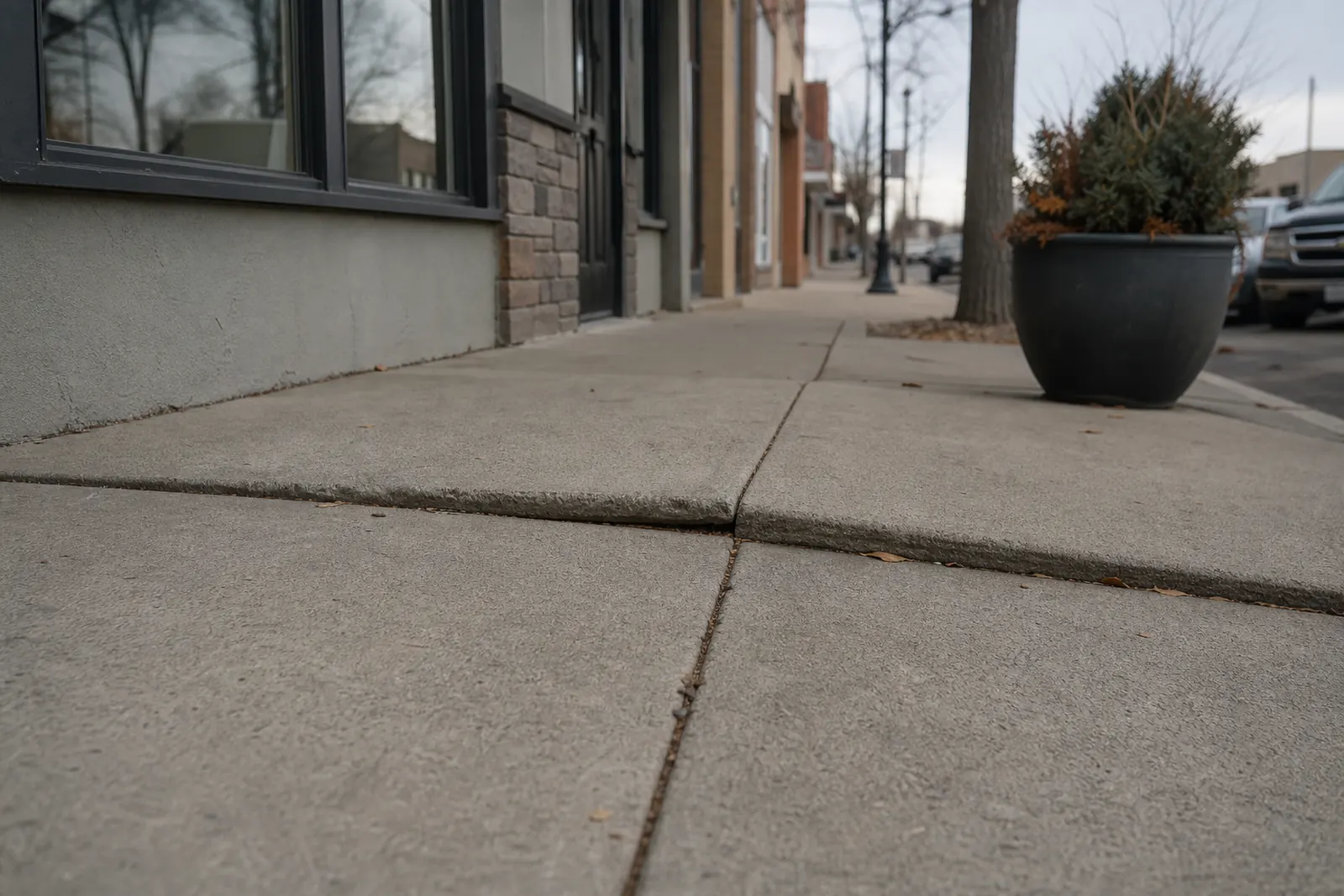
Can uneven commercial sidewalks be leveled instead of replaced?
Often, yes. When a sidewalk square along a storefront or commercial frontage settles and leaves a raised edge, polyurethane foam can usually lift it back in line with the squares around it. There’s no demolition, the work goes section by section, and the sidewalk is usually back in use soon after. Squares that are broken up or pushed up by roots are the exception, and we’ll tell you which ones those are.
Why commercial sidewalks get attention
A sunken square in front of a house is a nuisance. In front of a business, it’s where customers, delivery drivers and employees walk every day, often while looking at the door instead of their feet. Owners and managers are generally expected to keep walking surfaces in reasonable repair, and a trip edge on a busy frontage is the kind of thing that turns into a complaint, a claim or a note from an inspection.
We’re not attorneys or accessibility consultants, and nothing here is legal advice. What we can do is fix the edge.
A useful yardstick
Federal accessibility standards for public walking surfaces allow changes in level up to a quarter inch without treatment, require edges between a quarter and a half inch to be beveled, and treat anything larger as needing a ramp. Those rules are written for new construction and accessible routes, but they’re a good way to think about what counts as an edge. If you can see it, it’s probably already past a quarter inch.
What we see on commercial frontage
- Squares that dropped next to tree wells and planters
- Settlement over utility trenches that were cut across the sidewalk
- Edges where the sidewalk meets a driveway entrance or curb cut
- Squares tipped toward the building, sending water at the storefront
- Voids along the curb side where street runoff washed soil out
- Raised edges where snow equipment catches and chips the concrete
Lift, grind or replace
| Situation | Usually |
|---|---|
| Square settled, still whole | Lift it back in line |
| Small edge on a stable square | Grinding may work, though it leaves any void in place |
| Square pushed up by a tree root | Can’t be lowered by lifting. Replacement or root work |
| Square broken into pieces or crumbling | Replace |
| Several squares tipped over a trench | Lift them together so they line up |
Lifting tends to be the better fix when there’s a void under the low square, because it restores support and the edge is less likely to come back. Concrete trip hazards covers measuring offsets and the options in more detail.
How the work fits around a business
- We can work one stretch at a time so customers still have a way in.
- Nothing is broken out, so there are no breakers, dumpsters or concrete trucks at the curb.
- The work happens through small holes in the slab, with hoses run from the equipment.
- Foam cures quickly, so walks usually reopen soon after the work. We’ll tell you when each section is ready.
- We’ll talk through when the work makes sense for your hours. Ours are Monday through Saturday, 7:00 AM to 8:00 PM. Sunday closed.
Every completed job ends with a wash down of the work area, which on a storefront is something customers notice.
Who’s responsible for the sidewalk?
It depends on the city and the property. In many places the adjacent owner is responsible for the public sidewalk, and leases often assign it to a tenant or manager. Check your lease and your city’s rules. We’re happy to meet whoever makes the decision.
The evaluation
The commercial evaluation is free. We walk the frontage, note which squares have settled, which ones are good lifting candidates and which ones need replacing, and explain what’s driving the price. The general commercial side is covered on commercial concrete leveling, and the residential version of this page is sidewalk leveling.
Commercial sidewalk questions
Can customers still get in while you work?
Usually. We work a section at a time so there's a route to the door. We'll plan the order with you.
Can you work before or after business hours?
We'll talk through timing when we schedule. Our regular hours are Mon to Sat, 7 AM to 8 PM.
Will lifting satisfy an inspection note about trip hazards?
Lifting removes the height difference, which is usually what the note is about. We can't speak for any inspector, so check what they're asking for.
Can you lift sidewalk squares next to tree wells?
If they settled, often yes. If a root pushed them up, lifting can't lower them, and that section may need replacing.