
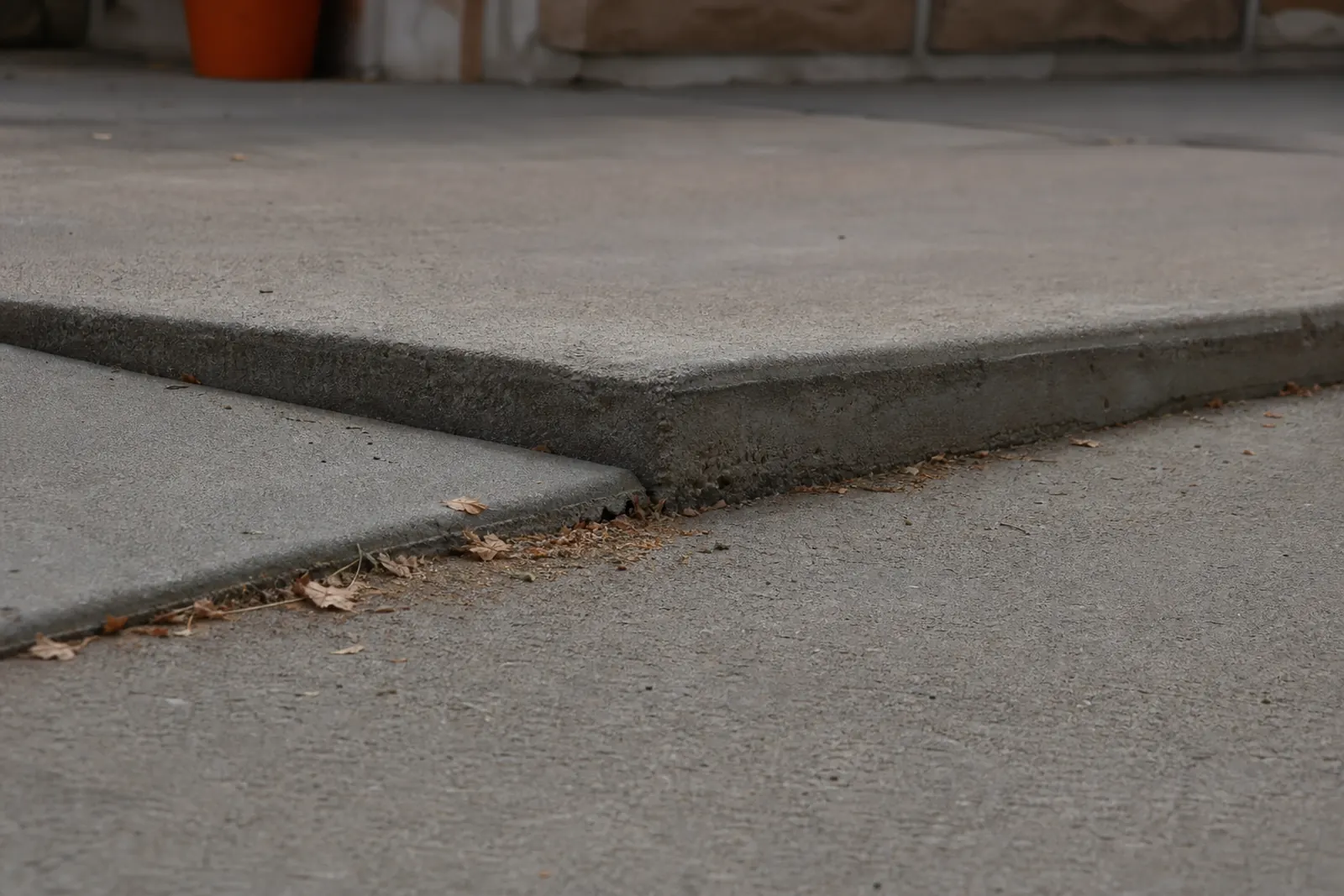
Why is my concrete uneven?
Uneven concrete means two slabs no longer sit at the same height, or one slab has tilted. It happens one of two ways: one side settled (dropped), or one side heaved (got pushed up). Settled concrete can usually be lifted back in line with foam. Heaved concrete can’t be pushed back down by lifting, so the fix is different. Telling the two apart is the first step.
Settled or heaved?
A few clues tell them apart.
| Clue | Probably settled | Probably heaved |
|---|---|---|
| Compared to the house, garage floor or curb | Sits lower than it should | Sits higher than it should |
| Nearby | Downspouts, sprinklers, soil gaps at edges | A large tree close by, roots visible at the edge |
| Shape | Tipped or dropped, flat surface | Humped or peaked, sometimes cracked across the top |
| Water | Collects on the low side | Runs off the high spot |
| Timing | Gradual, gets worse over years | Can come on with tree growth or seasonal changes |
The easiest reference is something that doesn’t move, like the garage floor or a curb. If the slab next to it is lower than it used to be, it settled. If it’s higher, something pushed it up.
What uneven concrete causes
- Even a small offset between two slabs catches toes. Concrete trip hazards covers how to measure them.
- A tilted slab can send water at the house or leave it standing in a low spot. Water pooling on concrete explains why that matters.
- A slab resting on uneven support flexes under load, and that’s how cracks start.
- Shovels and blowers catch on raised edges, and the edges chip.
Why slabs settle unevenly
Soil rarely gives way evenly under a slab. One edge gets more water than the other. One corner sits over a utility trench or old backfill. One side takes the vehicle weight. So one part drops and the rest stays put, leaving the slab tipped or offset from its neighbor. Concrete settlement goes into the process.
Fixing uneven concrete
If it settled
Sunken
Concrete has settled or lost support.
Lifted
Polyurethane foam is injected beneath the slab.
Level
The slab is raised toward its proper position, and the void space is stabilized.
Settled slabs are usually good candidates for lifting. We inject polyurethane foam through small holes in the low slab. It fills the empty space, then lifts the slab until it’s back in line with its neighbor. The edge disappears, water drains properly again, and the slab has support under it. How foam concrete lifting works walks through it.
If it heaved
Lifting can’t lower a slab. Sometimes the answer is to raise the slabs around the heaved one so they meet it, if the heave is small and stable. Often the better answer is to address the root or the cause and replace that section. We’ll tell you which one makes sense.
If it’s both
On a long run of sidewalk or driveway, it’s common to find some slabs that settled and one that heaved. We’ll show you which is which so you only replace what can’t be lifted.
Can yours be lifted?
If the slab is in one piece or a few large pieces and it moved down, it’s usually liftable. Can sunken concrete be lifted? explains what we look for, and the service pages cover each type of slab: sidewalks, driveways, walkways and patios.
Uneven concrete questions
Can uneven concrete be fixed without replacing it?
If the low slab settled and is still in decent shape, yes. Lifting it with foam brings it back in line with its neighbor.
Can you lower a slab that was pushed up?
No. Lifting only raises concrete. A heaved slab is usually handled by dealing with the cause and replacing that section, or occasionally by raising the slabs around it.
Is grinding a good fix for uneven concrete?
Grinding can remove a small edge, but it leaves the low slab where it is along with any void underneath. It also changes the surface. Lifting fixes the height difference itself.
Why did only one slab move?
Soil under a single slab can get more water, sit over looser fill or carry more weight than the ground under its neighbors. That's why settlement often shows up one panel at a time.