
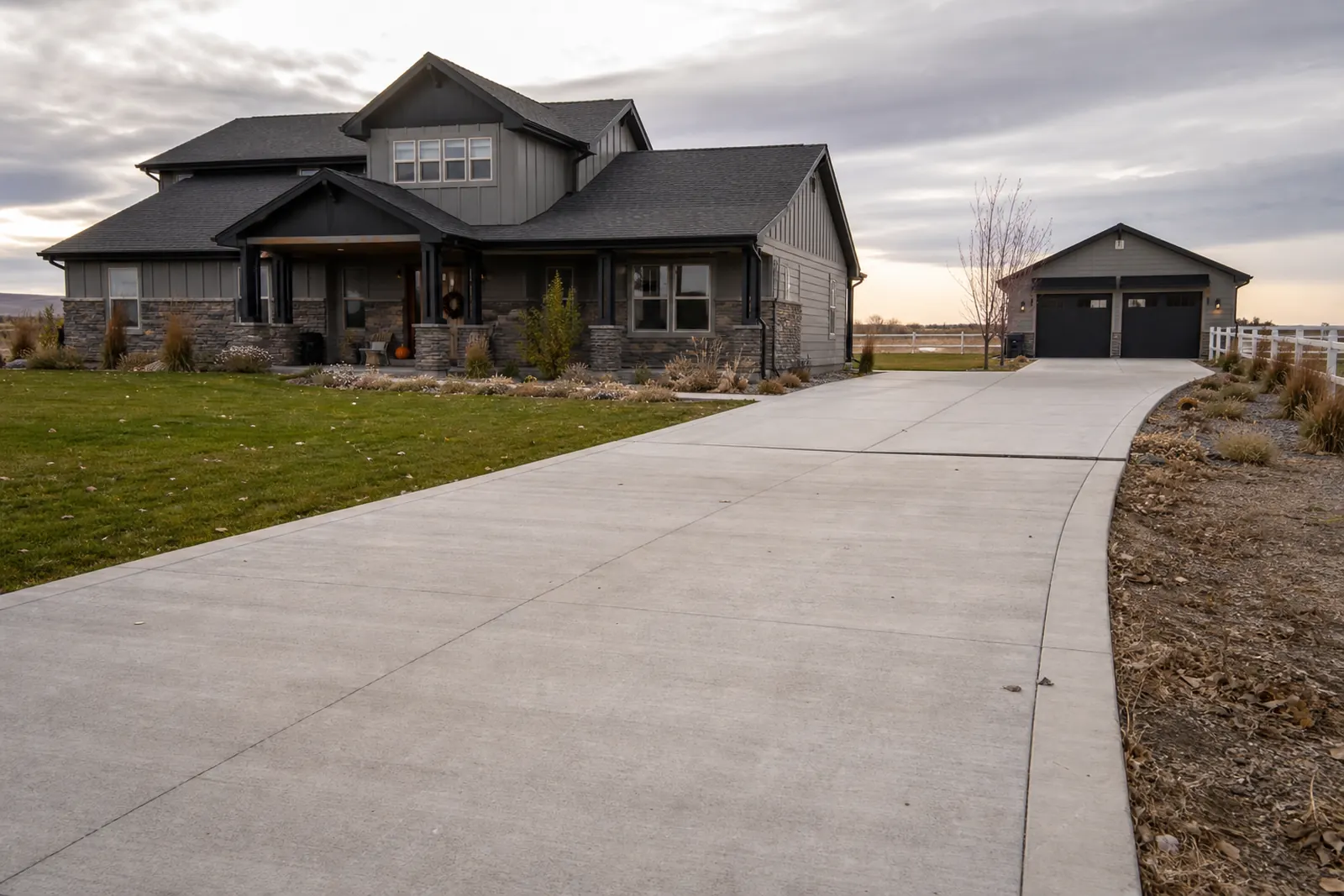
Concrete leveling in Hansen
Hansen is a small, rural community east of Kimberly, and most of the concrete we look at there is on homes with some land: long driveways, shop and garage aprons, back patios and walks between buildings. When those slabs sink, tip or start to rock but are still in good shape, polyurethane foam can usually lift them back into line and fill the empty space underneath. The evaluation is free.
About Hansen
Hansen was platted in 1905, during the years when irrigation projects were opening up farmland across the Magic Valley. It’s a small town of around 1,100 people, and the census counts it as entirely rural. Just north of town, the Hansen Bridge carries State Highway 50 across the Snake River Canyon toward the north side of the valley.
What that means for concrete: fewer tract subdivisions, more individual homes on acreage, and more slabs that serve working properties.
Concrete on rural properties
A home on acreage usually has concrete spread across the property, not just a driveway and a front walk.
| Where | What we see |
|---|---|
| Concrete at the house end of a long driveway | Edges undermined by runoff, panels dropped where vehicles turn |
| Detached shop or garage apron | Apron dropped below the floor, rocking under trucks and trailers |
| Back patio | Tipped toward the house, or pulled away from it |
| Walks between house and outbuildings | Lips at joints, sections tipped by roof water |
| Steps and landings | Leaning away from the door on older homes |
On rural lots, water doesn’t only come from the house. Field irrigation, ditches and the way the land drains can keep soil near a slab wet. Part of the evaluation is figuring out where the water comes from, because the lift holds best when the ground around it stays dry.
Shop aprons and heavy loads
Shop aprons are one of the most common rural calls. They carry pickups, trailers, tractors and equipment, often right at the edge of the slab where support is weakest. When they drop below the shop floor or start rocking, water heads into the shop and the edge can break off.
For aprons that carry heavy loads, filling the voids so the apron is fully supported matters as much as getting it back to height. Slab stabilization covers the support side, and garage apron leveling covers the lift.
Long driveways, short fixes
On a long driveway, only a few panels usually need attention: the ones near the house or shop where vehicles stop, turn and park. We lift the panels that moved and leave the rest alone. Driveway leveling explains the details.
Where concrete meets gravel
A lot of rural driveways and shop approaches in the Hansen area are gravel that turns into concrete near the house or shop. That transition is a weak spot. The concrete edge has gravel or soil beside it instead of another slab, water runs off the concrete and into the gravel, and tires hit the edge every time a vehicle comes on or off. Over time the soil under that edge washes out and the edge drops or breaks.
If the edge has only dropped, lifting and filling the void underneath can bring it back and give it support. Building up the gravel so it meets the concrete flush afterward helps keep tires from hammering the edge.
Rocking and hollow slabs
Rural slabs that have been undermined by water for a while often rock or sound hollow before they visibly drop. That’s the best time to deal with them, because filling the voids now can keep the slab from cracking. Voids under concrete describes how to check, and concrete void filling covers the fix.
How we handle a rural property
Sunken
Concrete has settled or lost support.
Lifted
Polyurethane foam is injected beneath the slab.
Level
The slab is raised toward its proper position, and the void space is stabilized.
On acreage, we usually start at the slab that prompted the call and then walk the rest of the concrete with you, since rural properties tend to have more than one problem spot. For aprons and driveway edges, the focus is filling voids for support. For patios and walks, it’s getting the slope back. Every lifted area is patched and washed down. How concrete leveling works explains the steps.
Nearby areas
Hansen is on the east side of our service area, just past Kimberly.
Hansen questions
Do you work on acreage and farm properties around Hansen?
Yes. Most of what we see around Hansen is on rural properties, from shop aprons to patios.
Can you lift a shop apron that carries a tractor?
Often, yes, if the apron is in solid pieces. We plan the lift so it's fully supported for the loads it carries.
My slab rocks but hasn't dropped much. Is it worth fixing?
Usually yes. Rocking means part of it has lost support. Filling the voids now can keep it from cracking.
Do you charge to come out to Hansen?
No. Evaluations are free in Hansen, the same as the rest of our service area.