
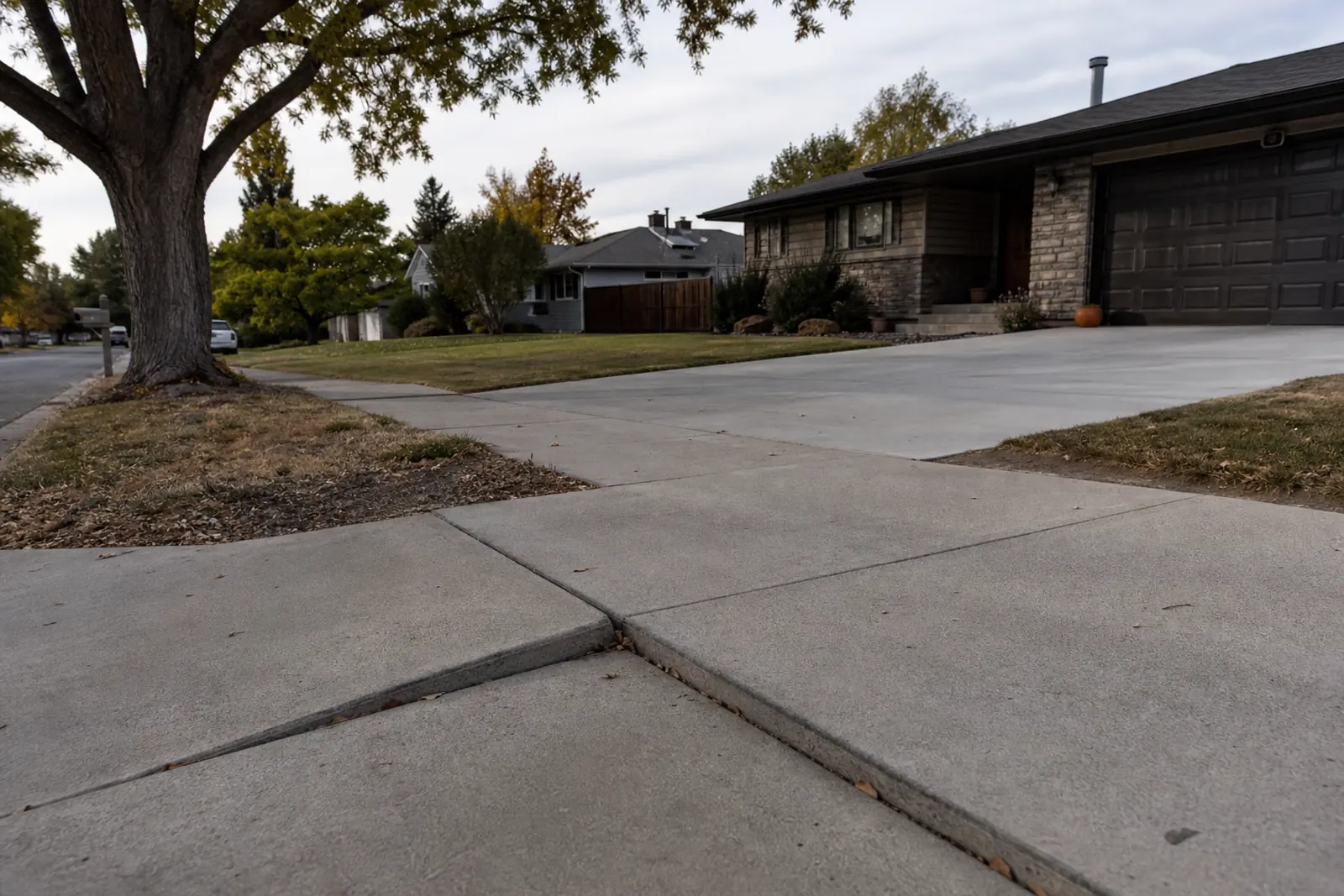
Concrete leveling in Twin Falls
Twin Falls is home base for us. The concrete problems here follow a pattern: garage aprons and steps settling on backfill in newer subdivisions, sidewalks and driveways moving with water and tree roots in older neighborhoods, and patios and walks tipping wherever lawns and landscaping keep slab edges wet. Most of it can be lifted with polyurethane foam instead of torn out, and the evaluation is free.
This page is about what we see around town. Our home page is the overview of concrete leveling in Twin Falls: what we do and how the work goes. Concrete leveling covers every kind of slab we lift.
A city built on irrigated ground
Twin Falls was founded in 1904 as a planned community on a broad plain at the south rim of the Snake River Canyon, and its growth followed the irrigation that Milner Dam made possible. That history still shows up under our driveways. The ground here is dry by nature, but yards across town are watered through most of the growing season. Water is what moves soil out from under slabs, and a lot of it lands right at concrete edges.
The climate adds the rest. Twin Falls is semiarid, with cold winters. Water that gets under a slab in the fall freezes and thaws through the winter, and each cycle leaves the base a little looser.
What we see in different parts of town
Newer subdivisions
On the newer edges of the city, the most common call is about concrete right next to the house: the garage apron dropping below the garage floor, front steps pulling away from the wall, and patios tipping toward the back door. These slabs sit on backfill placed when the house was built, and it can keep compressing for years.
Established neighborhoods
In older parts of town, the fill has long since settled. Movement there is usually driven by water and trees: sidewalk squares that dropped along a sprinkled lawn, driveway panels undermined at the edge, and squares pushed up by the roots of mature street trees. That last one matters, because a slab that was pushed up can’t be lifted back down.
Businesses and rentals
Twin Falls is the county seat and the largest city in the Magic Valley, so it has the most commercial concrete in our area: storefront sidewalks, walkways at offices and clinics, and walks and stoops at apartment properties. See commercial concrete leveling.
The problems we’re called about most in town
| What people see | What’s usually behind it |
|---|---|
| Drop at the garage door | Foundation backfill settling under the apron |
| Sidewalk edge by the street | Sprinkler water and runoff washing soil out |
| Patio tipped toward the house | Roof water and backfill along the foundation |
| Hollow-sounding driveway edge | Voids from irrigation along the lawn side |
| Raised square near a big tree | Root heave, which lifting can’t reverse |
| Steps pulled away from the door | Backfill settling beside the foundation |
A few Twin Falls-specific tips
- Check your sprinkler heads in spring. Heads that got bumped over the winter often start spraying slab edges. Turning them away from the concrete is one of the easiest ways to slow settlement.
- Watch the first slab out from the garage on any home built in the last several years. It’s the one most likely to drop.
- Mark it and measure it. If you’re not sure whether an edge is growing, mark both sides and check again after winter. Signs of concrete settlement has a full checklist.
- Watch the low spots in winter. A patch of ice that forms in the same place every morning is usually a settled slab holding water. It’s worth a look before it becomes a fall.
How a job works in town
In town, most jobs are close enough that we can often look at the concrete and talk through it on the same visit. The evaluation is free. If the slab is a good candidate, the work is done from the top through small ports, foam fills the voids and brings the slab back into line, and the ports are patched. On a typical city lot, equipment stays at the curb or in the driveway, with hoses run to the slab. How concrete leveling works covers every step.
Nearby areas
Twin Falls is the center of our service area. We also work in the towns around it on both sides of the canyon.
Twin Falls questions
Are you based in Twin Falls?
Yes. Twin Falls is home base and the center of our service area around the Magic Valley.
Why does concrete settle so much in newer Twin Falls subdivisions?
Slabs next to the house sit on foundation backfill, which can keep compressing for years. Irrigated yards keep that soil wet, which speeds it up.
Can you lift a sidewalk that a street tree pushed up?
No. Lifting only raises concrete. A root-heaved square usually needs the root dealt with and the section replaced. Squares around it that settled can often still be lifted.
Do you work at businesses in Twin Falls?
Yes. We lift sidewalks, walkways and entrance slabs at businesses, apartment properties and HOAs around town.