
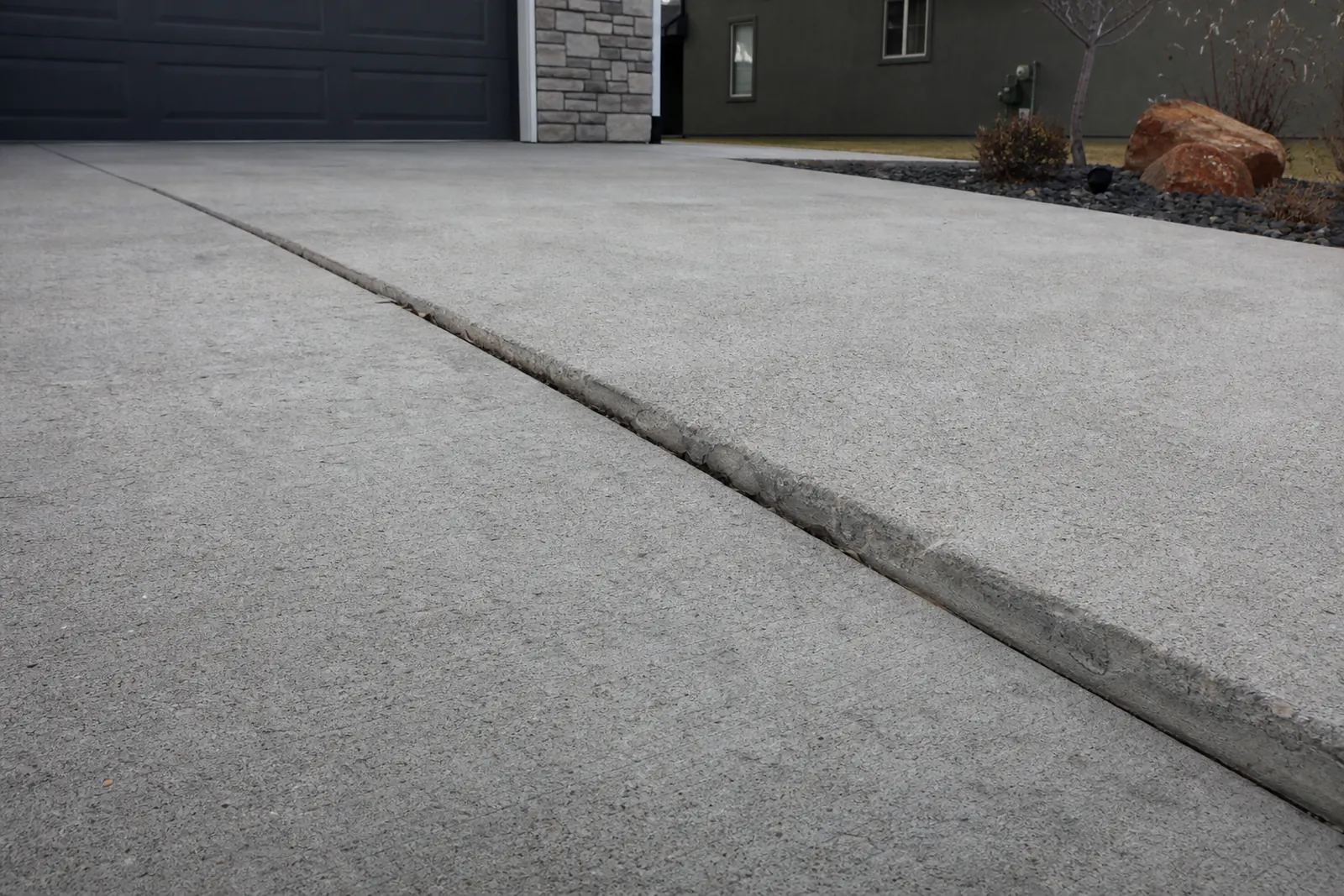
Why is my concrete cracked and sunken?
Cracks and settlement usually show up together because they have the same cause: the soil under the slab gave way in some places and not others. The slab loses support, bends under its own weight or a load, cracks, and the unsupported piece drops. Many cracked and sunken slabs can still be lifted if the pieces are large and solid. The crack itself stays, but the pieces come back into line.
Which came first?
Usually the void. Soil washes out or compresses under part of the slab, and the concrete spans the gap for a while. Eventually a vehicle, a hard freeze or just time loads that unsupported area past what it can carry. It cracks, and the piece over the void drops.
That’s why the crack pattern can tell you where the problem is underneath.
Reading the cracks
| What you see | What it usually means |
|---|---|
| One crack across a panel, one side lower | The low side lost support. Often liftable as two pieces |
| A crack near a corner, corner dropped | Soil washed out under that corner, often near water |
| Cracks running out from one spot | A concentrated load over a void, like a tire or post |
| Hairline cracks, no height change | Usually shrinkage from curing. Not a settlement problem |
| Many cracks, small pieces, crumbling | Advanced failure. Usually better replaced |
| A crack along a peak, slab humped up | Heave, not settlement. Lifting won’t fix it |
Fine hairline cracks are normal in most concrete and don’t mean it’s sinking. A crack with a height difference across it is the one to watch.
What happens if you leave it
A cracked, sunken slab usually keeps moving. Water gets into the crack and down into the void, carrying more soil away. Each piece moves on its own now, so the edges chip and the crack gets wider. A slab that’s in two clean pieces today can be in five pieces in a few years, and at that point it’s a replacement.
Can it be lifted?
Often. The questions that decide it:
- How big are the pieces? Two or three large pieces lift well. Many small ones don’t.
- Are the edges solid? Crumbling edges along the crack are a warning sign.
- Did it drop or heave? Dropped pieces can be lifted. Heaved ones can’t be pushed down.
- Is the surface sound? A slab worth saving should be in decent shape on top.
Can cracked concrete be lifted? goes through crack types in detail, and is my concrete too damaged to lift? covers the cases where it isn’t worth it.
How cracked slabs are lifted
Sunken
Concrete has settled or lost support.
Lifted
Polyurethane foam is injected beneath the slab.
Level
The slab is raised toward its proper position, and the void space is stabilized.
We place ports on both sides of the crack and inject polyurethane foam under each piece. The foam fills the void that caused the crack in the first place, then lifts the pieces together so they come back into line with each other and the slabs around them. The crack can be sealed afterward to keep water out. How foam concrete lifting works covers the process.
Lifting won’t make the crack disappear. What it does is restore support, close the height difference so it’s not a trip edge, and slow down the cycle of water getting in.
Where we see this most
- Driveways, where tires load cracked edges. See driveway leveling.
- Patios, where roof water washes out a corner. See patio leveling.
- Garage aprons, where backfill settles. See garage apron leveling.
Cracked and sunken concrete questions
Should I fix the crack or the settlement first?
The settlement. Lifting the pieces back into line and filling the void addresses the cause. The crack can be sealed afterward.
Are hairline cracks a sign of settling?
Usually not. Fine cracks with no height difference are common in concrete as it cures. A crack with one side lower is the kind that points to settlement.
Will lifting make my crack bigger?
We lift the pieces together in small steps to bring them back into line. A crack may open or close slightly as the pieces move, but the goal is to close the height difference.
When is a cracked slab too far gone?
When it's broken into many small pieces, the edges are crumbling, or the surface is failing. At that point replacement usually makes more sense.