
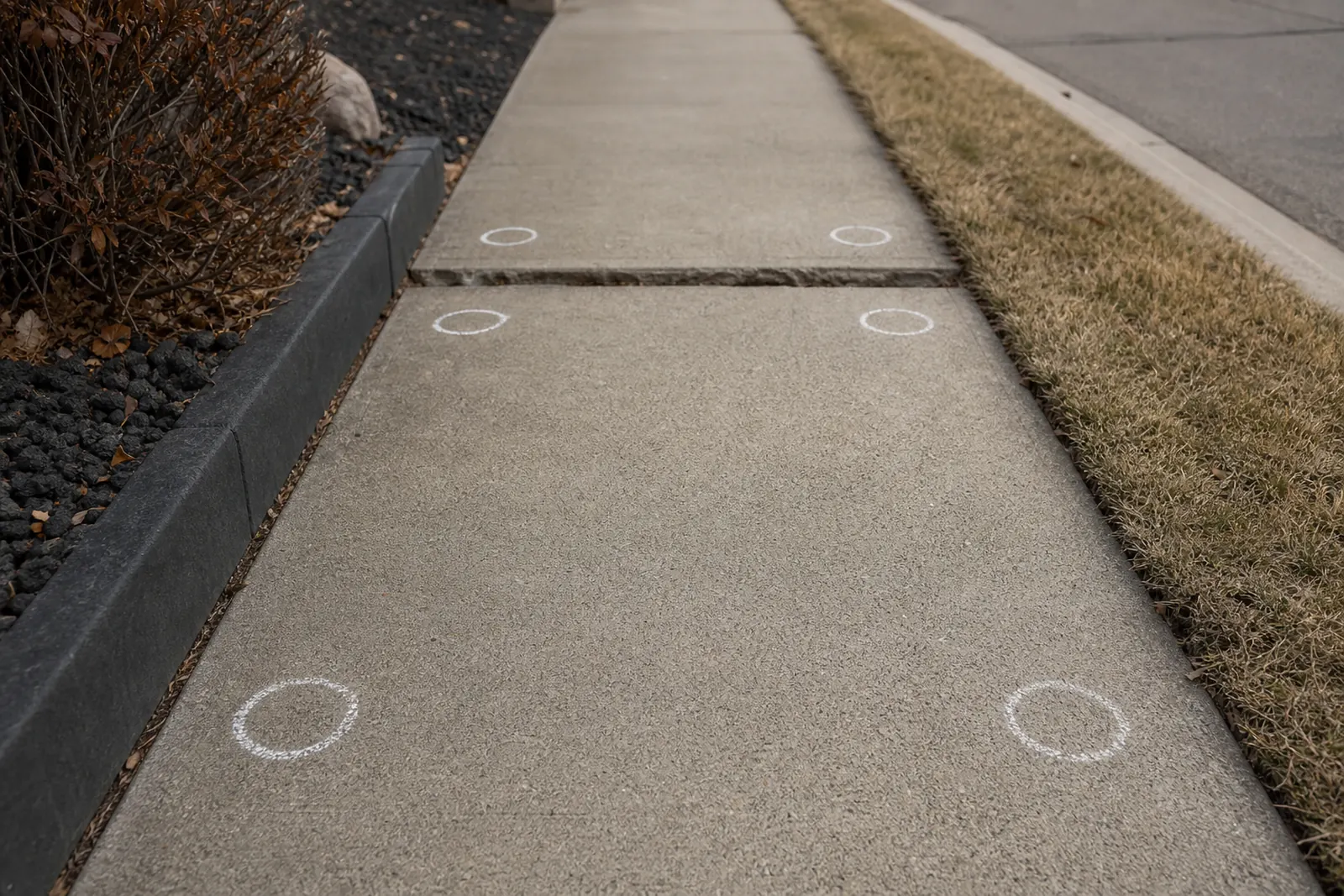
Can sunken concrete be lifted?
Often, yes. A sunken slab is usually a good candidate for lifting when it’s still in one piece or a few large, stable pieces, it moved down rather than being pushed up, the surface is in reasonable shape, and the thing that caused it to sink can be dealt with. When those four things line up, polyurethane foam can usually raise it back into line and fill the space underneath.
The four questions
These are the same four things we look at on every evaluation. You can check most of them yourself.
1. Is the slab still in one piece?
Walk over it and look closely. A slab that dropped as one unit, even if it tipped, is the best candidate. A slab with one or two cracks that leave large, solid pieces is usually fine too, since the pieces can be lifted together.
What’s not a good sign: a slab broken into many small pieces, pieces that move independently when you step on them, or crumbling along the cracks.
2. Did it go down, or up?
This is the one people often don’t think about. Lifting only raises concrete. Find something that doesn’t move, like the garage floor, the house, a curb or a slab that looks right, and compare.
- Lower than it should be: it settled. Good candidate.
- Higher than it should be: something pushed it up, usually a tree root or swelling ground. Lifting can’t lower it.
Uneven concrete has a table for telling the two apart.
3. Is the surface worth keeping?
Look at the top of the slab. Normal wear, some staining and hairline cracks are fine. But if the surface is flaking, scaling or crumbling across large areas, lifting it will just give you a level slab with a bad surface. In that case, replacement may be better value.
4. Can the cause be dealt with?
Something made the soil give way. Usually it’s water from a downspout, a sprinkler, a leak or runoff. Sometimes it’s loose fill that has mostly finished compressing. If the water can be redirected, or the settlement has slowed, a lifted slab has a good chance of staying put. If water will keep pouring into the same spot, that needs to change too.
Quick reference
| What you see | Usually |
|---|---|
| Whole slab dropped evenly | Good candidate |
| Whole slab tipped | Good candidate |
| One crack, two large solid pieces | Good candidate, lifted together |
| Several cracks, pieces still large | Often liftable, needs a closer look |
| Many small pieces, loose chunks | Usually replace |
| Humped or pushed up | Can’t be lowered by lifting |
| Crumbling surface across most of the slab | Usually replace |
| Dropped near a downspout | Liftable, and redirect the downspout |
How far can a slab be lifted?
Most jobs bring a slab back up to meet the concrete around it, whether that’s a small lip or a panel that has dropped a noticeable amount. The bigger the drop, the more empty space there usually is underneath, so it takes more foam. The limiting factor is rarely the height. It’s whether the slab can come up without cracking and whether it has something to line up with.
Slabs people are often surprised we can lift
- Steps and stoops that pulled away from the house, if they’re solid. See concrete step leveling.
- Garage aprons that dropped below the garage floor. See garage apron leveling.
- Stamped or colored patios, where lifting keeps the finish you’d lose with replacement. See patio leveling.
- Cracked driveway panels, when the pieces are big. See can cracked concrete be lifted?
Why timing matters
The same slab can be a great candidate one year and a poor one a few years later. A panel that has just started to drop usually has a modest void under it and no cracks. Leave it through a few more winters with water still running under the edge, and the void grows, the slab starts carrying weight unevenly and it cracks. A cracked slab can often still be lifted, but it’s a slower job, and a slab that breaks into many pieces can’t be.
So if you’re on the fence, it’s worth having it looked at while the answer is still an easy yes.
When the answer is no
If your slab fails one of the four questions, lifting probably isn’t the right fix. We’ll tell you that at the evaluation rather than lift something that won’t give you a good result. Is my concrete too damaged to lift? is the detailed checklist, and concrete leveling vs replacement compares the two options.
Getting a definite answer
Photos go a long way. A wide shot, a close-up of the edge with a tape measure, and a shot of any cracks will usually tell us whether it looks like a lifting job. The free evaluation confirms it on site. How concrete leveling works explains what happens from there.
Questions about lifting sunken concrete
Can a slab that sank several inches be lifted?
Often. A bigger drop usually means more void underneath and more foam, but if the slab is intact and has something to line up with, it can usually come back up.
Can you lift a slab that has been sunken for years?
Yes. Age of the settlement matters less than the condition of the slab. A slab that dropped long ago but is still whole is still a candidate.
What if only part of the slab sank?
That's very common. Ports are placed so the low part gets more foam, which brings the slab back to level.
Can I tell from photos whether it can be lifted?
Photos often give a good idea. We confirm it at the free evaluation, where we can check for voids and cracks up close.