
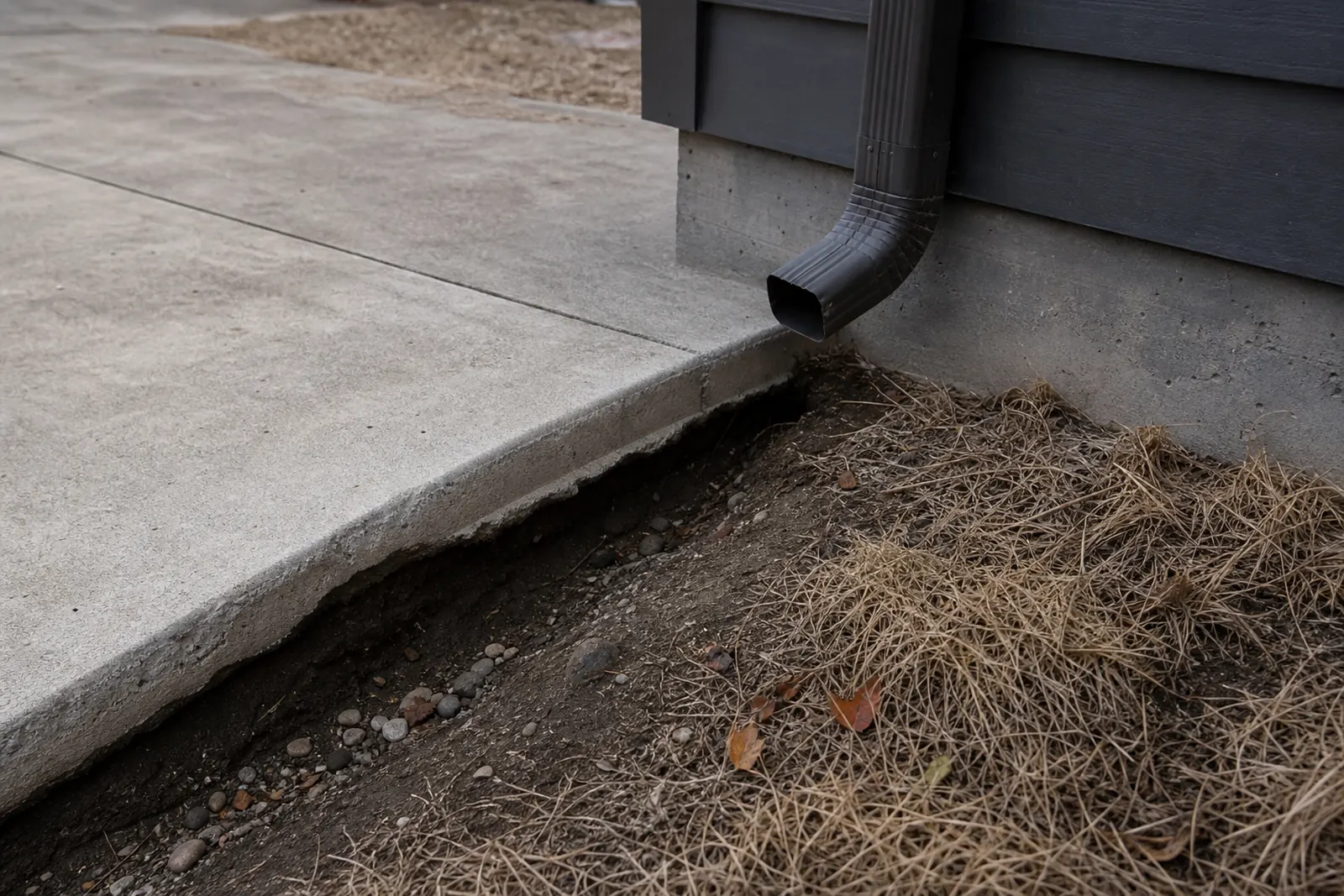
What is soil washout under concrete?
Soil washout happens when water running along or under a slab carries soil away with it, leaving empty space where the concrete used to rest. It’s one of the most common reasons slabs sink. The fix has two parts: stop or redirect the water, then fill the empty space and lift the slab back into line with polyurethane foam.
How water takes the soil
Water on its own doesn’t do much. Moving water does. Each time water runs along the edge of a slab or through a gap underneath it, it picks up fine soil particles and carries them off. One storm doesn’t make a difference. A downspout emptying at the same spot for ten years does.
Southern Idaho is dry, but around most homes the soil next to the concrete isn’t. Lawns, gardens and irrigation keep a lot of water moving right at slab edges through most of the growing season.
Common water sources
| Source | Where the washout shows up |
|---|---|
| Downspouts emptying at the slab | Corners of patios, walks and driveways near the house |
| Sprinklers spraying the concrete edge | Along sidewalks, driveways and walks next to lawns |
| Irrigation runoff | Low edges of slabs downhill of lawns and beds |
| Roof water with no gutters | A line along the slab under the eaves |
| Broken sprinkler lines or plumbing leaks | Anywhere, often with sudden settling |
| Snowmelt running off a slab | Edges and joints where water drains off |
Signs of washout
- Soil or sand washed out onto the lawn, gravel or street
- A gap under the slab edge you can see into
- The slab edge exposed where soil used to meet it
- A corner or edge that dropped near a downspout
- Hollow sounds near the edge
- Muddy water coming up through a joint
Voids under concrete covers the tap test and other ways to find empty space you can’t see.
Fix the water first
This part matters more than anything else. If water keeps running into the same spot, it will keep carrying soil out, and a lifted slab can start to lose support again next to the filled area. Before or right after lifting, it’s worth:
- Extending downspouts so they discharge away from the concrete
- Adjusting or moving sprinkler heads so they don’t spray the slab edge
- Fixing any leaks in irrigation or plumbing lines
- Sealing joints and the gap between the slab and the house
- Regrading soil so it slopes away from the slab edge instead of toward it
We’ll point out what we see at the evaluation. Most of it is simple and inexpensive, and it makes the lift last.
Then fill and lift
Sunken
Concrete has settled or lost support.
Lifted
Polyurethane foam is injected beneath the slab.
Level
The slab is raised toward its proper position, and the void space is stabilized.
Once the water is dealt with, we drill small ports over the washed-out area and inject polyurethane foam. It fills the empty space first, then lifts the slab if it has dropped. The cured foam is lightweight and doesn’t wash out the way soil does. Concrete void filling covers filling without lifting, and how foam concrete lifting works covers the full process.
Can yours be lifted?
If washout caught the slab before it broke up, the answer is usually yes. If it has been going on long enough that the slab cracked into many pieces, replacement may be the better choice. Can sunken concrete be lifted? explains how we decide. For the broader explanation of soil movement, see why does concrete sink?.
Soil washout questions
Why is soil washing out from under my driveway?
Usually water is running along or under the edge, most often from sprinklers, downspouts or runoff. Finding and redirecting that water is the first step.
Can I just backfill the washed-out edge?
Packing soil along the edge helps close the gap, but it doesn't fill space under the slab or raise it. It can wash out again if the water isn't redirected.
Does polyurethane foam wash out?
Cured polyurethane foam is a solid material and doesn't wash away the way soil does. The soil around it can still erode if water keeps running there.
Should I fix my sprinklers before or after lifting?
Either works, as long as it gets done. We'll point out any heads spraying the slab so you can adjust them.