
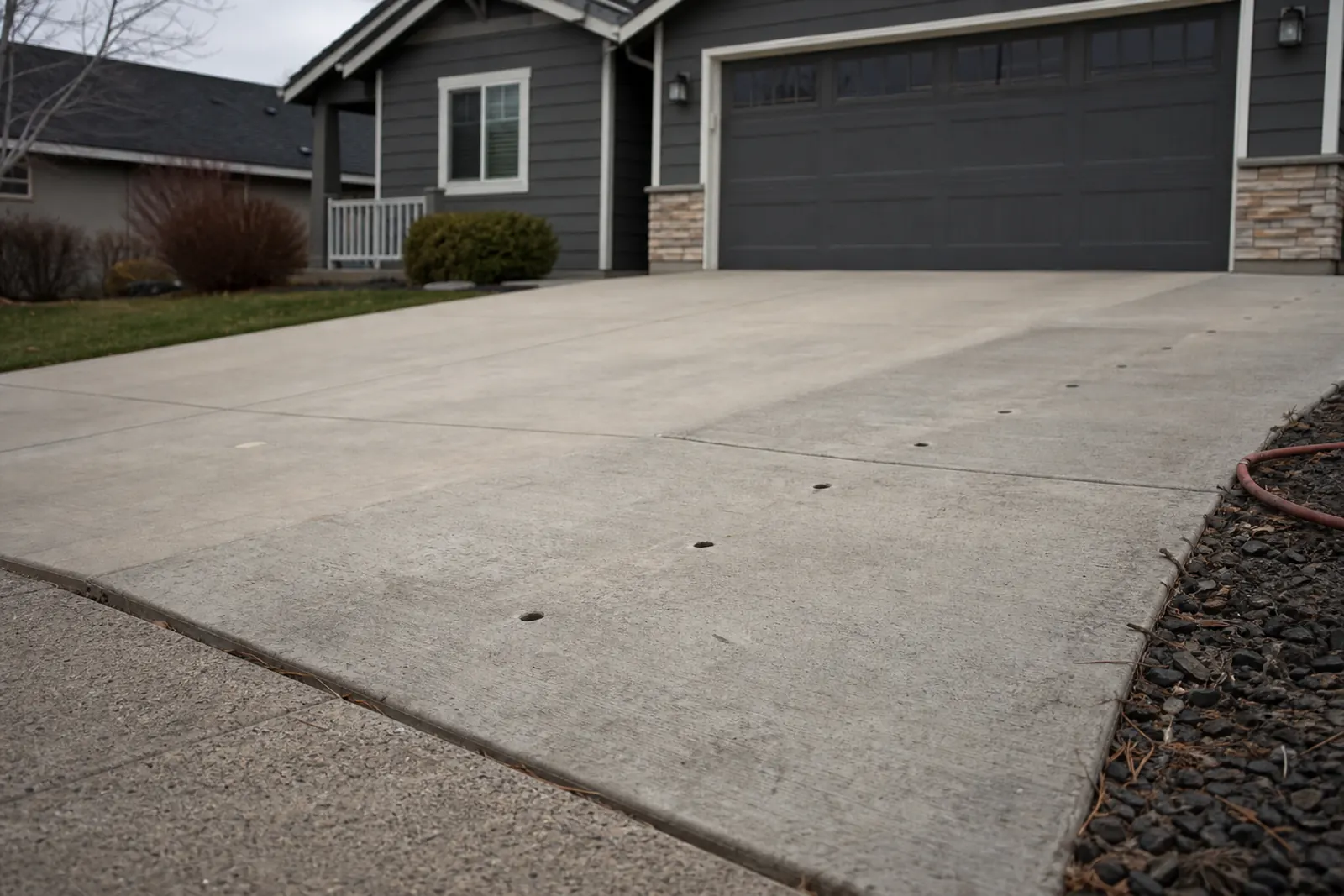
How does concrete leveling work?
From your side, it’s simple. You call or send photos, we come look at the concrete for free and tell you whether it can be lifted, you get a clear explanation of the price, and on the day of the job we drill small holes, inject polyurethane foam under the slab to fill the voids and raise it back into line, patch the holes and power wash the area. There’s no tearing out and no new concrete.
This page walks through the whole job as the property owner sees it. If you’re curious about what happens under the slab itself, how foam concrete lifting works covers that, and polyurethane concrete lifting covers the material.
1. You get in touch
Call 208-431-6379, or use the evaluation form. Tell us what you’re seeing: a panel that dropped, an edge people trip on, water pooling, a gap under the garage door. If you can, add a few photos. A wide shot of the area and a close-up of the problem spot with a tape measure in it are the most helpful.
You don’t need to know what’s causing it or what the fix should be. That’s our job.
2. The free evaluation
We come out and look at the concrete. That usually means:
- Measuring how far the slab has dropped and in which direction
- Checking whether it’s in one piece or cracked, and whether the pieces are solid
- Tapping the slab to find hollow areas
- Looking at the edges for gaps and washed-out soil
- Checking where water is coming from: downspouts, sprinklers, roof edges
- Looking at how the slab meets the house, garage, steps or street
Then we tell you what we see. The question we’re answering is the one that matters to you: can this concrete be lifted, or does it need to be replaced? If lifting makes sense, we explain what we’d do. If it doesn’t, we tell you that too, and why. Can sunken concrete be lifted? covers the criteria.
3. Pricing, explained
Every slab is different, so there’s no flat rate. Price comes down to how much concrete needs to move, how far, how much empty space is under it, and how easy it is to get to. We’ll walk you through what’s driving the number on your job. Concrete leveling cost explains each factor.
4. Getting ready for the job
There isn’t much to do, but a few things help:
- Clear the area. Move vehicles off the driveway, furniture off the patio, pots and mats off steps.
- Turn off sprinklers that hit the area for the day before and the day of the work.
- Keep pets inside while we’re working.
- Tell us about anything underground near the slab, like sprinkler lines or low-voltage lighting, if you know where it runs.
We’ll tell you if your job needs anything else.
5. The lift
Sunken
Concrete has settled or lost support.
Lifted
Polyurethane foam is injected beneath the slab.
Level
The slab is raised toward its proper position, and the void space is stabilized.
- Drill. Small ports, typically around 5/8 of an inch across, are drilled through the slab at planned spots.
- Inject. A two-part polyurethane foam is injected beneath the slab. It expands to fill the empty space first.
- Lift. As the foam keeps expanding, it raises the slab. We lift in small steps and check the level against the concrete around it, the garage floor or the house.
- Stop at level. When the slab is back in line and sloping the right way, we stop.
Most of the equipment stays nearby, with hoses run to the slab. There’s no excavation around the edges and no heavy machinery driving across your lawn in a normal lift.
6. Patch and wash down
The ports are filled and patched. Then the work area gets power washed. It’s free on every completed job, and it’s there because a finished repair should look finished.
7. After the job
Polyurethane foam cures quickly, so the slab is usually back in use soon after the work. We’ll tell you when yours is ready for foot traffic and for vehicles.
A few things help the lift last:
- Keep downspouts and sprinklers from dumping water at the slab edge
- Seal joints and the gap along the house, where water gets under the slab
- Keep an eye on the area after the first winter
How long does concrete leveling last? explains what affects how long the result holds.
When the answer is replacement
Sometimes the evaluation ends with us telling you the slab isn’t a good lifting candidate: it’s broken into too many pieces, it heaved instead of settled, or the surface is failing. We’d rather tell you that than lift something that won’t give you a good result. Concrete leveling vs replacement lays out how the two compare.
Questions about the process
Do I need to be home during the work?
Not always. We need access to the area and a way to reach you. We'll talk through it when we schedule.
Is concrete leveling loud?
Drilling the ports makes some noise for short stretches. The injection itself is fairly quiet.
Will you damage my lawn?
In a normal lift, the work is done from the slab through small holes, with hoses run from the equipment. There's no digging along the edges.
What do I need to do before the job?
Clear the area, turn off sprinklers that hit it, and keep pets inside. We'll tell you if your job needs anything else.
Can I send photos before you come out?
Yes. A wide shot and a close-up with a tape measure help us understand what's going on before the evaluation.