
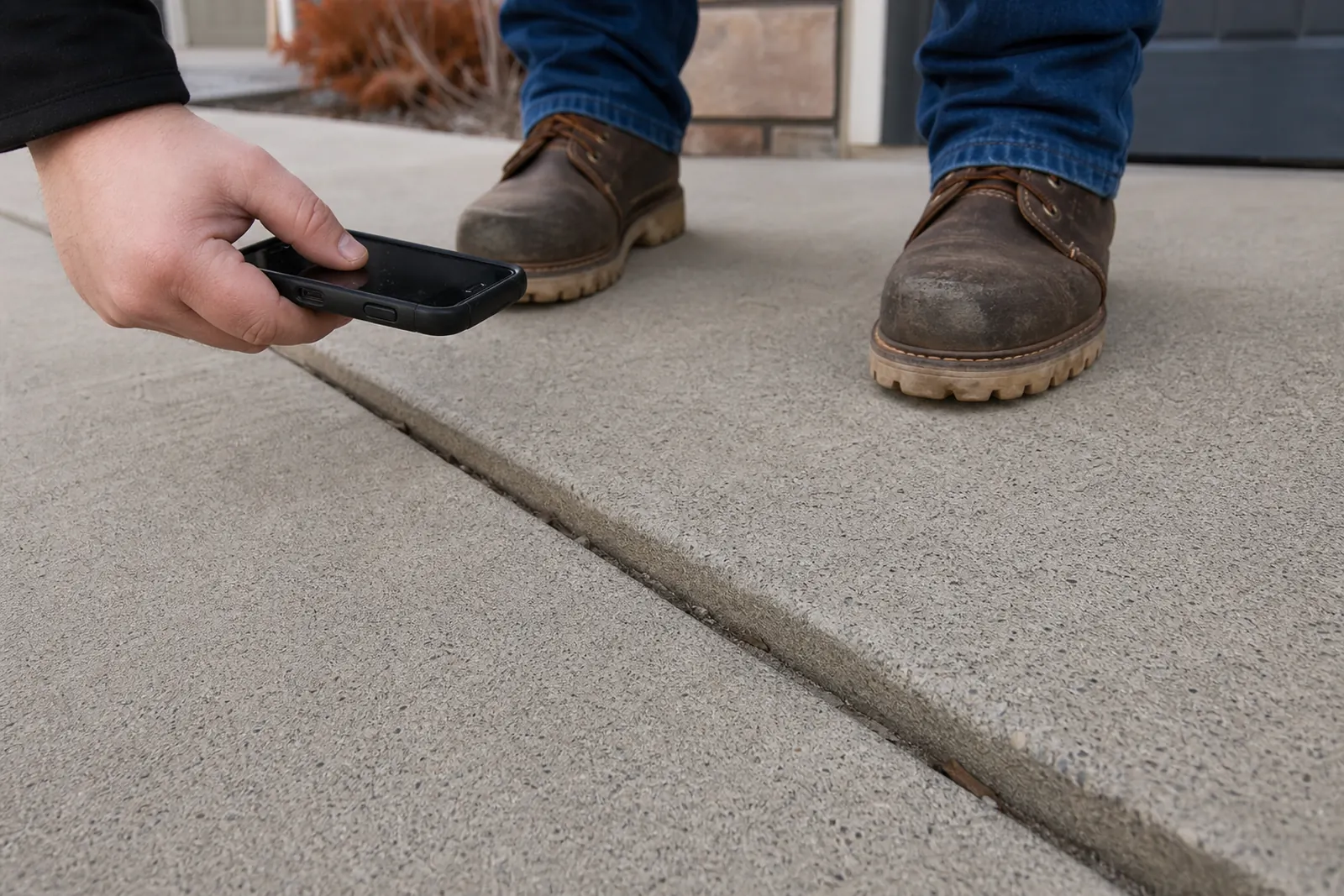
What are the signs of concrete settlement?
The most common signs are a lip or height difference between two slabs, a slab tipped so water runs the wrong way, a gap between the slab and the house or the soil, a hollow sound when you tap it, water or ice collecting in the same low spot, and cracks with one side lower than the other. A walk around your property with a tape measure and a straightedge will find most of them in about twenty minutes.
What to bring
- A tape measure
- A straight board or a level, a few feet long
- A piece of chalk or a paint marker
- Your phone, for photos
- A tennis ball or a marble, for checking which way things slope
- Something to tap with, like a hammer or the handle of a heavy screwdriver
The walk-around, in order
Start at the garage and work your way around. It’s the order that catches the most common problems first.
1. The garage door
Stand inside the garage with the door open and look at where the garage floor meets the driveway.
- Is the driveway lower than the garage floor? Measure the drop.
- Close the door. Is there a gap under the seal?
- Is the joint between the two slabs wide and open?
- After rain, does water run toward the garage?
2. The driveway
Walk down the driveway looking at each joint.
- Any lips where one panel is higher than the next?
- Any panel that looks tipped?
- Cracks with one side lower than the other?
- Gaps under the edges on the lawn side?
- A panel that thumps or moves when you drive over it?
3. The walk to the front door
- Lips at the joints, especially where the walk meets the driveway and the steps
- A section tipping toward the house
- Soil washed out along the edges next to beds
4. The front steps
- A gap between the top landing and the house wall
- A top step that’s now taller than the others
- Steps leaning away from the house or to one side
- A railing pulled loose or out of line
5. Around the house
Walk the perimeter, looking at any concrete that touches the foundation.
- Slabs sloping toward the house instead of away
- Gaps along the wall
- Downspouts emptying onto or beside concrete
- Sprinkler heads spraying slab edges
6. The patio
- Water pooling against the house after rain
- A step down from the back door that wasn’t there before
- Furniture that rocks
- Hollow sounds, especially near the house and under downspouts
7. The sidewalk
- Lips between squares
- Squares tipped toward the street or the lawn
- Squares pushed up near trees
How to measure a lip
Lay the straightedge across the joint on the higher slab so it sticks out over the lower one. Measure straight down from the bottom of the straightedge to the lower slab. Do it at both ends of the joint, since slabs often tip and the lip is bigger at one end. Take a photo with the tape in the shot.
How to check slope
Set a ball on the slab and let it go. It rolls toward the low side. On a patio or walk next to the house, it should roll away from the house. On a driveway, it should roll away from the garage. If it rolls toward the building, the slab has likely tipped.
The tap test
Tap the slab every foot or so, especially near edges, corners and joints. Solid concrete on firm soil gives a dull thud. Concrete over a void sounds hollow, a bit like a drum. Chalk-mark the hollow areas. The pattern usually lines up with an edge, a joint or a water source. Voids under concrete explains what the hollow spots mean.
Settled or heaved?
When you find a lip, figure out which slab moved. Compare to something that doesn’t move, like the garage floor, the house or a curb. If one slab is lower than it should be, it settled. If one is higher, it was pushed up, usually by a root. Uneven concrete has a table to help.
Keep a simple record
| Spot | Measurement | Date | Notes |
|---|---|---|---|
| Garage to driveway | Height of drop | Today | Gap under door? |
| Driveway joint 2 | Lip height, both ends | Today | Crack? |
| Top step to wall | Width of gap | Today | Railing loose? |
| Patio at back door | Ball rolls which way? | Today | Water after rain? |
Check the same spots after winter. If the numbers are growing, the settlement is still active. Concrete settlement explains what that means.
What to do with what you find
- Lips, tipped slabs and gaps are usually settlement, and settled slabs can often be lifted. See can sunken concrete be lifted?
- Hollow spots mean voids, which can be filled before the slab drops. See concrete void filling.
- Water sources at slab edges should be redirected regardless.
- Heaved or broken-up slabs may need to be replaced. See is my concrete too damaged to lift?
To understand what caused it, read why does concrete sink?
Questions about checking for settlement
How often should I check my concrete?
Once in spring after the freeze and thaw season is a good habit. Check again any time you notice water pooling or a new edge.
What measurement means I should call someone?
If a lip catches your foot, water runs toward the house, or a slab rocks, it's worth having it looked at, whatever the number.
Is a gap between my patio and the house a settlement sign?
Usually. It often means the patio dropped along the house where the backfill settled.
Can I send you my measurements and photos?
Yes. Photos with a tape measure in them are very helpful. Send them through the evaluation form.