
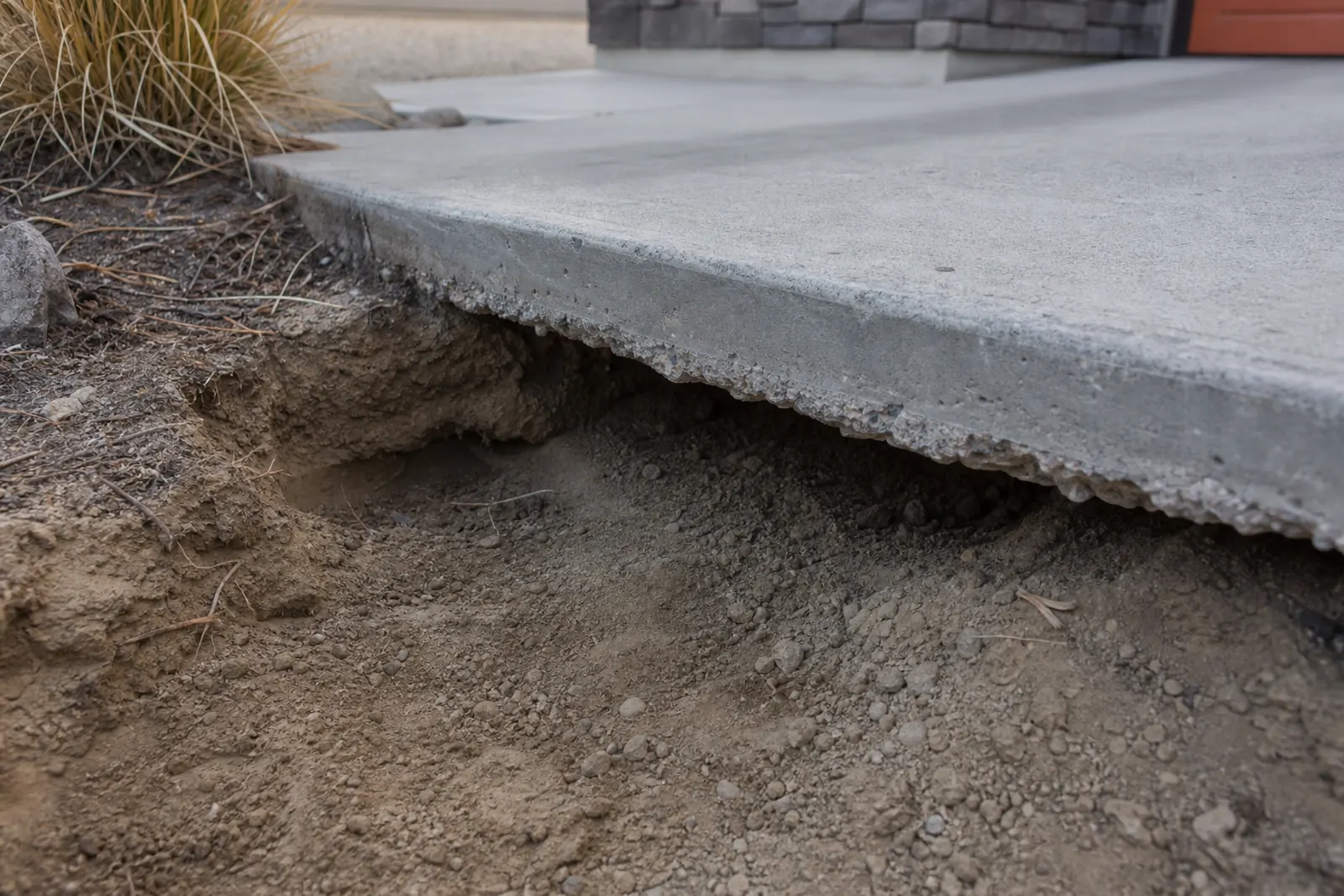
Why does concrete sink?
Concrete sinks because the soil under it gives way. The slab itself is strong, but it’s only a few inches thick and it rests on the ground. When soil under part of it compresses, washes away or loosens, that part of the slab loses support and drops. The most common causes are poorly compacted fill, water carrying soil out from under the edges, and freeze and thaw loosening the base over the winters.
A slab is a plate on the ground
It helps to picture how a driveway or patio is built. Soil is graded, sometimes a layer of gravel base is added, and concrete is poured on top. The concrete isn’t anchored to anything. It just rests there, and it’s designed to spread its load evenly over the ground underneath.
That works as long as the ground stays put. Concrete is very good at carrying weight pressed straight down on it. It’s much less good at spanning a gap. So when soil disappears from under one part of a slab, the concrete either bridges the gap for a while and then cracks, or the whole slab tips toward the low side.
Cause 1: Fill that was never compacted well
When a house is built, the ground around the foundation is dug out, the foundation is poured, and the soil is pushed back into the gap. This backfill is looser than the undisturbed ground farther out. If it’s placed and compacted in thin layers, it stays fairly firm. If it’s pushed in all at once, it keeps settling under its own weight for years.
The same thing happens over utility trenches for water, sewer, gas and electric lines, and on lots that were built up with fill.
Where it shows up: garage aprons, front steps, patios and walks right next to the house, and any slab crossing a trench. Driveway sinking near the garage is the classic example.
Cause 2: Water carrying soil away
This is the big one. Moving water picks up fine soil particles and carries them off. Every time water runs along the edge of a slab or through a gap under it, a little more soil leaves.
The usual sources:
- Downspouts emptying at slab edges
- Sprinklers spraying concrete edges
- Runoff from lawns, beds and the street
- Roof water dripping in a line from eaves without gutters
- Leaking irrigation lines and plumbing
- Snowmelt running off and under slabs
In a dry climate like southern Idaho’s, you might not expect water to be the main culprit. But yards here are watered heavily through the growing season, and much of that water ends up at concrete edges. Soil washout under concrete covers the fixes.
Cause 3: Freeze and thaw
When water gets into the soil under a slab and freezes, it expands. When it thaws, the soil doesn’t always settle back the way it was. Each cycle leaves the base a little looser and a little more open, which lets more water in next time. Over several winters, this can loosen the support under edges and joints enough for slabs to shift.
Where it shows up: areas that stay wet into winter, like low spots, shaded sides of the house and slab edges next to irrigated lawns.
Cause 4: Soil that changes with moisture
Some soils behave differently wet and dry. Fine, silty soils can lose strength when they get wet and pack down further under a load. That’s part of why one slab near a sprinkler settles while another a few feet away, on the same soil, doesn’t move at all.
Cause 5: Load in the wrong place
Vehicles on driveway edges, a hot tub on a patio corner, or equipment rolling onto a shop apron all push down hardest on the parts of a slab where support is often weakest. On their own, loads rarely sink a slab on firm soil. Combined with any of the causes above, they make it happen faster.
Cause 6: Animals and decay
Burrowing animals can remove soil under slab edges. Buried organic material, like old roots or construction debris left in fill, can decay and leave empty space behind.
The opposite problem: heave
Not all uneven concrete sank. Sometimes a slab is pushed up. Tree roots growing under a sidewalk or driveway are the most common cause. Soil that swells when wet can do it too.
This matters because the fix is different. Lifting raises concrete. It can’t lower a slab that was pushed up. Uneven concrete explains how to tell settled concrete from heaved concrete.
Why it usually gets worse
Settlement tends to feed itself. A slab that dropped leaves a low spot that collects water, or a gap at the edge that lets water in. That water carries away more soil. The slab now rests on uneven support, which is how cracks start. Concrete settlement describes how it progresses.
What to do about it
Sunken
Concrete has settled or lost support.
Lifted
Polyurethane foam is injected beneath the slab.
Level
The slab is raised toward its proper position, and the void space is stabilized.
The fix usually has two parts: deal with the cause, and restore support under the slab. Redirecting downspouts and sprinklers, sealing joints and regrading soil take care of the first part. Lifting the slab with polyurethane foam takes care of the second, filling the empty space and raising the concrete back into line. How foam concrete lifting works explains the process, and can sunken concrete be lifted? explains when it makes sense.
For the service itself, see concrete leveling, or go straight to your slab: driveways, sidewalks, patios or steps.
Questions about why concrete sinks
Is sinking concrete a sign of bad concrete?
Usually not. The concrete is typically fine. The soil under it moved.
Why does concrete sink more near the house?
The soil right next to the foundation is backfill from construction, which is looser than undisturbed ground. Roof water lands there too.
Can new concrete sink?
Yes. If it was poured over loose fill or water keeps washing soil out, new concrete can settle just like old concrete.
Does a dry climate mean less settling?
Not necessarily. Irrigated yards put a lot of water at slab edges, and that's what moves soil.