
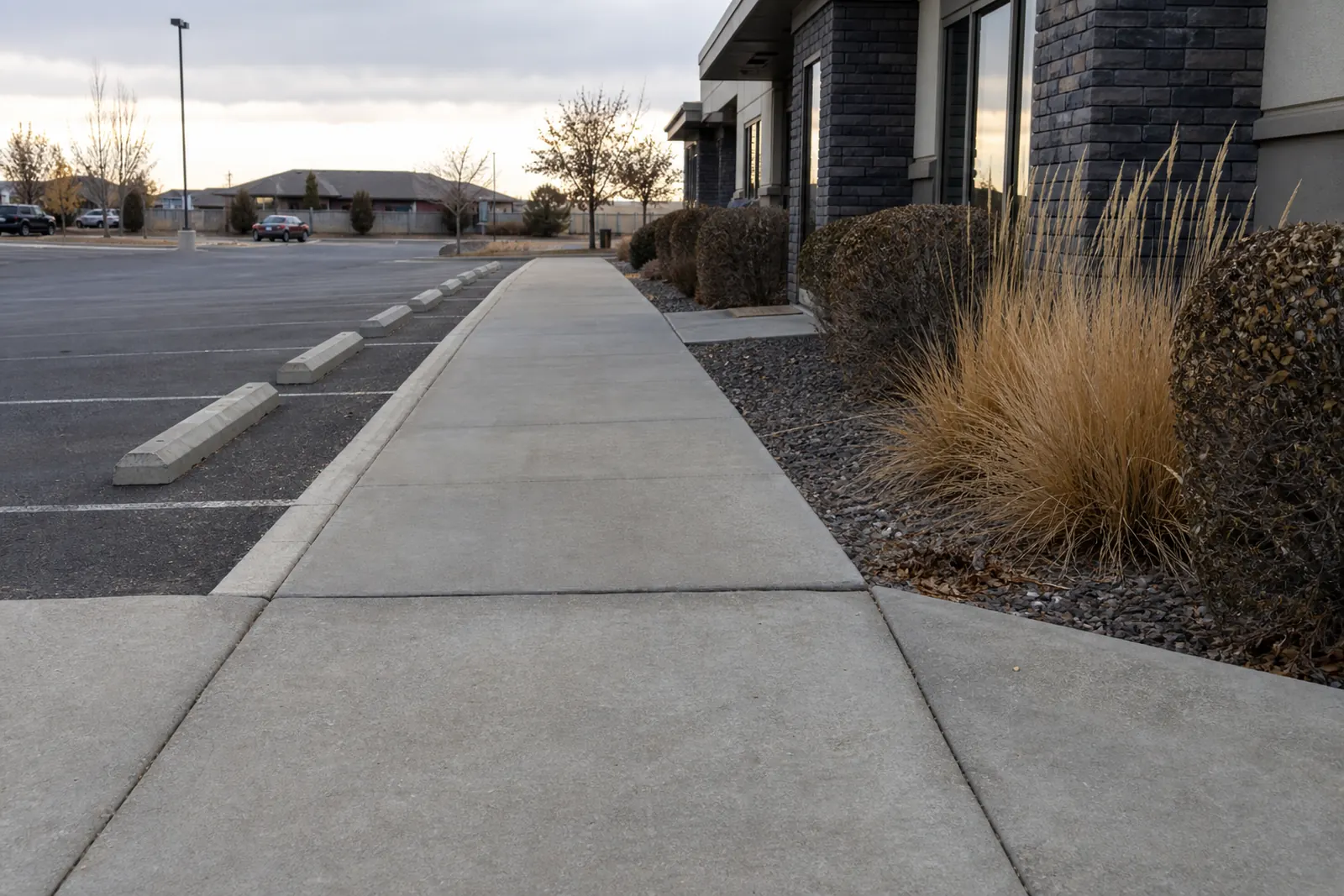
Can walkways at a commercial property be leveled?
Yes, in most cases. Walkways from the parking lot to the entrance, between buildings, and around office, clinic and church campuses settle the same way residential walks do. If the sections are still intact, polyurethane foam can lift them back in line one section at a time, so the rest of the property stays open. Broken or heaved sections are the exception.
The walkways we mean
This page is about walks inside a property, not the public sidewalk along the street, which is covered on commercial sidewalk leveling. Think of:
- Walks from the parking lot to the main entrance
- Paths between buildings on an office park, clinic or school campus
- Walks along the side of a building to a back entrance or dumpster enclosure
- Routes from accessible parking spaces to the door
- Walks around churches, community buildings and event spaces
Why they settle
Commercial walkways often run right alongside buildings, where roof drains and downspouts discharge, and next to landscaped islands that are irrigated for most of the season. They cross utility trenches and sit on fill that was placed when the site was graded. Delivery carts, maintenance vehicles and snow equipment add load at the edges. Put together, it’s common to find several sections that have tipped or dropped across a large property.
Soil washout under concrete and voids under concrete explain what’s going on underneath.
What to watch for
- Edges between sections where people catch their feet
- Walks tipping toward the building, sending water at the wall or doors
- Standing water or ice in the same spot every winter
- Sections that rock or clunk under carts
- Gaps under walk edges beside landscaped islands
- A lip where a walk meets a curb ramp or the parking lot
Routes from accessible parking are worth special attention, since an edge there affects the people least able to step over it.
How the work fits around your property
| Concern | How we handle it |
|---|---|
| Keeping routes open | Work one section or one route at a time |
| Staff and visitors | Mark off the work area and keep the equipment nearby |
| Timing | Plan the order and timing around your hours |
| Mess | No demolition or new concrete. The area is washed down when we finish |
| Back in use | Foam cures quickly, so sections usually reopen soon after the work |
Lift or replace?
We’ll walk every route with you and sort the sections into three groups: lift now, watch, and replace. Sections that are still in one piece or a few large pieces and moved down are usually good lifting candidates. Sections that are broken up, crumbling or pushed up by roots aren’t. Can sunken concrete be lifted? explains the criteria.
If you need to take the information to an owner, a board or a facilities budget, tell us and we’ll talk through what would help.
Fix the water too
On commercial sites, the water source is often obvious once you look: a downspout emptying onto the walk, an irrigation zone that overshoots, a roof drain with no splash block. Redirecting it helps the lift hold. We’ll point out what we see.
Getting started
The evaluation is free. The general commercial side is on commercial concrete leveling, and the process is on how concrete leveling works.
Commercial walkway questions
Can you prioritize the worst sections first?
Yes. We'll walk the property with you and sort sections by what needs attention now and what can wait.
Do you work on church and school properties?
Yes. Walkways at churches, schools and community buildings settle the same way, and we can plan the work around events and schedules.
Can a walk that sends water at the building be fixed?
If it tipped because it settled, lifting the low edge usually restores the slope away from the building.
Will lifting affect a curb ramp?
We lift walk sections to meet ramps and curbs cleanly. If the ramp itself has failed, that's a replacement job.