
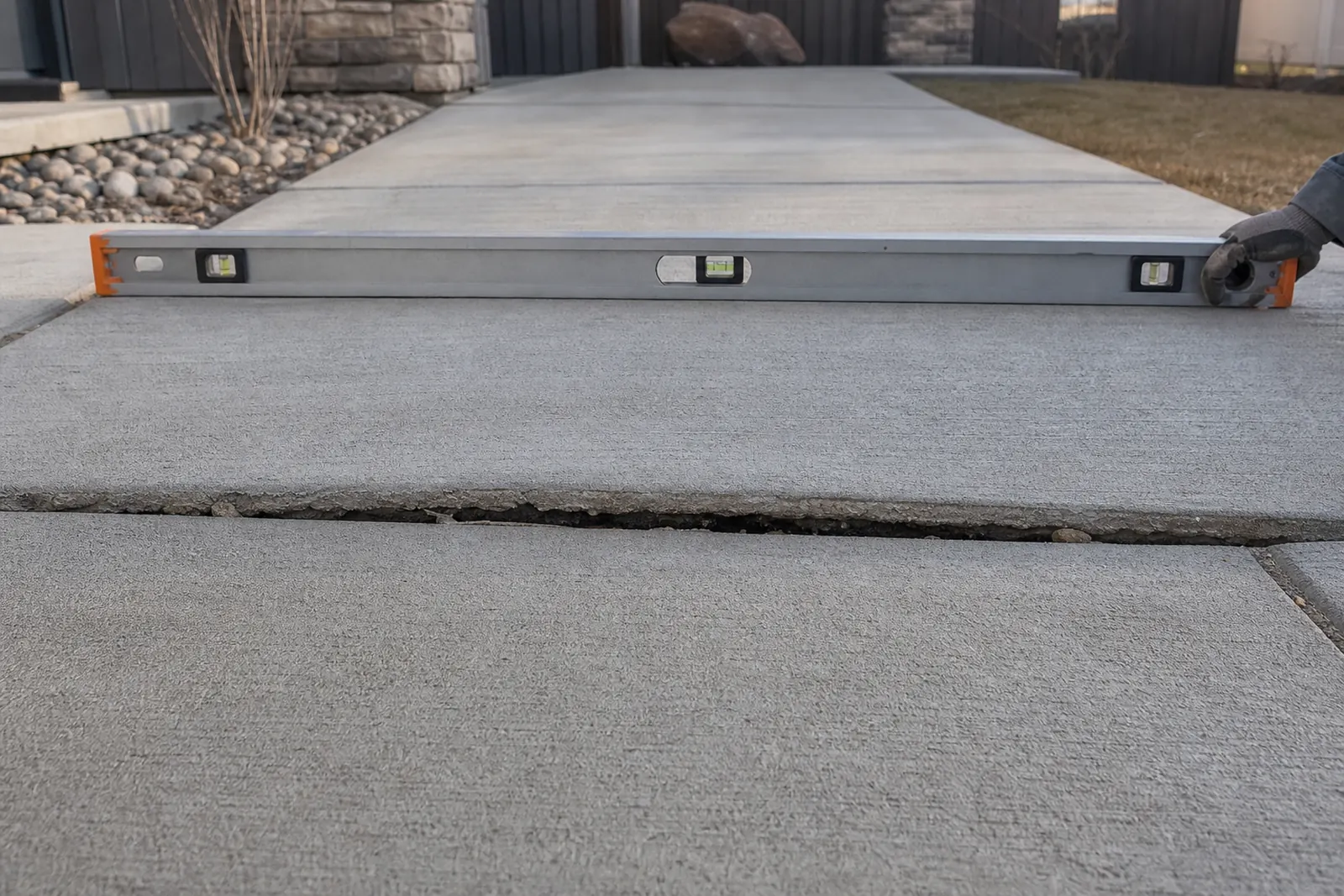
What is slab stabilization?
Slab stabilization puts solid support under concrete that rocks, flexes or keeps shifting, so it stops moving. We inject polyurethane foam beneath the slab to fill the soft or empty spots it’s resting on. Sometimes that includes lifting the slab back into line. Sometimes the slab is roughly where it should be and just needs to stop moving.
Movement you can feel
A settled slab is one you can see. An unstable slab is often one you feel first.
- A sidewalk or walkway section that rocks when you step on one corner
- A driveway panel that thumps or clunks when a car rolls over the joint
- A slab that moves a little more each season, then settles again
- Cracks that keep opening and closing
- Water or fine soil pumping up through a joint after a vehicle passes
- A patio that sits level most of the year but shifts in spring
That pumping is a telling sign. Every time the slab moves, it pushes water and fine soil out through the joint, which makes the empty space under it bigger. The slab can move more each time.
Why slabs keep moving
A slab is stable when the soil under it is firm and in full contact with the concrete. It becomes unstable when that contact is lost in some spots and not others. The concrete then rests on high points and bridges over low points. Load it in the wrong place and it rocks.
Common causes are water washing soil out from under one side, fill that compresses unevenly, and freeze and thaw loosening the base each winter. Concrete settlement explains how slabs move over time, and soil washout under concrete covers the water side.
Stabilize, lift or both
| What the slab is doing | What usually helps |
|---|---|
| Rocks but is still at the right height | Fill the voids to stabilize it without lifting |
| Dropped and rocks | Fill and lift back into line in one step |
| Moves under vehicles at joints | Fill under the joint edges on both panels |
| Keeps moving every season | Stabilize, and deal with the water source that keeps washing soil out |
| Pushed up by roots or swelling ground | Lifting and filling won’t correct heave. Replacement or root work may be needed |
How slab stabilization works
Sunken
Concrete has settled or lost support.
Lifted
Polyurethane foam is injected beneath the slab.
Level
The slab is raised toward its proper position, and the void space is stabilized.
We drill small ports over the areas where the slab has lost support, typically around the edges, corners and joints. Polyurethane foam is injected and expands into the empty space, filling it and pressing up against the underside of the concrete. When a slab only needs stabilizing, we watch it closely and stop before it starts to lift. When it also needs to come up, we continue into a controlled lift.
The foam hardens into a lightweight, solid layer between the soil and the slab, so the concrete rests on even support again. Ports are patched and the area is power washed before we leave. How foam concrete lifting works covers the steps in more detail.
Why stabilizing early is worth it
A slab that rocks is carrying weight on a few points instead of across its whole surface. That’s how cracks start. It’s also how a small void turns into a big one, because every movement pumps a little more soil out. Stabilizing the slab while it’s still in one piece usually means a smaller job than lifting it after it has cracked and dropped.
When stabilization isn’t enough
If the slab is broken into many pieces, stabilizing it just holds the pieces in place. If the ground is being pushed up, not washed out, foam won’t stop that. And if water keeps pouring into the same spot, the soil next to the filled area can keep eroding. If we think your slab is past the point where stabilizing makes sense, we’ll tell you. Is my concrete too damaged to lift? walks through the signs.
What affects the cost
The amount of void under the slab, how many areas need attention, whether lifting is also needed and how easy the area is to reach. The evaluation is free, and concrete leveling cost explains each factor.
Slab stabilization around the Magic Valley
We stabilize and lift slabs in Twin Falls and the surrounding towns.
Slab stabilization questions
What's the difference between stabilizing and lifting?
Stabilizing fills the empty space so the slab stops moving. Lifting goes further and raises it back into line. Many jobs need both.
Why does my driveway panel thump when I drive over it?
Usually the edge at the joint has lost support, so it rocks under the tire. Filling under that edge typically stops the movement.
Can a slab be stabilized if it's cracked?
If the pieces are large and solid, yes. Stabilizing holds them on even support. If the slab is broken into many small pieces, replacement may be the better choice.
What's the water coming up through the joint?
That's called pumping. When the slab moves under weight, it pushes water and fine soil out through the joint, which enlarges the void underneath. It's a sign the slab needs support.