
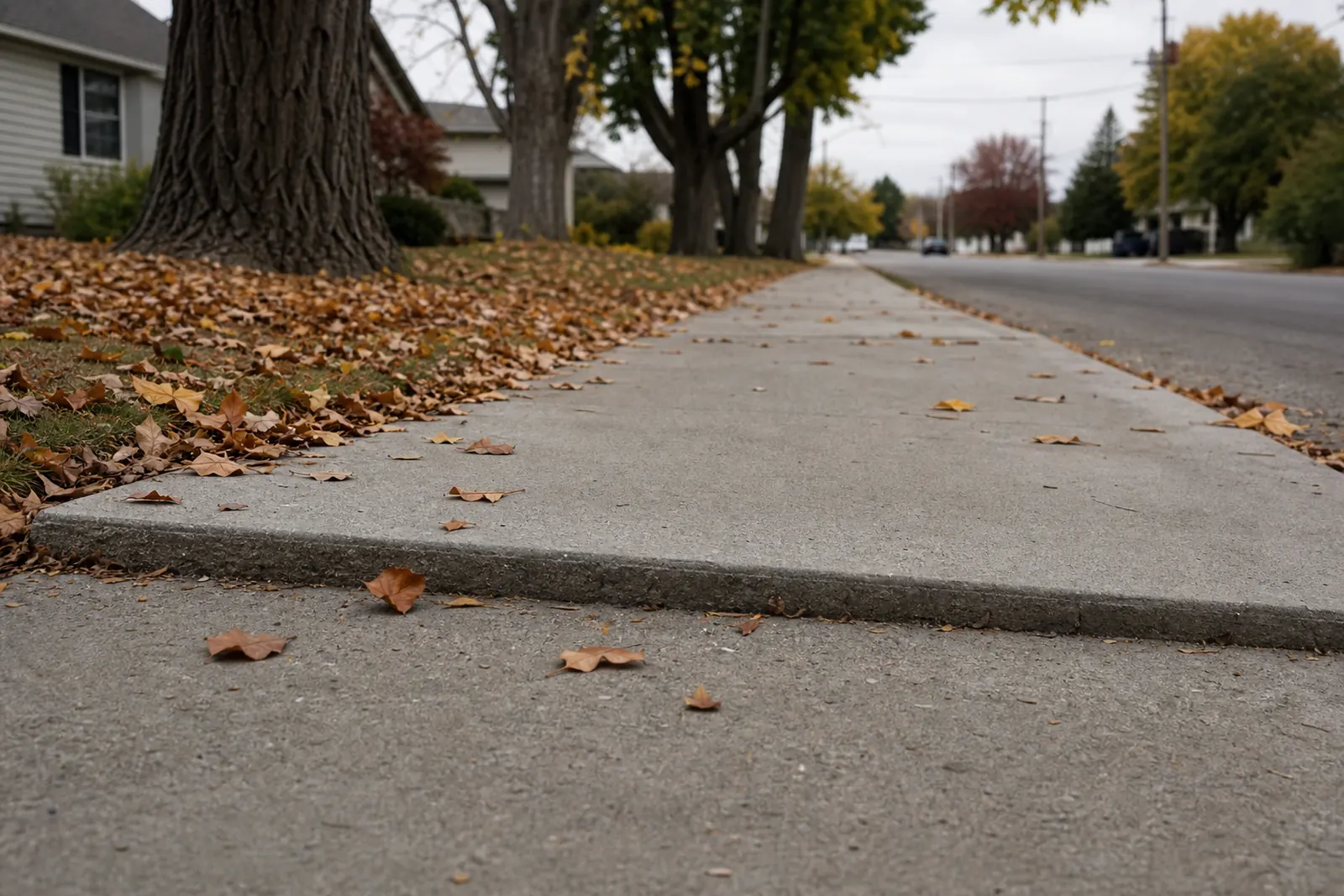
Can a sunken sidewalk be raised instead of replaced?
Usually. When one sidewalk square drops or tips and leaves a raised edge, polyurethane foam can often lift it back in line with the squares beside it. That removes the lip people catch their toes on and puts support back under the slab. If the square is shattered or has been pushed up by a tree root, it’s a replacement job, and we’ll say so.
The sidewalk problem most people notice first
Sidewalks tend to fail one square at a time. The concrete itself is usually fine. What changed is the ground under one square, and that square drops a little lower than the one next to it.
That leaves a lip. At first it’s a quarter inch you barely notice. A few winters later it’s the edge the mail carrier warns you about, or the spot where a neighbor’s kid went down on a scooter. Nothing about the sidewalk looks broken, but it’s no longer safe to walk without watching your feet.
- One square sits lower than the next and leaves an edge
- A square has tipped so one side is high and the other low
- The sidewalk has dropped away from the driveway or the curb
- Water sits in one square after rain or sprinklers
- A gap has opened under the edge of a square along the lawn
- The joint between two squares keeps getting wider
Why sidewalks settle
Sidewalks are thin slabs laid on fill between a lawn and a street, which puts them in a tough spot. Water is the usual problem. Lawn sprinklers soak one edge, runoff from the street hits the other, and fine soil gets carried out from under the concrete over time. Once there’s a gap, the square has nothing under it and drops the next time it’s loaded.
Poor compaction when the sidewalk was poured, utility trenches that were backfilled under it later and freeze and thaw cycles all play a part too. If you want the longer explanation, why does concrete sink? covers it.
Sunk or pushed up?
This matters more than anything else on a sidewalk. A square that sank can usually be lifted. A square that was pushed up by a tree root can’t be pulled down by lifting. In that case, lifting the neighbors to meet it is sometimes possible, but often the right answer is removing the root problem and replacing that section. Uneven concrete explains how to tell the difference.
Who is responsible for the sidewalk?
In many cities, including many in Idaho, the owner of the property beside a public sidewalk is expected to keep it in repair, even though the sidewalk sits in the public right of way. Rules differ from city to city, so if you’re unsure, your city’s public works department can tell you what applies to your street.
Whoever owns the problem, a trip edge is worth dealing with before someone gets hurt. Lifting is often the quickest way to fix it without a full tear-out. For offsets specifically, concrete trip hazards goes into measuring them and the options for each.
How a sidewalk gets lifted
Sunken
Concrete has settled or lost support.
Lifted
Polyurethane foam is injected beneath the slab.
Level
The slab is raised toward its proper position, and the void space is stabilized.
- Look. We check how far each square has moved, which direction, whether anything is cracked, and where water is coming from.
- Lift. Small ports are drilled in the low square. Polyurethane foam goes in underneath, fills the empty space and raises the slab gradually.
- Level. We stop when the square is back in line with its neighbors, so the edge is gone and the walking surface is even.
- Wash down. The ports are patched, and the sidewalk and work area get power washed before we leave.
Because there’s no new concrete to cure, a sidewalk usually goes back into use much sooner than a replaced one. We’ll tell you when yours is ready. The full picture is on how foam concrete lifting works.
When a sidewalk square should be replaced
Lifting isn’t the answer for every square. Replacement usually makes more sense when:
- The square is broken into several small pieces
- A tree root has pushed it up
- The surface is crumbling or badly scaled
- The city requires a specific repair method for that stretch
We’ll show you which squares can be lifted and which can’t, so you’re only replacing what actually needs it. Concrete leveling vs replacement compares the two.
What affects the cost
Sidewalk jobs are usually priced on how many squares need lifting, how far they’ve dropped, how much empty space is underneath and how many squares need to move together. The evaluation is free, and concrete leveling cost explains each factor.
Running a business or managing a rental? Commercial frontage has its own considerations, covered on commercial sidewalk leveling.
Sidewalk leveling around the Magic Valley
We lift sidewalks in Twin Falls and the surrounding towns.
Sidewalk leveling questions
Can you lift just one sidewalk square?
Yes. Many sidewalk jobs are one or two squares that dropped. We lift the low square to meet the ones beside it.
A tree root pushed my sidewalk up. Can you fix that?
Lifting can't lower a slab that was pushed up. Sometimes the squares around it can be raised to meet it, but often that section needs the root dealt with and new concrete.
How small a lip is worth fixing?
If people are catching their feet on it, it's worth fixing. Even a small edge can trip someone, and settled squares tend to keep dropping if the cause isn't addressed.
Will the lifted sidewalk look different?
It's the same concrete, so the color and finish stay as they were. You'll see a few small patched holes where the foam went in.
Is sidewalk lifting different from grinding the edge down?
Grinding shaves the raised edge off but leaves the low square where it is, with whatever gap is under it. Lifting raises the low square and fills the space underneath.