
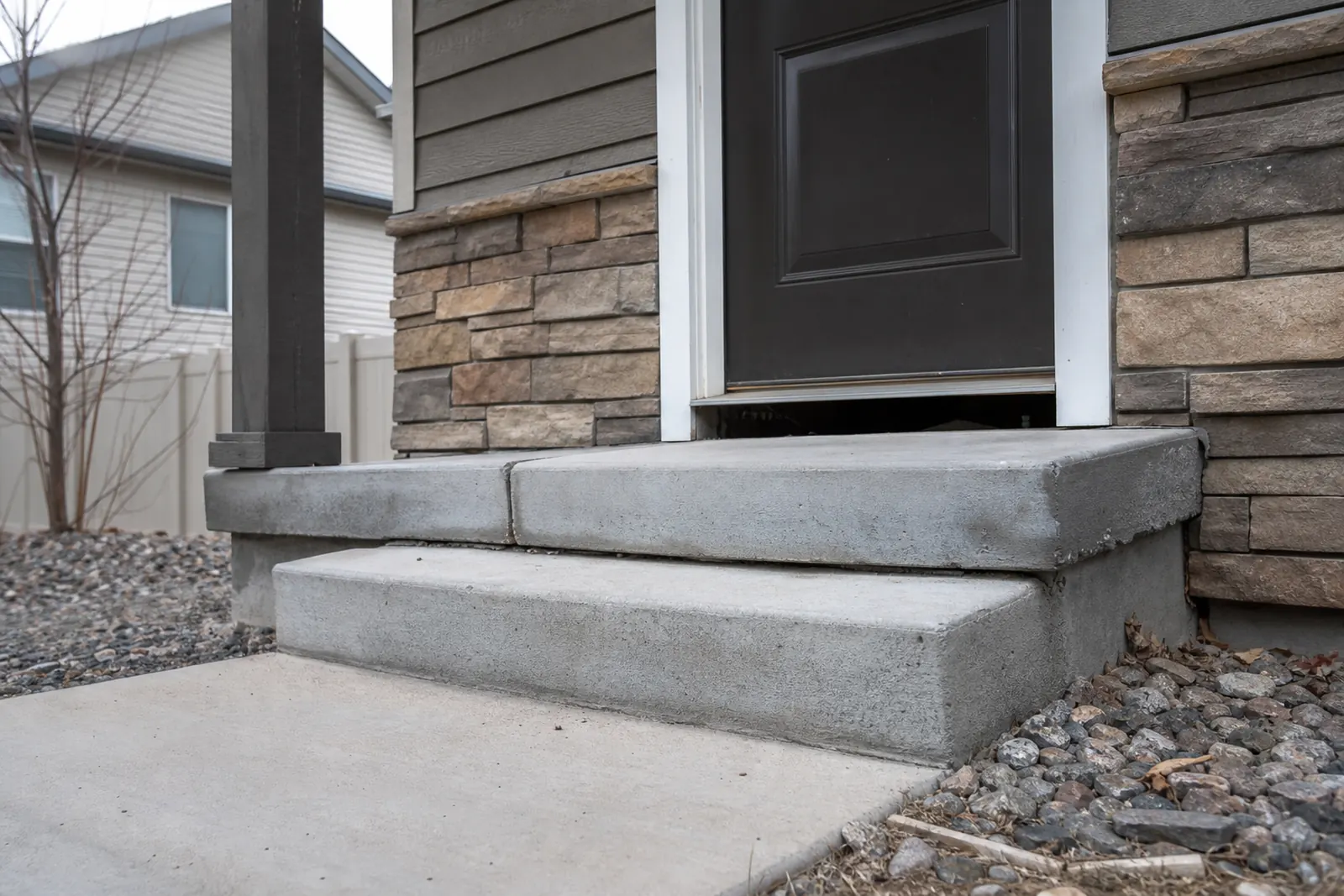
Can concrete steps that pulled away from the house be lifted?
In many cases, yes. Concrete steps and front stoops are heavy blocks that often sit on backfill right next to the foundation. When that soil settles, the whole unit tips away from the house or drops below the door. If the steps are still solid, polyurethane foam can often lift them back up against the house and fill the space that let them sink.
Signs your steps or landing have moved
Steps settle differently from flat slabs. Because they’re one heavy piece, they tend to lean rather than crack straight across.
- A gap between the top landing and the house wall
- The top step is now lower than the door threshold, so the first step out is bigger
- The steps lean away from the house or to one side
- The railing has pulled loose or no longer lines up
- Water runs toward the door instead of off the landing
- A crack where the landing meets a walkway or patio
That gap against the house matters more than it looks. Water and snowmelt go straight down it, right against the foundation, and the soil under the steps keeps washing out.
Why steps sink and lean
The ground right next to a house foundation is backfill. It was dug out when the foundation went in and pushed back in afterward, often without much compaction. A set of concrete steps is a lot of weight sitting on that loose fill, and over the years it compresses. Gutters that overflow above the door and downspouts nearby make it worse by keeping that soil wet.
Because the house itself sits on footings that don’t move, the steps drop while the doorway stays put. That’s why the gap opens against the wall. Signs of concrete settlement covers what to watch for on the rest of the property too.
Can every set of steps be lifted?
It depends on how they were built. We check this first.
| How the steps were built | What it usually means |
|---|---|
| Solid poured steps and landing | Usually a good candidate for lifting as one unit |
| Steps poured with the landing and a walkway | Often lifted together so the joints line up |
| Hollow steps or steps with a void inside | We look closely. The foam may need to fill the inside before it can lift |
| Steps tied into the foundation | May not move without cutting them free, which changes the job |
| Steps crumbling or broken into pieces | Usually better replaced |
How step leveling works
Sunken
Concrete has settled or lost support.
Lifted
Polyurethane foam is injected beneath the slab.
Level
The slab is raised toward its proper position, and the void space is stabilized.
- Look. We measure the gap at the wall, the height at the door and how far the steps lean, and check how they’re built and what’s holding them.
- Lift. Small ports go into the landing and steps, and polyurethane foam fills the empty space beneath them.
- Level. As the foam expands, the steps rise and rotate back toward the house. We lift in small steps and check against the threshold and the wall.
- Wash down. The ports are patched and the steps and entry area are power washed before we leave.
Once the steps are back against the house, the joint at the wall can be sealed to keep water from running down it again. That’s often the most important part for the long run. See how foam concrete lifting works for more on the process itself.
Why this matters at the front door
Steps are where people carry groceries, bring kids in and go out in the dark in winter. A top step that’s suddenly an inch or two taller than the rest is the kind of thing people miss. It’s also where visitors and delivery drivers form their first impression of the property. Getting the steps back to even risers and tight against the house is one of the more satisfying lifts we do.
When new steps make more sense
If the concrete is spalling, the edges are breaking off or the steps are cracked through in several places, lifting won’t give you a good result. New steps may also be the right call if you want a different shape, a wider landing or a different number of risers. If that’s what we see, we’ll let you know before anything is drilled. When should concrete be replaced? goes through the reasons.
What affects the cost
Size and weight of the steps, how far they’ve moved, how much void is under them and whether a walkway or patio needs lifting with them. The evaluation is free. Concrete leveling cost explains each factor.
Step leveling around the Magic Valley
We lift steps and landings in Twin Falls and the surrounding towns.
Concrete step questions
Can you close the gap between my steps and the house?
If the steps pulled away because they settled, lifting them usually rotates them back toward the wall and closes most of the gap. Sealing the joint afterward helps keep water out.
Will lifting the steps affect my railing?
The railing moves with the steps. If it's anchored to both the steps and the house, it may need to be loosened before the lift and refastened afterward.
Are precast steps liftable?
Often. Precast step units are heavy single pieces, and if they're sound they can usually be lifted like poured steps. We'll look at how they're set first.
My top step is higher than the others now. Is that from settling?
Usually it's the reverse: the steps dropped while the door stayed put, so the first step down from the threshold got taller. Lifting the steps brings that riser back toward the others.