
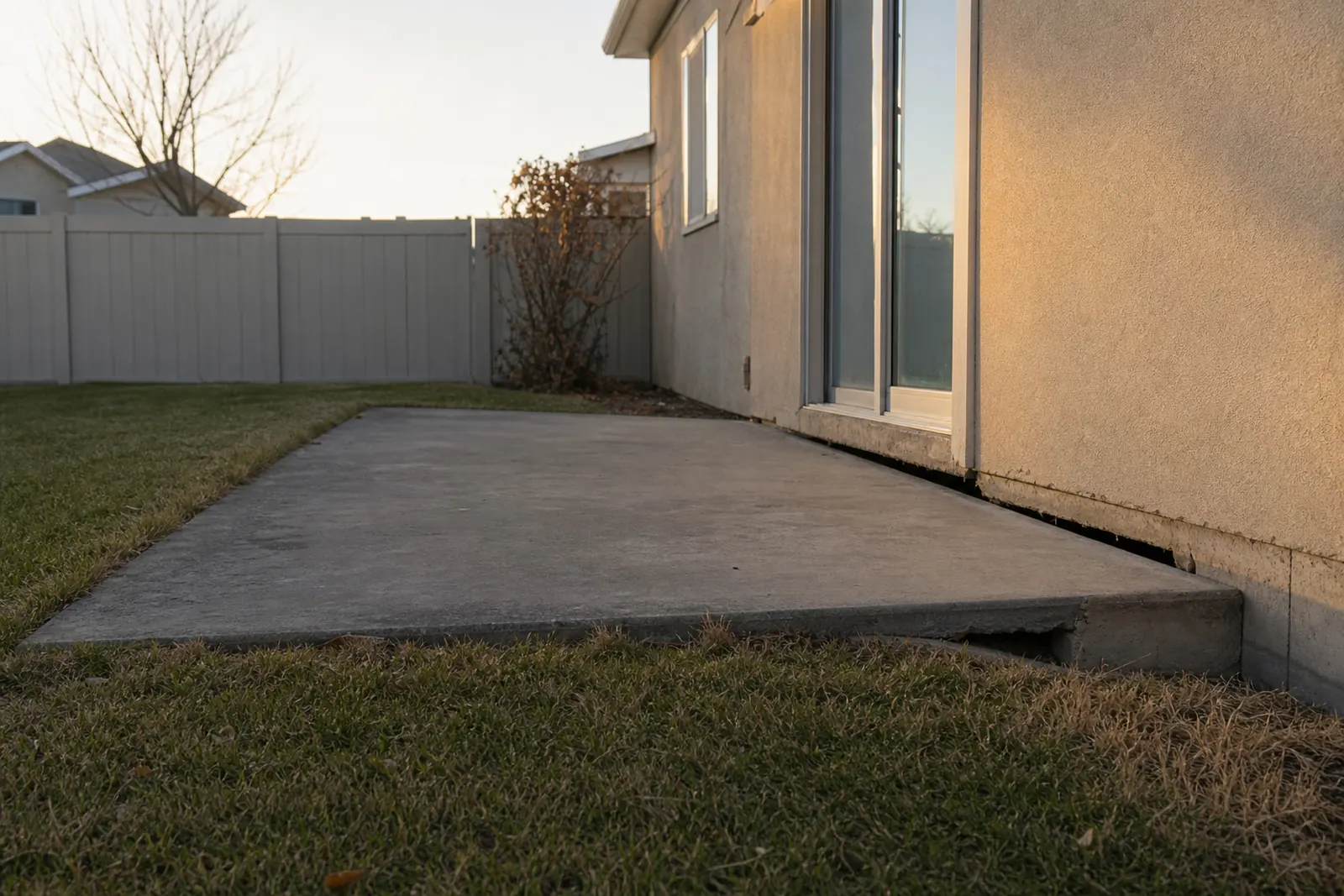
Can a sunken patio be leveled?
Most concrete patios that have settled can be lifted back toward level with polyurethane foam, as long as the slab is still in one piece or a few large pieces. The most common patio problem we see is a slab that has tipped toward the house, sending water at the foundation. Lifting the low side restores the slope away from the house and fills the empty space that let it drop.
Which way is your patio leaning?
With a patio, the direction it moved matters as much as how far. Stand at the back door and look.
Tipped toward the house
This is the one to deal with first. A patio is supposed to slope slightly away from the house so water runs off into the yard. When the edge by the house sinks, rain, snowmelt and sprinkler water run back toward the foundation and sit against it. Over time that can mean damp crawl spaces, washed-out soil under the patio and faster settling.
Pulled away from the house
Sometimes the patio drops along the house wall and leaves a gap or a step down from the door. Water can run straight into that gap. The soil next to a foundation is backfill from when the house was built, and if it wasn’t packed well it keeps compressing for years.
Dropped in the middle or at a corner
A low spot in the middle usually shows up as a puddle that won’t drain. A dropped corner often lines up with a downspout, a garden bed or a sprinkler head that has been soaking that spot for a long time.
- Water runs toward the house or pools against the wall
- There’s a new step or gap at the back door
- Patio furniture rocks or sits unevenly
- A crack runs across the slab with one side lower
- Soil has washed out along an edge
- The slab sounds hollow when you tap it
Why patios settle
Patios are often poured with less attention to the base than a driveway gets, since no one plans to drive on them. They also sit right where roof water, sprinklers and garden beds keep the soil wet. Put those together with the backfill beside the foundation and it’s no surprise patios are one of the most common slabs we lift. The soil side of this is explained in why does concrete sink?.
If water has been running under the slab for a while, there may be a lot of empty space underneath. We check for that at the evaluation, because big voids under a patio need to be filled before the slab is lifted. Voids under concrete describes what to look for.
How patio leveling works
Sunken
Concrete has settled or lost support.
Lifted
Polyurethane foam is injected beneath the slab.
Level
The slab is raised toward its proper position, and the void space is stabilized.
We drill a pattern of small ports, typically around 5/8 of an inch across, and inject polyurethane foam beneath the low areas. The foam fills the empty spaces, then starts raising the slab. On a patio, the key is getting the slope right, so we check fall away from the house as we go and stop when water will run the way it should.
Once the patio is back in place, the ports are patched and the patio gets power washed. There’s no new pour and no tearing out landscaping or fencing to get equipment in. Foam cures quickly, and we’ll tell you when you can put the furniture back. For the details under the slab, see how foam concrete lifting works.
Things we check on patios
| Situation | What it usually means |
|---|---|
| Patio has posts for a cover or pergola | We look at how the posts are set before lifting, since a post footing may not move with the slab |
| Stamped or colored concrete | Lifting keeps the existing finish, so you don’t lose the pattern to a replacement |
| Hot tub on the slab | The tub may need to be drained or moved off the area for the lift |
| Pavers or flagstone | Foam lifting is for poured concrete slabs, not individual pavers |
| Patio attached to the house steps | Steps and landings are often lifted together with the patio |
When a new patio may make more sense
If the patio is badly cracked into many pieces, crumbling on the surface or too small for how you use it, replacing it may be the better value. The same is true if you want a different shape or a covered area that needs new footings anyway. If that’s where your patio is, we’ll say so. When should concrete be replaced? goes through the bigger-picture reasons.
What affects patio leveling cost
Size of the area that moved, how far it dropped, how much void space is under it and how easy it is to reach the backyard all play in. So do things sitting on the slab. The evaluation is free, and concrete leveling cost explains what drives price.
Patio leveling around the Magic Valley
We level patios in Twin Falls and the surrounding towns.
Patio leveling questions
My patio slopes toward the house. Can lifting fix that?
If the slope changed because the slab settled, lifting the low side can usually restore the fall away from the house. If it was poured that way, lifting may still help, and we'll tell you what's realistic.
Can you lift a stamped concrete patio?
Yes. Lifting raises the existing slab, so the stamped pattern and color stay. The small patched holes are the only new marks.
Do I need to move my patio furniture?
Yes, the area should be clear before we start. Heavy items like a hot tub may need to be drained or moved.
There's a gap between my patio and the house. Should it be filled?
The gap usually means the patio dropped along the house. Lifting it back up and filling the voids underneath is the first step. The joint along the wall may need sealing afterward to keep water out.
Can you level a paver patio?
Foam lifting is designed for poured concrete slabs. Paver patios are usually releveled by pulling the pavers and fixing the base.