
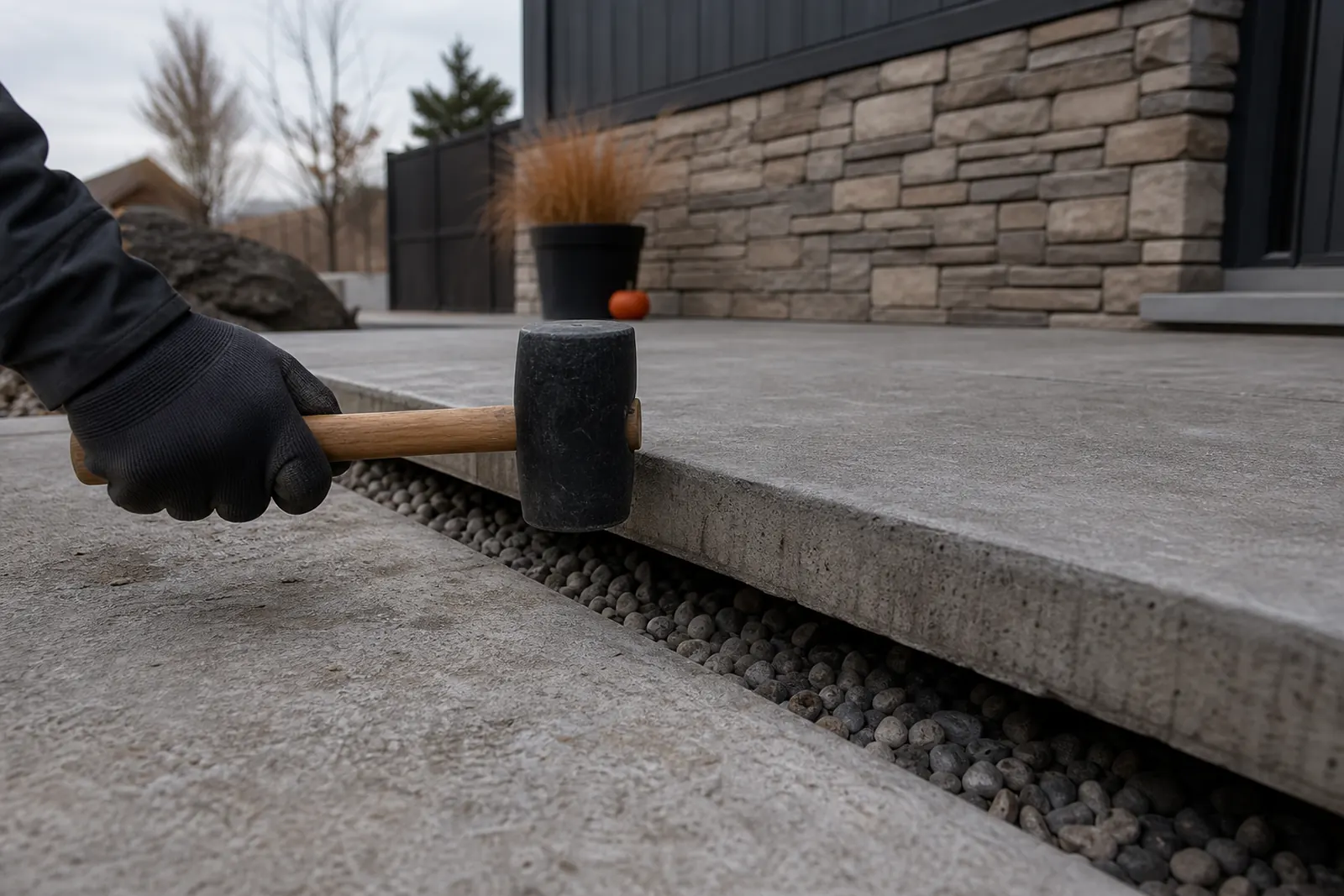
How can you tell if there’s a void under concrete?
The most common signs are a hollow, drum-like sound when you tap the slab, a gap you can see between the slab edge and the soil, and new cracks near an edge or corner. A slab that flexes, rocks or clunks under weight usually has empty space under part of it too. Voids can be filled with polyurethane foam, often before the slab drops or breaks.
What a void is
A void is empty space between the bottom of a slab and the soil it’s supposed to be resting on. Concrete is poured onto soil, and for a while the two are in full contact. Over time, soil can wash away, compress or shrink back from the slab, and the concrete ends up bridging over a gap.
The tricky part is that you can’t see most voids. The slab looks fine on top until it cracks or drops.
Signs to check for
The tap test
Walk the slab tapping it with a hammer, a heavy screwdriver handle or the heel of a boot. Solid concrete on firm soil makes a dull, flat thud. Concrete over a void sounds hollow and higher-pitched, a bit like a drum. Mark the hollow areas with chalk so you can see the pattern. It usually lines up with an edge, a joint or a spot where water collects.
Look at the edges
- A gap you can slide your fingers or a ruler into under the slab edge
- Soil lower than the slab along the side, with the slab edge exposed
- Sand or fine soil washed out onto the lawn or gravel after rain
- Burrow holes under the edge from rodents
- A dark, wet line along the edge that never quite dries
Watch how it behaves
- A slab that rocks when you step on one corner
- A driveway joint that clunks when you drive over it
- Water or mud squeezing up through a joint after a car passes
- A crack that opens and closes with the seasons
What happens if a void is left alone
Voids don’t usually fix themselves. The empty space collects water, which carries more soil out, which makes the void bigger. Meanwhile the concrete is carrying weight across the gap. Eventually one of three things happens: the slab cracks over the void, the unsupported edge breaks off, or the whole panel drops. Cracked and sunken concrete shows what that looks like when it gets there.
The sooner a void is filled, the more likely it is that only filling is needed, without lifting or dealing with cracked pieces.
Where voids come from
Water is behind most of them: downspouts, sprinkler overspray, irrigation runoff, plumbing leaks and snowmelt at the edges. Poorly compacted fill, freeze and thaw, and burrowing animals account for most of the rest. What causes voids under concrete? goes into each cause, and soil washout under concrete covers the water side in more depth.
How voids are fixed
Sunken
Concrete has settled or lost support.
Lifted
Polyurethane foam is injected beneath the slab.
Level
The slab is raised toward its proper position, and the void space is stabilized.
We drill small ports over the hollow areas and inject polyurethane foam. The foam expands into the empty space and fills it, then hardens into a lightweight, solid support. If the slab has already dropped, we continue into a controlled lift. If it hasn’t, we inject carefully so it’s supported without being pushed out of line. Concrete void filling covers the service in detail, and how foam concrete lifting works covers what happens under the slab.
We’ll also point out where the water is coming from. Filling the void helps, but if a downspout keeps dumping at the same spot, the soil next to the fill can keep eroding.
Can your slab be saved?
If the slab is still in one piece or a few large pieces, it’s usually worth filling. If it has already broken up badly, is my concrete too damaged to lift? explains when replacement makes more sense.
Voids under concrete questions
Does a hollow sound always mean a void?
Usually it means the slab isn't in full contact with the soil in that spot. It's a good reason to have it looked at, especially if it's near an edge or a joint.
How big can voids get?
It varies a lot. Some are a thin gap under an edge, others extend well under the slab. We judge size from sounding the slab and from how much foam it takes to fill.
Can rodents cause voids under concrete?
They can. Burrows under slab edges remove soil, and the openings let water in to wash out more.
Is a void under my slab dangerous?
It's not usually an immediate danger, but the unsupported concrete can crack or drop without much warning, especially under vehicles. Filling it early is simpler.