
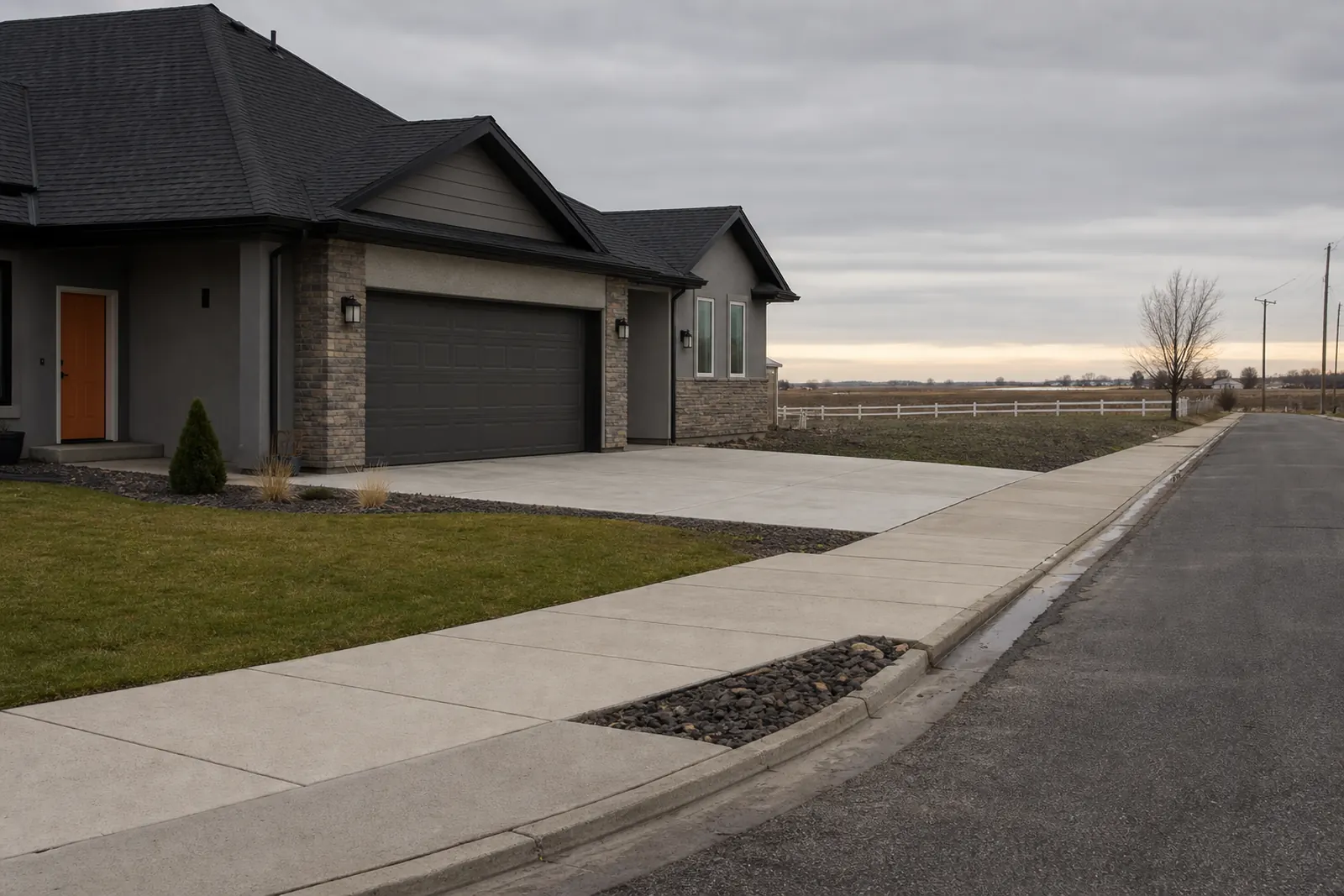
Concrete leveling in Kimberly
Kimberly has grown fast, and a lot of its concrete is on newer homes: driveways, garage aprons, walks and patios poured over fill that’s still settling. It also has older lots around the original town where slabs have moved with water over the decades. In both cases, sunken and tipped slabs can usually be lifted back into line with polyurethane foam. Kimberly is a few miles east of Twin Falls, and the evaluation is free.
A growing town, and what that means for concrete
Kimberly was founded in 1905 and named for Peter L. Kimberly, one of the investors behind Milner Dam, which made irrigation practical across this part of the valley. For most of its history it was a small farm town. Between the 2010 and 2020 censuses its population grew from about 3,300 to about 4,600, and the median age is on the young side.
That growth matters for concrete. New homes mean new slabs sitting on new backfill, and backfill next to a foundation usually keeps compressing for the first several years. It also means a lot of families, kids on bikes and scooters, and strollers on front walks, which is where a small trip edge becomes a real nuisance.
What we see on newer homes
Most calls from newer Kimberly homes are about the concrete closest to the house.
- The garage apron dropping below the garage floor, leaving a gap under the door
- Front steps or a stoop pulling away from the wall
- A patio tipping toward the back door so water runs at the house
- The first driveway panel out from the garage developing a lip
- Walks from the driveway to the door settling unevenly at the ends
These tend to show up in the first several years after a house is built, then slow down as the fill finishes settling. Lifting the slab and filling the voids underneath gives it support now. Relevant pages: garage apron leveling, concrete step leveling, patio leveling and driveway sinking near the garage.
What we see on older lots
Around the older part of town, the fill under the concrete settled long ago. When slabs move there, it’s usually water: a downspout emptying at a patio corner, sprinklers soaking a sidewalk edge, or a leak that washed soil out. Older driveways and sidewalks near mature trees can also be pushed up by roots, which is a different problem from settling. Uneven concrete explains how to tell the two apart, and soil washout under concrete covers the water side.
New home, new concrete: is it the builder’s problem?
We hear this question a lot in growing towns. If your home is new and the concrete has already moved, it may be worth checking whether your builder’s paperwork covers concrete. We can’t tell you what yours says. What we can do is explain what we see, whether the slab can be lifted, and why it moved.
Where the water comes from in Kimberly yards
Kimberly sits in irrigated farm country, and home landscapes here are watered hard through the summer. The slabs that move are almost always the ones getting that water at their edges. A few easy fixes help any lift last:
- Turn sprinkler heads so they don’t spray concrete edges
- Extend downspouts away from patios, walks and aprons
- Seal the joint between the garage floor and the apron
- Keep soil graded so it slopes away from slab edges
What a lift looks like on a newer home
Sunken
Concrete has settled or lost support.
Lifted
Polyurethane foam is injected beneath the slab.
Level
The slab is raised toward its proper position, and the void space is stabilized.
On a newer home, the lift usually centers on the concrete closest to the house. We check how far the apron, steps or patio have dropped against the foundation and the garage floor, fill the voids the backfill left behind, and raise the slab back to where it was poured, keeping water moving away from the house. The ports are patched and the area washed down. How concrete leveling works has the full walkthrough.
Services in Kimberly
We handle driveway leveling, sidewalk leveling, walkway leveling, patios, steps and aprons, plus commercial concrete leveling for businesses and rentals. If you’re wondering why your concrete moved at all, why does concrete sink? explains it.
Nearby areas
Kimberly sits between Twin Falls to the west and Hansen to the east. We work across the whole area.
Kimberly questions
My Kimberly home is only a few years old. Why is the concrete already sinking?
Slabs next to a new house sit on foundation backfill that can keep compressing for several years. Irrigated yards keep that soil wet, which speeds it up.
Should I wait for the settling to stop before lifting?
Not necessarily. If it's causing a gap under the garage door or water running at the house, lifting and filling the voids now gives the slab support while the fill finishes settling.
Do you come out to Kimberly for evaluations?
Yes. Kimberly is a few miles from Twin Falls and part of our regular service area. Evaluations are free.
Can you lift a stamped patio on a newer home?
Usually, yes. Lifting keeps the existing pattern and color, which you'd lose with replacement.