
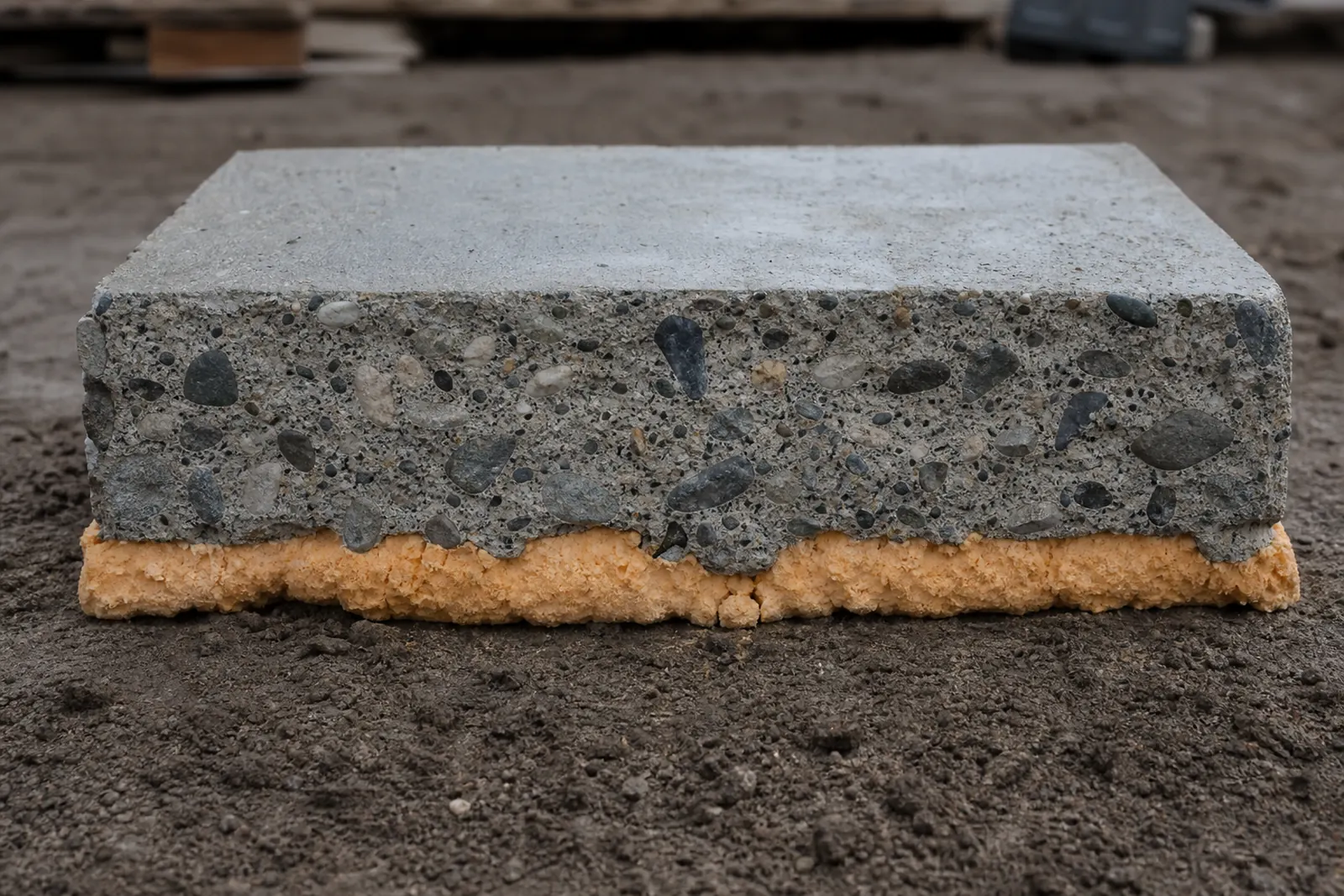
How does foam concrete lifting work?
Small holes are drilled through the sunken slab at planned points. A two-part polyurethane foam is injected through them. Under the slab, the foam expands and flows into the empty spaces first. Once those are full, the continued expansion pushes up on the concrete and lifts it. By injecting in controlled amounts at different ports, the slab is raised gradually until it’s back in line, then the foam hardens and holds it there.
What’s under a sunken slab
Before the foam goes in, it helps to picture what’s down there. A slab that sank is usually resting on a few high points of firm soil, with empty space or soft, loose soil under the rest. Some of that space might be a thin gap along an edge. Some might be a larger pocket where water washed soil away.
The foam has two jobs: fill those spaces so the slab has full support, and lift the slab back to where it belongs.
Step by step, under the slab
Sunken
Concrete has settled or lost support.
Lifted
Polyurethane foam is injected beneath the slab.
Level
The slab is raised toward its proper position, and the void space is stabilized.
1. Planning the ports
Where the holes go matters. Ports are laid out based on how the slab moved: more on the low side, near edges that dropped, and near joints where the slab needs to line up with its neighbor. On a typical panel there are several ports, spaced so the foam can reach the whole area.
2. Drilling
Each port is typically around 5/8 of an inch across and goes through the full thickness of the slab to the soil below. The small size is part of why the finished repair is hard to spot.
3. The first injection: filling
The injection gun mixes the two liquid components as they go in. The foam starts expanding within moments, and it follows the path of least resistance, which means it flows into the voids and gaps first. Early injections mostly fill space. The slab doesn’t move much yet.
4. Controlled lift
Once the voids near a port are full, the expanding foam has nowhere to go but up against the slab. That’s when lifting starts. We inject in small amounts and move between ports, watching the slab against a fixed reference like the next panel, the garage floor or a string line. Lifting in small steps keeps the slab from rising too far or cracking.
5. Leveling and matching
The goal is to bring the slab back in line with the concrete around it, and to restore the slope so water drains the right way. A slab that tipped needs more lift on one side than the other, so some ports get more foam than others.
6. Curing
The foam hardens quickly into a rigid, lightweight material filling the space between the soil and the slab. That’s what holds the slab up from then on.
7. Patching
The ports are cleaned out and patched. Then the area is power washed.
Why controlled lifting matters
A slab isn’t flexible. Lift one spot too fast and the concrete can bend and crack. That’s why the injection is done in small amounts, spread across ports, with someone watching the slab the whole time. On slabs that are already cracked, the pieces are lifted together so they come up as a unit.
What the foam can’t reach
Foam fills space it can flow into. It doesn’t compact soil that’s still loose and full of water, and it can’t reach voids that are completely cut off from the ports. That’s one reason port placement matters, and one reason we ask about water sources and leaks before starting. If the soil keeps washing out after the lift, the ground next to the foam can keep eroding. Polyurethane concrete lifting covers the material and its limits.
Lifting vs filling vs stabilizing
The same process can stop at different points:
| Goal | Where the process stops |
|---|---|
| Void filling | After the voids are filled, before the slab moves |
| Stabilizing | When the slab is fully supported and no longer rocks |
| Lifting | When the slab is back in line with the concrete around it |
Concrete void filling and slab stabilization cover those jobs. For the whole job from your side, including the evaluation and prep, see how concrete leveling works.
Questions about foam lifting
How many holes does it take to lift a slab?
It depends on the size of the slab and how it moved. A typical panel has several ports spaced so the foam can reach the whole area.
Can the slab be lifted too high?
That's why we lift in small amounts and watch the slab against a fixed reference. We stop when it's back in line.
Why doesn't the foam just leak out the sides?
Foam follows the path of least resistance, and some can reach the edges, especially where there are big gaps. Controlled injection and port placement keep it where it's needed.
Will lifting crack my slab?
Controlled lifting in small steps is meant to avoid that. Slabs that already have cracks are lifted with the pieces together.