
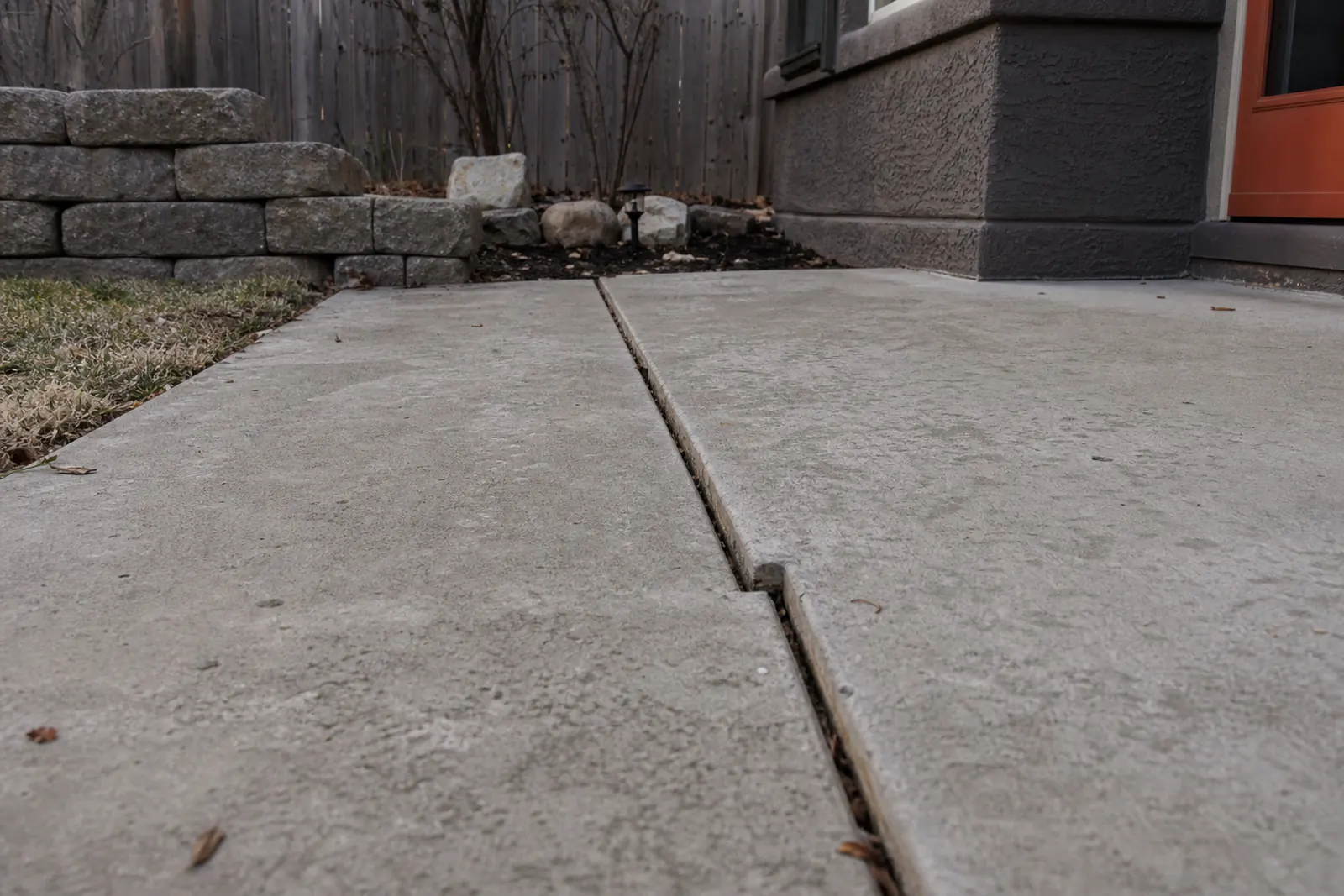
Can cracked concrete be lifted?
Often, yes. If the crack leaves large, solid pieces, they can usually be lifted together with polyurethane foam and brought back into line. The crack itself won’t disappear, but the height difference across it can be closed and the slab gets support underneath again. Concrete broken into many small pieces, crumbling along the cracks or pushed up is usually better replaced.
Not all cracks are the same
Almost all concrete cracks eventually. The question isn’t whether your slab has cracks. It’s what kind, and what they’re telling you about the slab.
| Crack type | What it looks like | Can it be lifted? |
|---|---|---|
| Hairline shrinkage cracks | Thin, often random, no height difference | Nothing to lift. Normal in most concrete |
| Single crack, one side lower | A clean break across a panel, one piece dropped | Usually yes, both pieces lifted together |
| Corner crack | A triangle of concrete broken off a corner, dropped | Often yes, if the corner piece is solid |
| Two or three cracks, large pieces | Panel in a few big pieces, some settled | Often yes, needs a closer look |
| Spiderweb or many cracks | Lots of small pieces, some loose | Usually no. Replacement is better |
| Crack along a hump | Slab peaked or raised along the crack | No. That’s heave, not settlement |
| Cracks with crumbling edges | Pieces breaking down along the crack | Usually no, or only with caution |
Joints are not cracks
Most concrete has straight lines cut or tooled into it every few feet. Those are control joints. They’re put there on purpose so the slab cracks along a neat line as it shrinks, instead of randomly across the middle. A dark straight line at a joint isn’t a crack you need to worry about, even if you can see a fine crack running along the bottom of it.
What matters at a joint is the same as anywhere else: whether the slabs on each side are at the same height. If one side dropped, that’s settlement, and the fix is lifting the low side, not repairing the joint.
A crack that wanders across a panel, away from the joints, is the kind that tells you something about the support underneath.
What the crack is telling you
A crack with a height difference across it almost always means one side lost support. Soil washed out or settled under that side, the concrete bent over the gap, and it broke. Cracked and sunken concrete explains how to read the crack pattern.
That’s good news for lifting. The same foam that raises the dropped piece also fills the void that caused the crack in the first place.
How cracked slabs are lifted
Sunken
Concrete has settled or lost support.
Lifted
Polyurethane foam is injected beneath the slab.
Level
The slab is raised toward its proper position, and the void space is stabilized.
Ports are placed on both sides of the crack so each piece gets foam beneath it. The pieces are raised together in small steps so they come back up as a unit and line up with each other and the slabs around them. Lifting one piece far ahead of the other would open the crack or break the edge, so the pace matters.
Once the slab is back in line, the crack can be sealed to keep water out. That slows down the cycle of water getting under the slab and washing out more soil.
What lifting does and doesn’t do for a crack
What it does:
- Closes the height difference so there’s no trip edge
- Restores support under both pieces
- Brings back drainage if the slab had tipped
- Stops the pieces from rocking independently
What it doesn’t do:
- Make the crack disappear
- Glue the pieces back into one slab
- Repair crumbling or broken edges along the crack
If a smooth, uncracked surface matters to you, replacement is the only way to get it. If you want the concrete level, supported and safe to walk on, lifting usually does the job.
Cracks that rule lifting out
The slab is probably past lifting when:
- It’s broken into many small pieces that move separately
- The edges along the cracks are crumbling or spalling
- Pieces are missing or loose
- The slab is humped along a crack from roots or heave
Is my concrete too damaged to lift? goes through the full checklist.
Where cracked slabs show up most
Driveways are the most common, because vehicle weight breaks slabs over voids near edges and joints. Driveway leveling covers those. Patios with a corner dropped near a downspout are next, covered on patio leveling. For the general criteria on any slab, see can sunken concrete be lifted?
Questions about lifting cracked concrete
Should I seal the crack before lifting?
No. Lift first, then seal. The pieces need to move into line before the crack is sealed.
Will the crack get bigger when you lift?
Pieces are lifted together in small steps to keep them lined up. The crack may shift slightly as they move, but the goal is to close the height difference.
Can a cracked slab be lifted more than once?
If it settles again, it can often be lifted again, as long as it's still in solid pieces. Dealing with the water source helps keep that from being necessary.
Are hairline cracks a reason to lift?
No. Hairline cracks without a height difference are normal in concrete and don't mean the slab has settled.