
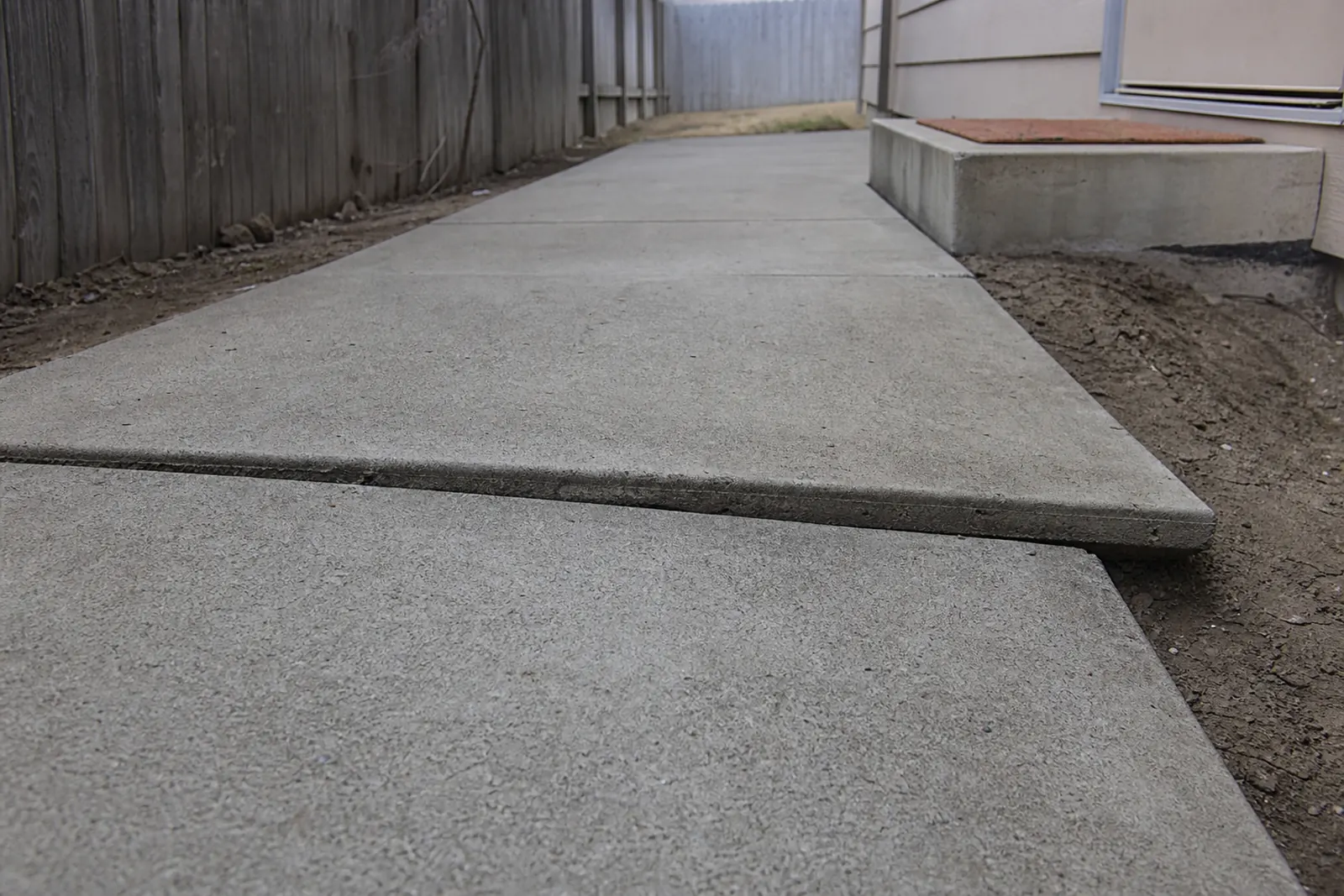
What should you do about sunken concrete?
Find out why it dropped and whether the slab is still sound. A slab that sank but is still in one piece, or in a few large pieces, can often be lifted back into place with polyurethane foam and given support underneath. Concrete that is broken up, crumbling or pushed up rather than down usually needs to be replaced. A free evaluation will tell you which one you have.
What sunken concrete looks like
Sunken concrete is any slab that now sits lower than it was poured. Sometimes it drops evenly. More often one edge or corner goes first.
- One panel sits lower than the one beside it and leaves a lip
- A slab has tipped so water runs the wrong way
- A driveway panel sits below the garage floor
- A patio or walk has dropped away from the house
- A gap has opened between the slab edge and the soil
- Steps or a landing now sit lower than the door
Why concrete sinks
The concrete almost never fails first. The soil under it does. A slab is a rigid plate resting on the ground, and when the ground under part of it compresses, erodes or loosens, that part of the slab drops.
Loose fill
Soil that was placed and never compacted well keeps settling for years. It’s most common next to foundations, over utility trenches and on lots that were built up with fill.
Water
Water carries fine soil out from under slabs, especially at edges where downspouts, sprinklers or runoff hit. Soil washout under concrete goes into this.
Freeze and thaw
Water that gets under a slab in winter freezes and expands, then thaws and leaves the base looser than before. Over several winters that adds up.
Load
Vehicles on driveway edges and heavy items on patios push down hardest where the soil is already weakest.
For the full explanation, see why does concrete sink?.
Why sunken concrete gets worse
Once a slab drops, it usually has empty space under part of it. That space tends to collect water, which carries more soil away. The slab also carries weight unevenly now, which is how cracks start. A sunken panel that’s a quarter inch low this year can be an inch low in a few years, and cracked.
That’s the argument for dealing with it sooner. Lifting a slab that has dropped a little but is still whole is usually a simpler job than lifting one that has cracked into pieces.
Can sunken concrete be lifted?
In many cases, yes. The main things that decide it are:
- Is the slab intact? One piece or a few large, stable pieces is a good sign.
- Which way did it move? Down is liftable. Up, from roots or swelling ground, is not.
- What is the surface like? A sound surface is worth saving. A crumbling one may not be.
- Is the cause still active? If water is still washing soil out, it needs to be addressed too.
Can sunken concrete be lifted? goes through these in detail.
How it’s fixed
Sunken
Concrete has settled or lost support.
Lifted
Polyurethane foam is injected beneath the slab.
Level
The slab is raised toward its proper position, and the void space is stabilized.
We drill small holes, typically around 5/8 of an inch across, and inject polyurethane foam beneath the slab. The foam expands to fill the empty space, then raises the slab in a controlled way until it’s back in line with the concrete around it. The holes are patched and the area is power washed. Polyurethane concrete lifting explains the material and how it’s used.
The service page for your slab has the specifics: driveway leveling, sidewalk leveling, patio leveling, walkway leveling or concrete step leveling.
When it’s not worth lifting
If most of the slab is broken, crumbling or has heaved, replacing it may be the better use of your money. If that’s what we see, we’ll say so. Is my concrete too damaged to lift? walks through the signs.
Sunken concrete questions
Will sunken concrete keep sinking?
Often it does, because there's usually empty space and water under it. How fast depends on the soil and how much water is getting in.
Is sunken concrete a sign of a foundation problem?
Usually not. Driveways, patios and walks rest on shallow soil and move independently of the house foundation. If you're seeing cracks in the house itself, that's a question for a structural professional.
Can I just fill the gap with sand or soil?
Packing soil along the edge doesn't raise the slab or fill the space under the middle, and it can wash out again. Lifting with foam fills the voids and brings the slab back up.
How much does a slab need to sink before it's worth fixing?
If it's creating a trip edge, sending water toward the house, or rocking under weight, it's worth a look regardless of how far it dropped.