
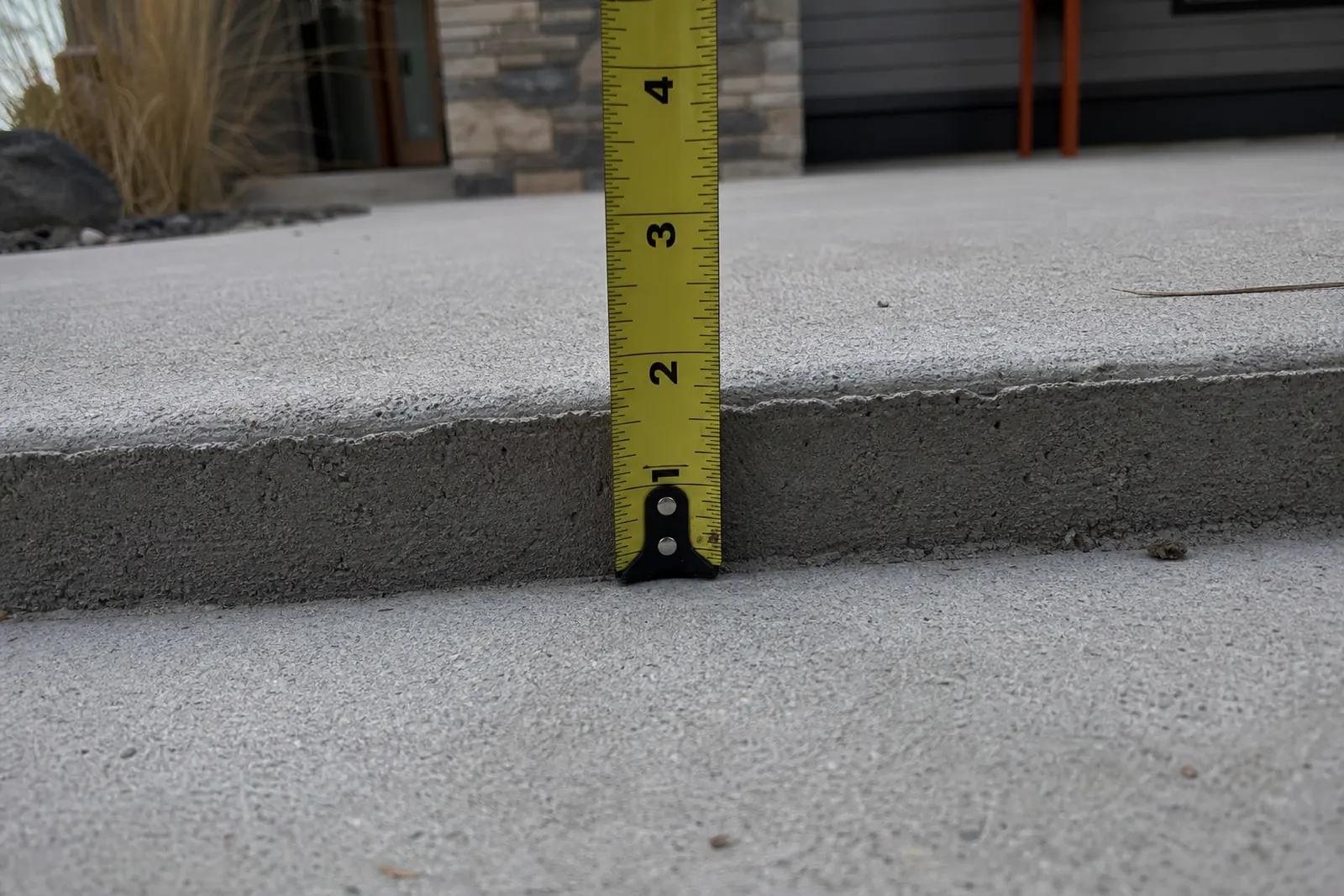
How do you fix a concrete trip hazard?
Most concrete trip hazards are an edge where one slab dropped below the next. The most lasting fix is usually to lift the low slab back up so the edge disappears and the slab has support underneath again. Small edges are sometimes ground down instead. Slabs that are broken up or were pushed up by roots may need to be replaced.
What makes an edge a trip hazard
It doesn’t take much. People lift their feet only a little when they walk, especially on a surface they expect to be flat. A small raised edge on a sidewalk, walkway or entry catches the toe of a shoe and throws people forward.
Federal accessibility standards for public walking surfaces allow changes in level up to a quarter inch without treatment, and require edges between a quarter and a half inch to be beveled. Your home walk isn’t held to those rules, but they’re a useful sense of scale: an edge you can see is already bigger than the threshold those standards start at.
- An edge you can feel with the toe of your shoe
- A spot where people have tripped, or where you catch yourself watching your feet
- An offset where the walk meets the driveway, steps or garage
- A raised edge that snow shovels and blowers keep catching
- Paint or chalk marks someone put on the edge to warn people
How to measure an offset
Lay a straight board or level across the joint on the high slab, and measure down to the low slab with a tape. Measure at the worst point, then along the joint, because slabs often tip and the edge is bigger at one end. Take a photo with the tape in it. That’s also exactly what we’d like to see if you send photos with an evaluation request.
Why trip hazards form
Almost always, one slab settled. Soil under it washed out, compressed or loosened, and it dropped while the slab beside it stayed put. Sometimes it’s the opposite: a tree root pushed one slab up. Uneven concrete explains how to tell which, and why does concrete sink? explains the soil side.
Your options
| Option | What it does | Good for |
|---|---|---|
| Lift the low slab | Raises it back in line and fills the void under it | Settled slabs that are still sound |
| Grind the high edge | Shaves the edge down to a slope | Small offsets on otherwise stable slabs |
| Replace the section | New concrete poured to the right height | Broken, crumbling or heaved slabs |
| Mark it and wait | Paint or cones warn people | Short term only, until it’s fixed |
Lifting tends to be the better fix when the low slab has a void under it, because grinding leaves that void in place and the slab can keep dropping.
How lifting fixes it
Sunken
Concrete has settled or lost support.
Lifted
Polyurethane foam is injected beneath the slab.
Level
The slab is raised toward its proper position, and the void space is stabilized.
We drill small ports in the low slab and inject polyurethane foam beneath it. The foam fills the empty space and raises the slab until its edge meets the one beside it. The ports are patched and the area is washed down. There’s no new concrete to cure, so the walk is usually back in use soon after. More on the process: how foam concrete lifting works.
At home and at a business
At a house, a trip edge on the front walk or the public sidewalk is usually the owner’s to fix, and it’s a common source of neighborly worry. See sidewalk leveling and walkway leveling.
At a business or rental, it’s also a customer and tenant safety issue that owners and managers are expected to keep up with. We can’t give legal advice, but we can fix the edge. Commercial entrance trip hazard repair and commercial sidewalk leveling cover those situations.
Can your trip hazard be lifted?
If the low slab is whole or in a few large pieces, and it moved down, it’s usually a good candidate. Can sunken concrete be lifted? explains the criteria.
Trip hazard questions
How big does a concrete edge have to be to trip someone?
Smaller than most people think. Accessibility standards for public walks start requiring treatment above a quarter inch. If you can see it or feel it with your shoe, it's worth fixing.
Is grinding or lifting better for a trip hazard?
Grinding works for small edges on stable slabs. Lifting is usually better when the low slab has settled and has a void under it, since it fixes the height and the support.
Can I send photos instead of scheduling a visit first?
Yes. Photos with a tape measure across the edge help us see what's going on. We'll tell you whether it looks like a lifting job.
Will the edge come back after lifting?
Filling the void and restoring support is what keeps it from dropping again. If water is still washing soil out at that spot, it's worth fixing that too.