
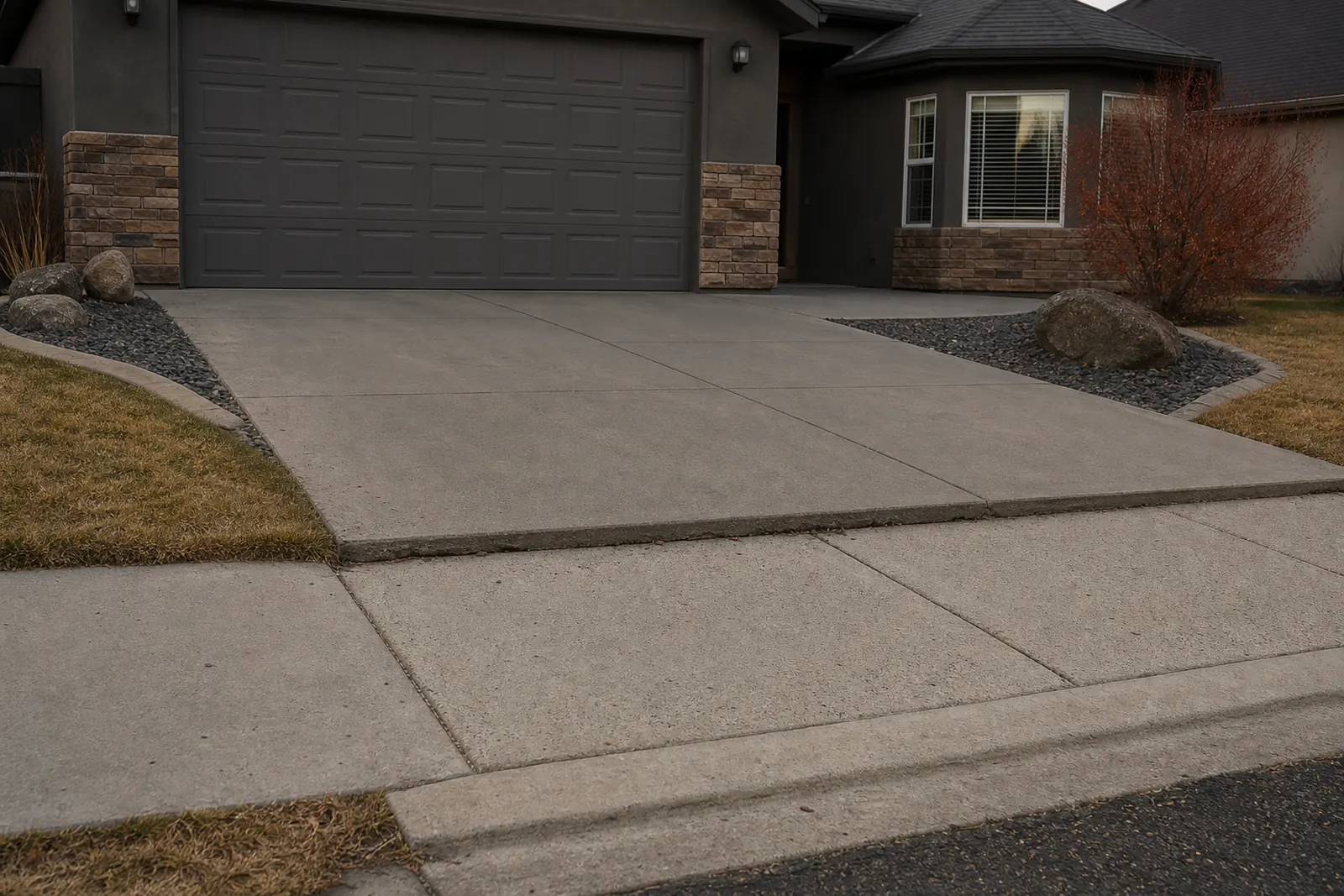
Can a sunken driveway be lifted?
Often, yes. If the sunken panel is still in one piece, or in a few large, stable pieces, polyurethane foam can usually raise it back toward the height of the concrete around it and fill the empty space underneath. If the panel is badly broken up, crumbling, or has been pushed upward, lifting may not make sense, and we’ll tell you that at the free evaluation.
What you might be seeing
Most people call about a driveway because something changed that they can see or feel when they drive over it.
- A panel by the garage door that now sits lower than the garage floor
- A lip where the driveway meets the sidewalk or the street
- One section tipped toward the house, or away from it
- Water sitting in a low spot after rain or sprinklers
- A gap along the edge of the slab where soil has washed away
- A hollow sound when you tap one part of the slab
- Joints that open a little wider every spring
Any one of these is worth a look. Two or three together usually means the soil under the slab has moved.
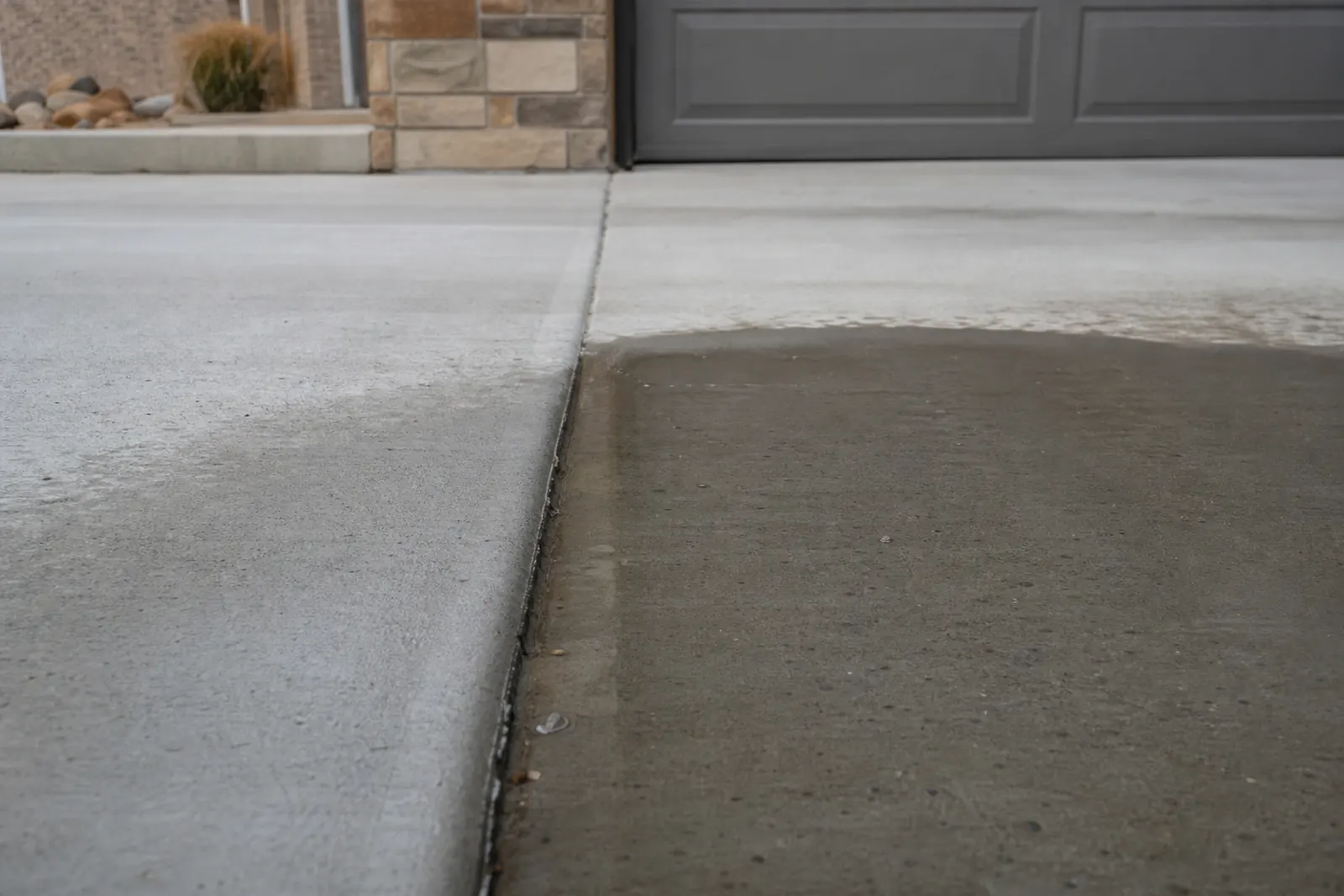
Why driveways sink
A driveway is a set of concrete slabs resting on soil. The concrete rarely fails on its own. The ground under it changes, and the slab follows it down.
Backfill next to the garage
The soil beside the garage foundation was dug out and backfilled when the house was built. If that fill wasn’t compacted well, it can keep settling for years, which is why the panel right outside the garage door is so often the first one to drop. Driveway sinking near the garage covers this in more detail.
Water at the edges
Downspouts that empty onto the driveway, sprinklers that overspray the edges and runoff from the street all carry fine soil out from under the slab. The edge loses support first, then the panel tips or drops.
Weight in the wrong place
Vehicles put the most load on the edges and joints of a driveway. When the soil underneath is already soft, that’s where a panel starts to move.
Freeze and thaw
Water that gets under the slab in winter freezes, lifts, and leaves a looser base behind when it thaws. Over a few winters, joints start to shift. Why concrete sinks explains the soil side of this.
Is your driveway a good candidate for lifting?
This is the question the evaluation answers. These are the things we look at before telling you which way we’d go.
| What we check | Usually a good candidate | Replacement may make more sense |
|---|---|---|
| The panel | One piece, or a few large, stable pieces | Many small pieces or crumbling edges |
| How it moved | Sank or tipped downward | Pushed upward, for example by tree roots |
| The surface | Sound, with normal wear | Badly scaled or flaking across large areas |
| What you want | Keep the concrete you already have | A new layout, a wider driveway or a new finish |
If you’re not sure where your driveway falls, Is my concrete too damaged to lift? and Can cracked concrete be lifted? go through the common cases.
How driveway leveling works
Foam lifting raises the slab from underneath through small holes. There’s no breaking out the panel and no new pour.
Sunken
Concrete has settled or lost support.
Lifted
Polyurethane foam is injected beneath the slab.
Level
The slab is raised toward its proper position, and the void space is stabilized.
- Look. We check how far the panel has dropped, where it’s cracked, what the joints are doing and where water has been going. You get a straight answer on whether lifting makes sense.
- Lift. Small ports, typically around 5/8 of an inch across, are drilled at planned points. A two-part polyurethane foam is injected beneath the slab and expands into the empty space.
- Level. The panel rises gradually while we watch the level against the garage slab, the sidewalk or the panel next to it, and the foam fills the voids so the slab has support again.
- Wash down. The ports are patched, and the work area is power washed before we leave.
Polyurethane foam cures quickly, so a driveway is usually back in use soon after the work is done. We’ll tell you when yours is ready for vehicles. For the full process, see how foam concrete lifting works.
When a new driveway may make more sense
Lifting isn’t the right answer for every driveway. Replacement may be the better call when:
- Most of the driveway is broken into small pieces, not just one or two panels
- The surface is scaling or flaking badly across large areas
- A panel has been pushed up, which lifting can’t reverse
- You want a different layout, a wider driveway or a new finish anyway
If that’s what we see, we’ll tell you plainly, even though it means we won’t be doing the work. Concrete leveling vs replacement compares the two in more detail.
What affects the cost of driveway leveling
Every driveway is different, so pricing comes after we’ve seen it. The main factors are:
- How many panels need lifting
- How far they’ve dropped
- How much empty space is under the slab, since more void means more foam
- How easy the area is to reach
- Whether cracked sections need to be lifted together
The evaluation is free, and we’ll walk you through what’s driving the cost for your driveway. Driveway leveling cost goes into each factor.
Driveway leveling around the Magic Valley
We level driveways in Twin Falls and the towns around it, on both sides of the Snake River Canyon.
Driveway leveling questions
Can I drive on my driveway after it's lifted?
Polyurethane foam cures quickly, so driveways are usually back in use soon after the work. We'll tell you when yours is ready for vehicles.
Will the lifted panel match the rest of the driveway?
Yes, because it's the same concrete. The only new marks are the small patched ports where the foam went in.
Why does the panel by the garage keep sinking?
The soil beside the garage foundation is usually backfill from when the house was built. If it wasn't compacted well, it keeps settling. Lifting the panel and filling the voids underneath gives it support again.
Can you lift a cracked driveway panel?
Often. If the crack leaves large, stable pieces, they can usually be lifted back into line together. The crack itself will still be there.
Will lifting fix water pooling on my driveway?
If the water sits in a low spot created by settlement, lifting the panel back toward level usually lets it drain the way it was built to. If the driveway was poured without enough slope to begin with, lifting may not change that, and we'll tell you.
Do you level driveways outside Twin Falls?
Yes. We work in Twin Falls, Kimberly, Jerome, Filer, Buhl, Hansen, Burley and Gooding. If your town isn't listed, call and ask.