
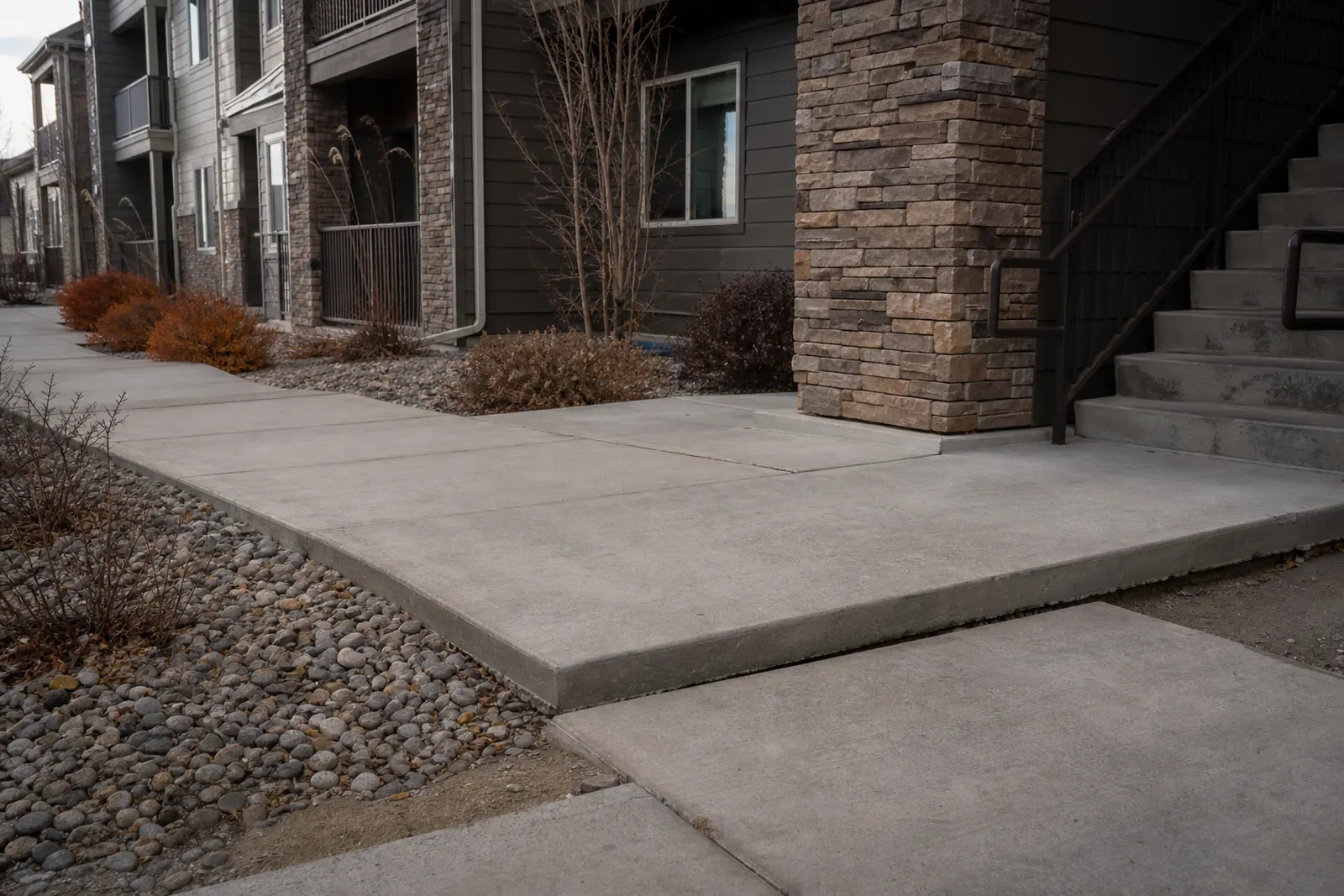
Can apartment walkways and stoops be leveled?
Yes. Apartment and multifamily properties usually have a lot of concrete: walks to every building, stoops at every door, breezeways, sidewalks to parking and mailbox areas. When sections settle and leave trip edges, polyurethane foam can often lift them back in line without tearing anything out. We work area by area so residents keep access to their units.
Why multifamily properties see so much settlement
A multifamily property has more concrete per acre than almost anything else, and most of it sits on soil that was graded and filled when the complex was built. Every building has foundation backfill around it. Walks cross utility lines to each unit. Irrigation runs along nearly every walk. Downspouts empty at dozens of corners.
It’s normal to find settlement in several spots across a property. The job is sorting out which ones matter now.
What managers usually call about
- A resident tripped, or complained about an edge
- Stoops that dropped and now leave a tall first step at the door
- Walks tipped toward buildings, with water against the foundation
- Ice forming in the same low spots every winter
- A lip at the mailbox area, trash enclosure or parking walk
- An inspection or insurance walkthrough flagged uneven concrete
Stoops and entry slabs
Stoops at unit doors are one of the most common multifamily problems. They sit on foundation backfill, get roof water from the eaves above and carry traffic every day. When they drop, the step up to the door gets taller than the others, and a gap opens along the building. Solid stoops can usually be lifted back up to the threshold and against the wall. Concrete step leveling covers how.
Working around residents
| Concern | How we handle it |
|---|---|
| Access to units | Work one building or one walk at a time, keeping a route open |
| Notices | We’ll tell you which areas and roughly when, so you can let residents know |
| Parking | The equipment stays nearby and takes up as little space as it can |
| Downtime | No new concrete to cure, so walks usually reopen soon after the work |
| Clean-up | The work area is power washed when each job is complete |
Planning a multi-area job
For larger properties, it helps to look at everything at once. At the evaluation we walk the property with you or your maintenance lead and sort what we find into three groups:
- Lift now: trip edges, stoops below thresholds, walks sending water at buildings.
- Watch: small offsets that aren’t causing trouble yet.
- Replace: sections that are broken up, crumbling or heaved.
That gives you a clear picture for planning and budgeting. If the information needs to go to an owner or asset manager, tell us and we’ll talk through what would help.
Fix the water while you’re at it
On multifamily sites, a few simple changes can prevent a lot of repeat settlement: extending downspouts at building corners, adjusting irrigation that overshoots onto walks, and sealing joints along buildings. We’ll point out what we see. Soil washout under concrete explains why it matters.
Small rentals too
This isn’t only for large complexes. Duplexes, fourplexes and small rental properties have the same stoops, walks and driveways, and landlords call for the same reasons: a tenant complaint, a trip edge, water against the building.
Getting started
The commercial evaluation is free. The general commercial side is on commercial concrete leveling, and HOA-managed communities are covered on HOA concrete leveling.
Multifamily questions
Can you lift stoops at every unit on a building?
Yes, if they're solid. We usually work one building at a time so residents always have a way in.
Do residents need to leave while you work?
No. We keep a route open to each unit and only close the section we're working on.
Can you help us plan work over several budget periods?
We'll sort what we find into what needs attention now, what to watch and what needs replacing, which makes it easier to plan.
Do you work for small landlords too?
Yes. Duplexes, fourplexes and single rentals have the same stoop and walkway problems.