
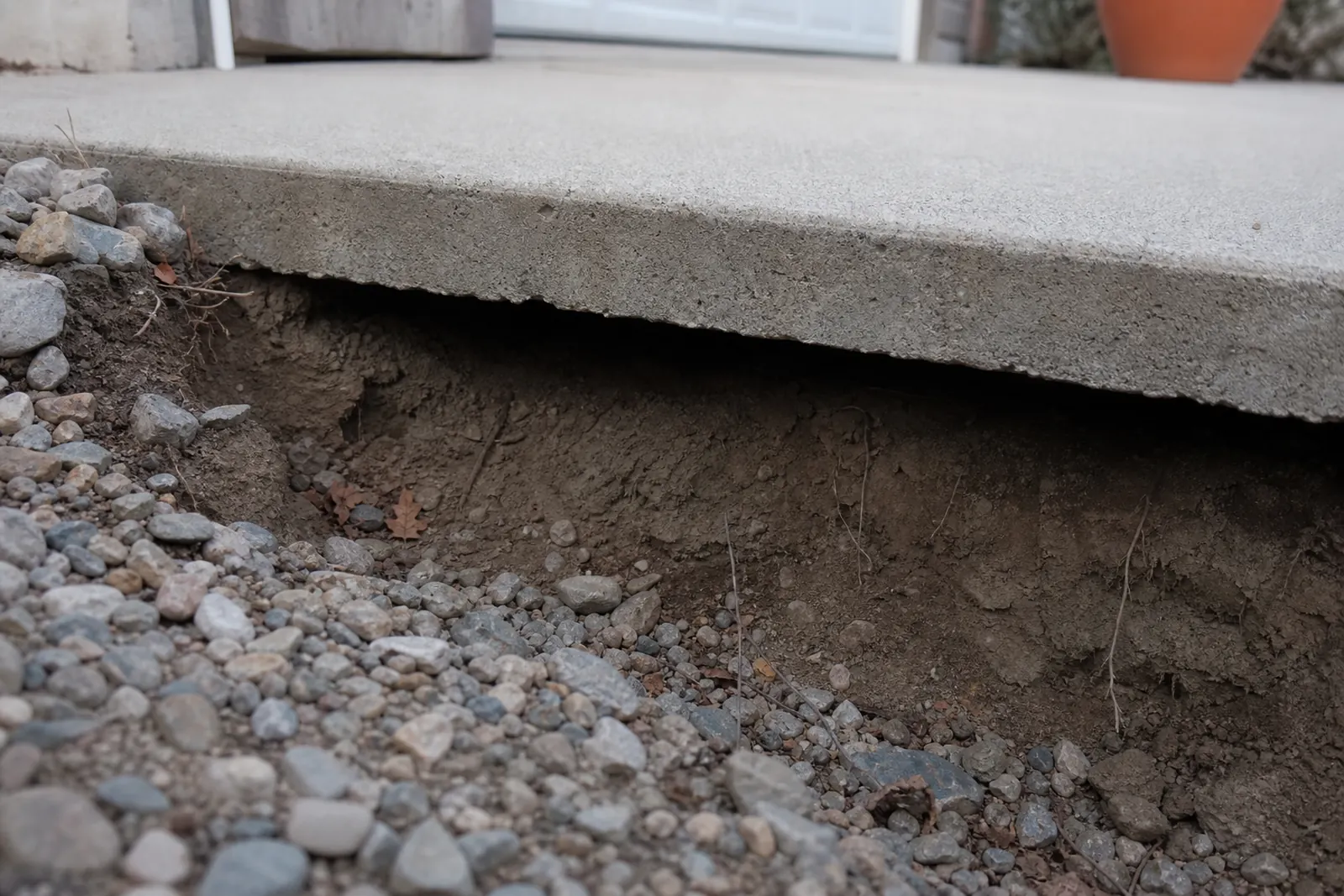
What is concrete void filling?
Void filling puts support back under a slab where soil has washed out or settled away and left empty space. We inject polyurethane foam through small holes in the concrete. The foam expands to fill the hollow areas and hardens in place. It can be done with little or no lift when the slab hasn’t dropped yet, or as part of a lift when it has.
A slab can be hollow before it sinks
Most people don’t call until a slab has dropped. But the empty space usually shows up first. Soil washes out or compresses, and for a while the concrete bridges the gap on its own. Then a vehicle rolls over the edge, or a hard winter loosens things further, and the unsupported part cracks or drops.
Filling voids at that earlier stage is often simpler than lifting later, because the concrete hasn’t moved or cracked yet.
Signs there may be a void under your concrete
- A hollow, drum-like sound when you tap or walk on part of the slab
- A visible gap between the edge of the slab and the soil
- Soil or sand washing out from under an edge after rain or sprinklers
- A slab that flexes or rocks slightly under weight
- New cracks that run near an edge or corner
- A plumbing or irrigation leak that was recently repaired near the slab
Voids under concrete goes into how to spot them, and what causes voids under concrete? explains where the soil goes.
Where void filling is most useful
Under driveway and apron edges
Vehicle tires load the edges and joints of a driveway. When soil has washed out along the edge, the concrete there is carrying weight with nothing under it. Filling it before the edge breaks off is the goal.
Next to the house
Slabs beside the foundation, like patios, walks and steps, often sit on backfill that settles away from them. Roof water adds to it. Filling those voids helps keep the slab from tipping later.
After a leak
A broken irrigation line or a leaking pipe can wash out a surprising amount of soil. Once the leak is fixed, the space it left under the slab is still there. Void filling puts support back.
Along sidewalks and walkways
Sprinklers and street runoff can hollow out the edges of sidewalk squares. Filling them can help stop a square from tipping into a trip edge.
How void filling works
Sunken
Concrete has settled or lost support.
Lifted
Polyurethane foam is injected beneath the slab.
Level
The slab is raised toward its proper position, and the void space is stabilized.
- Look. We tap and sound the slab, look for edge gaps and washout, and ask about leaks and drainage. This tells us where the voids are likely and how big.
- Drill. Small ports, typically around 5/8 of an inch across, are drilled at planned spots over the hollow areas.
- Fill. Polyurethane foam is injected and expands to fill the empty space. If the slab has already dropped, we continue into a controlled lift. If it hasn’t, we inject carefully so the slab is supported without being pushed out of line.
- Wash down. The ports are patched and the area is power washed before we leave.
The foam is lightweight, so it fills the space without loading down weak soil much. More about the material is on polyurethane concrete lifting.
What void filling can’t do
Filling a void doesn’t stop the water that made it. If a downspout is still emptying at the edge of the slab or a sprinkler is still soaking one corner, that needs to change, or new voids can form beside the filled area. We’ll point out what we see so you can deal with the source.
We also can’t see under the slab. We find voids by sound, by what we see at the edges and by how the foam behaves as it goes in. That’s why we watch the slab closely during the fill.
If the slab is already badly broken, filling the space under it won’t make it whole again. In that case replacement may be the better answer, and is my concrete too damaged to lift? explains how we decide.
Void filling and lifting together
On many jobs the two go together. One panel dropped, and the panels beside it are hollow but still level. We lift the dropped panel and fill under its neighbors, so the problem doesn’t simply move one slab over. If a slab also rocks or keeps shifting, slab stabilization covers that side of the work.
What affects the cost
How much empty space is under the slab is the biggest factor, because more void means more foam. Access, the number of areas and whether lifting is also needed matter too. The evaluation is free, and concrete leveling cost explains each factor.
Void filling around the Magic Valley
We fill voids and lift slabs in Twin Falls and the surrounding towns.
Void filling questions
Can you fill voids without lifting the slab?
Yes. When the slab is still where it belongs, we inject carefully to fill the space without pushing it out of line.
How do you know where the voids are?
We sound the slab by tapping, look for gaps and washout at the edges, and watch how the foam goes in. We can't see under the concrete, so we work carefully and watch the slab throughout.
Will the void come back?
The filled space stays filled. New voids can form nearby if water keeps washing soil out, so fixing the water source matters.
Should I fill voids after a plumbing leak?
It's worth having the slab checked. A leak can wash out soil under concrete, and the space usually stays there after the leak is fixed.