
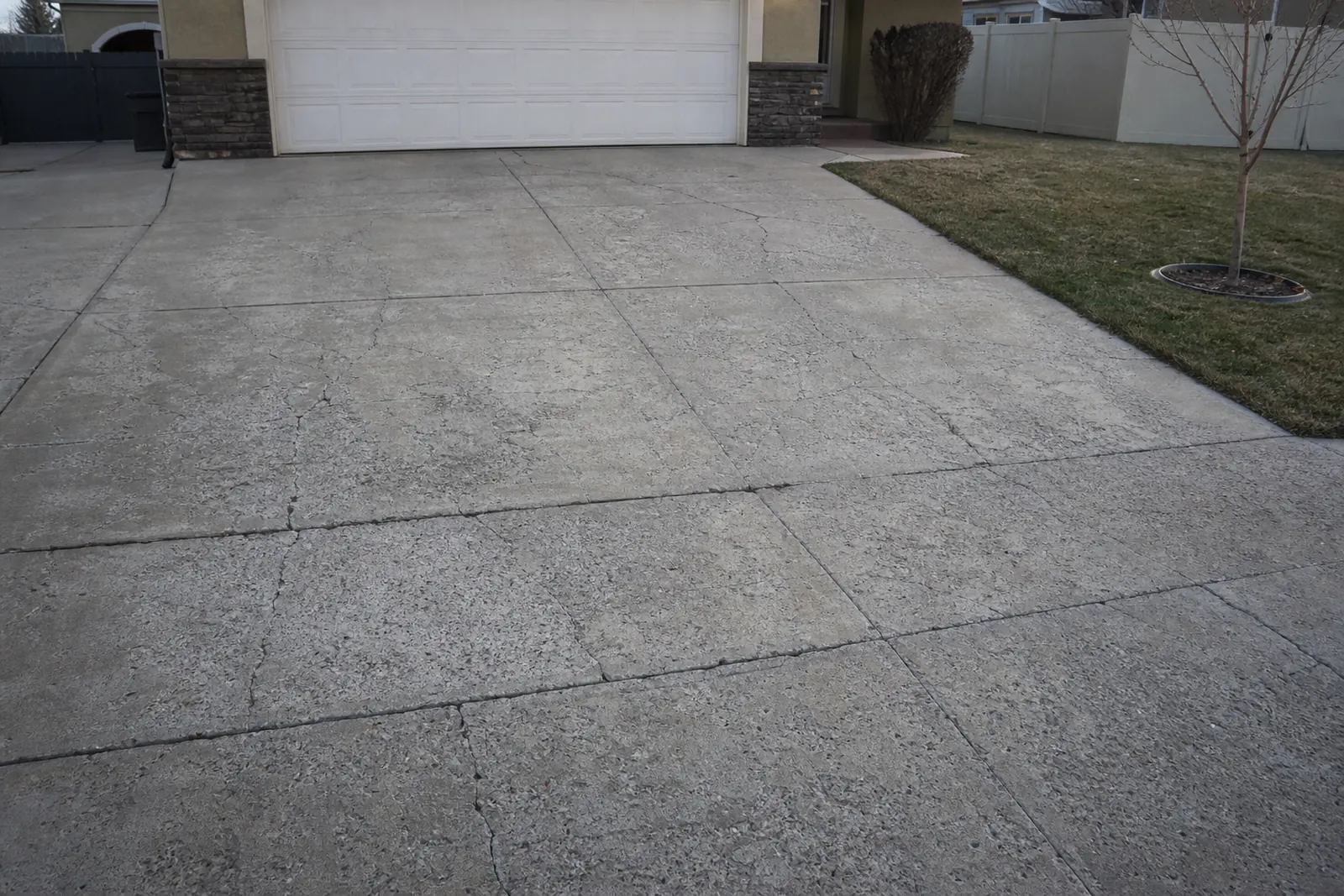
When should concrete be replaced instead of leveled?
Replace concrete when the slab itself has failed or when you want something different. That means most of the slabs in an area are broken up, the surface is worn out, roots or swelling ground pushed it up, the drainage needs a redesign, or you’re changing the size, layout or finish anyway. If the slab only sank, it can usually be leveled instead.
This page is about the bigger picture: the reasons that go beyond a single cracked panel. For the slab-by-slab checklist, see is my concrete too damaged to lift?
Reasons replacement makes sense
Most of the area has failed
One broken panel is a spot repair. When most of a driveway, patio or walk is broken up, crumbling or scaling, replacing individual pieces becomes a patchwork. Starting over gives you a uniform slab with a proper base.
The surface is worn out
Concrete that has been through many winters, deicing salts or a poor original finish can scale and spall until the top layer is gone. Leveling doesn’t restore a surface. If what bothers you most is the surface, not the height, replacement is the fix.
It was pushed up
Tree roots and swelling soil lift concrete. Leveling can’t bring it down. If a root is the cause, dealing with the tree and replacing the section is often the answer, though sometimes the surrounding slabs can be raised to meet a small, stable heave.
Drainage needs to change
If water has always pooled on a slab because it was poured too flat, or the whole area drains toward the house by design, lifting a settled panel won’t fix that. Replacing with a new slope, or adding drainage, might.
You want something different
A wider driveway, a bigger patio, a new walkway route, a decorative finish, or room for a new garage bay. If the layout is changing anyway, it rarely makes sense to lift the old slab first.
Something needs to go under it
New plumbing, electrical or irrigation lines under a slab often mean cutting it anyway. If a large part has to come out, replacing it can be simpler.
Reasons that don’t, by themselves, mean replacement
| Reason | Why it may not mean replacing |
|---|---|
| The slab sank | Settled slabs can usually be lifted |
| There’s a crack | Large, solid pieces can be lifted together |
| It’s old | Age matters less than condition |
| It’s stained | Stains are cosmetic, and the wash down often helps |
| One panel is bad | Replace that one, lift the rest |
| Water pools in one spot | If that spot settled, lifting often fixes it |
A mix is often the best answer
On a lot of properties we see a combination: several panels that settled but are sound, and one or two that are broken or heaved. Lifting the good ones and replacing the bad ones keeps most of your concrete and costs less than replacing everything. It also keeps the look consistent where the old concrete stays.
Before you replace
If you’re getting a replacement quote, it’s worth asking two things:
- What made the old slab fail? If it was water or poor base prep, make sure the new slab’s plan deals with it.
- Does everything need to go? Often only part of the area has actually failed.
Concrete leveling vs replacement compares the two options, and concrete leveling cost vs replacement covers what goes into each price.
What a good replacement plan includes
If replacement is the right call, the new slab should be set up so it doesn’t end up where the old one did. Worth asking your concrete contractor about:
- Base preparation: soft or loose soil removed, and new base material compacted in layers.
- Slope: enough fall away from the house and garage that water runs off instead of sitting.
- Joints: control joints spaced so the slab cracks where it’s supposed to.
- Water: downspouts, sprinklers and runoff that washed out the old slab redirected before the new one goes in.
A new slab on a well-prepared base with the water dealt with has a much better chance of staying put.
Our part
We lift and level concrete. If your slab needs to be replaced, we’ll tell you at the evaluation so you can take it to a concrete contractor. If some of it can be lifted and some can’t, we’ll mark which is which. Can sunken concrete be lifted? explains how we decide.
Replacement questions
Should I replace my whole driveway if one panel is broken?
Usually not. Replace the broken panel and lift any others that settled. That keeps the rest of the driveway in place.
Will new concrete match the old?
New concrete is usually lighter and looks different from old concrete for years. That's worth considering if only part of the area needs work.
Does replacement fix the reason concrete sank?
Only if the new slab's plan deals with it. Base preparation and water management are what keep a new slab from settling.
Can a heaved slab ever be saved?
Occasionally the slabs around a small, stable heave can be raised to meet it. More often the heaved section needs to be replaced after the root or cause is dealt with.