
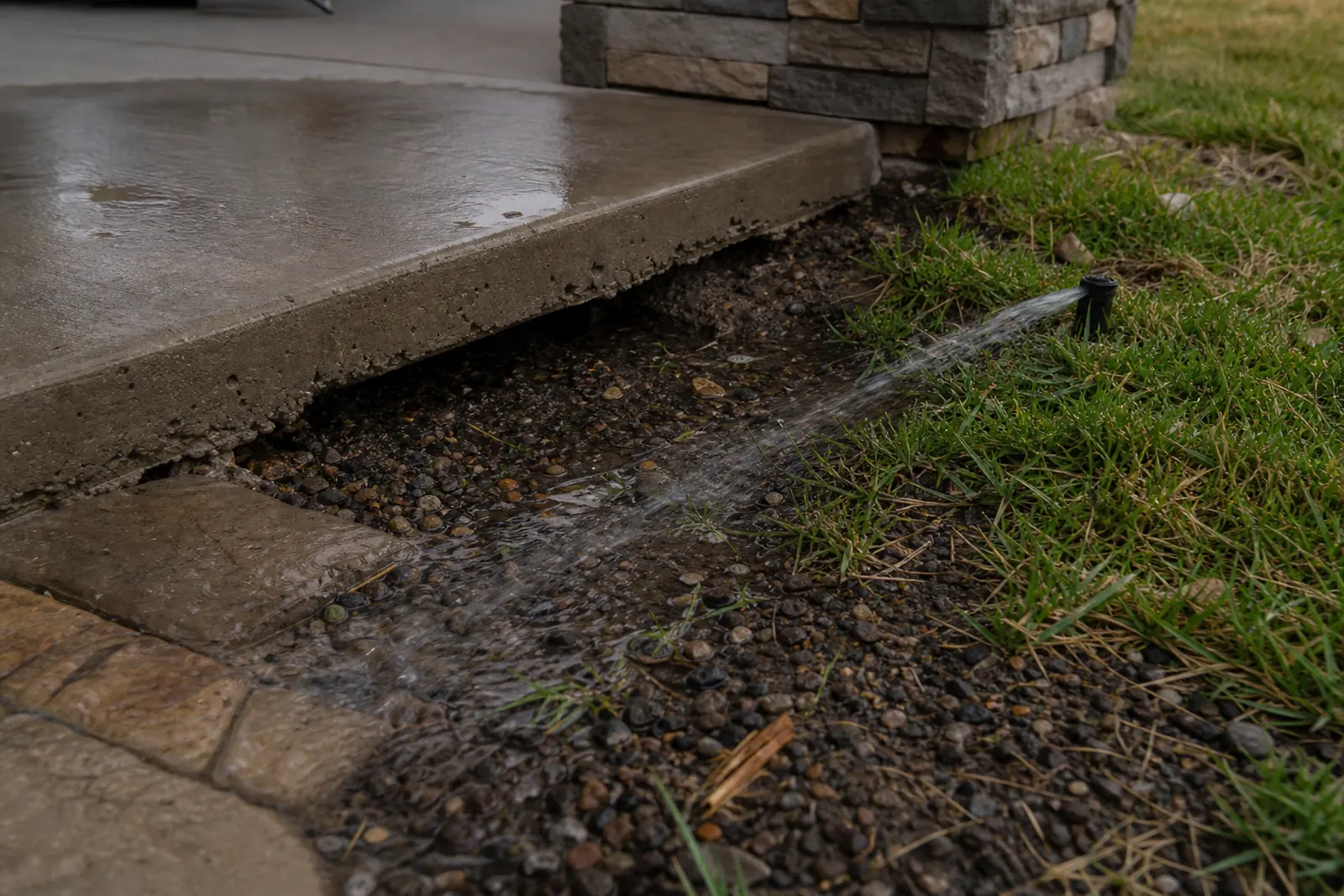
What causes voids under concrete?
Voids form when soil under a slab is removed or shrinks away from the concrete. The most common cause is water: downspouts, sprinklers, runoff and leaks carrying fine soil out from under the edges. Loose fill that compresses over time, freeze and thaw, burrowing animals, and buried debris that decays account for most of the rest. Because the concrete can bridge the gap for a while, voids often exist for years before the slab cracks or drops.
Why a void can hide
Concrete is stiff. When soil disappears from under part of a slab, the concrete doesn’t sag right away. It spans the empty space, supported by the soil that’s still there around it. From the top, nothing looks wrong. That’s why voids are usually found by accident: a hollow sound, a gap noticed while weeding, or a crack that seems to appear overnight.
Cause 1: Water erosion
Water is behind most voids we see. Moving water carries soil particles with it, and fine soils are the easiest to move.
Downspouts
A downspout that empties at the corner of a patio or the edge of a walk puts a concentrated stream of water in the same spot every storm. Over years, it can hollow out a pocket under the slab corner.
Sprinklers and irrigation
Heads that spray concrete edges soak the soil beside and under them several times a week through the growing season. The water runs under the edge and carries soil out, often a little farther each summer.
Runoff
Water flowing across a lawn, off a roof or down a street reaches slab edges and runs along or under them. Street runoff is a common cause of voids along sidewalk and driveway edges at the curb.
Leaks
A broken sprinkler line or a leaking pipe near a slab can move a lot of soil quickly. Voids from leaks are often larger and more sudden than voids from surface water, and they can be well under the slab, not just at the edge.
Snowmelt
Snow piled beside driveways and walks melts slowly and runs along slab edges through late winter and spring.
Cause 2: Settling fill
Fill that was placed without good compaction keeps compressing. The slab on top, being stiff, doesn’t follow it down right away. A gap opens between the bottom of the concrete and the top of the settling soil. This is common next to foundations, under garage aprons and steps, and over utility trenches.
Cause 3: Freeze and thaw
Water in the soil under a slab expands when it freezes and can push soil around. After it thaws, the soil may not settle back into full contact with the concrete. Over many winters, small gaps open, especially near edges and joints where water gets in.
Cause 4: Pumping at joints
On driveways and slabs that carry vehicles, a slab that has lost some support moves slightly each time a tire rolls over the joint. That movement pushes water and fine soil up and out through the joint. Each time, a little more soil leaves, and the void under the joint grows. You’ll sometimes see muddy stains or fine soil deposits along the joint.
Cause 5: Animals
Rodents dig under slab edges, where the concrete gives them a roof over their burrows. The burrows remove soil directly and give water an easy path under the slab.
Cause 6: Decaying material
Roots, stumps, wood scraps and other organic material buried in fill decompose over years and leave empty space behind.
Where voids tend to be
| Location | Most likely cause |
|---|---|
| Patio or walk corner under a downspout | Concentrated roof water |
| Sidewalk or driveway edge along a lawn | Sprinkler water |
| Driveway edge at the street | Street runoff |
| Garage apron and steps | Settling foundation backfill |
| Driveway joints | Pumping under vehicle loads |
| Anywhere, suddenly | A leak |
Why voids matter
A void means the slab is carrying weight over a gap. Eventually the concrete over it cracks, the unsupported edge breaks, or the slab drops. The void also collects water, which makes it bigger. Voids under concrete covers the warning signs and how to check for them.
Filling a void
Sunken
Concrete has settled or lost support.
Lifted
Polyurethane foam is injected beneath the slab.
Level
The slab is raised toward its proper position, and the void space is stabilized.
Voids are filled by injecting polyurethane foam through small holes in the slab. The foam expands into the empty space and hardens into solid, lightweight support. If the slab has already dropped, it can be lifted at the same time. Concrete void filling explains the service.
The most important part is dealing with the cause at the same time: extending downspouts, adjusting sprinklers, fixing leaks and sealing joints. Otherwise new voids can form next to the filled one. For the bigger picture of how soil moves, see why does concrete sink?.
Questions about voids
Can a void form under brand-new concrete?
Yes. If the fill under it keeps compressing or water reaches it, a void can form within the first few years.
Why is there mud along my driveway joint?
That's usually pumping. The slab moves under vehicles and pushes water and fine soil up through the joint, which enlarges the void underneath.
Will fixing my downspout fill the void?
No. It stops the void from growing, but the empty space stays until it's filled.
How fast do voids grow?
It depends on how much water reaches them. A slow sprinkler drip may take years. A leaking pipe can wash out a large void quickly.